Showing posts with label world. Show all posts

Black Death

Black Death
Black Death

The Black Death (Black Plague, The Plague, Bubonic Plague) was so named because the skin on many of its victims turned black, a result of massive blood clots. Although there have been many plagues throughout history, the three most associated with the term Black Plague are pandemics (epidemics that affect huge geographic areas) that occurred in Byzantium during the sixth century b.c.e., throughout Europe and the British Isles during the 14th century, and in 1894 in Asia. The first outbreak in 540 c.e., often referred to as the Plague of Justinian, began in Egypt, according to Procopius.

The disease spread from the coasts to inland areas, killing thousands of people each day. Allegedly, corpses were put on ships and sent out to sea to be abandoned. The power shift from south to north and from the Mediterranean to the British Isles is attributed to this devastation.

It was the second pandemic—a series of outbreaks that escalated from an early episode in 1331 to the disastrous events in 1346—that is most frequently referred to as the Black Death. In 1346 a Mongol prince and his armies attempted to lay siege to Caffa, in the Crimea. However, the soldiers were stricken with this dreadful disease and withdrew, but not before catapulting infected corpses over the city wall.


The Christian defenders, who thought they were now safe from attack, left to return home but perished from the plague. The few who reached home spread the disease throughout Europe and as far north as Greenland. Within a year 80 percent of Marseille had died. According to various sources, the death rate varied from 12 to 50 percent. It is estimated that in Europe 20–25 million, and throughout the world 42 million people died.

There are three forms or types of the disease: bubonic, pneumonic, and septicemic. The most dramatic is the septicemic version. Immense numbers of bacteria cause DIC (disseminated intravascular coagulation), a condition where there is so much debris in the bloodstream, the blood hemorrhages under the skin and the afflicted person’s body, or parts of it, becomes black. These victims died almost immediately, within one to three days after they showed symptoms of the disease.
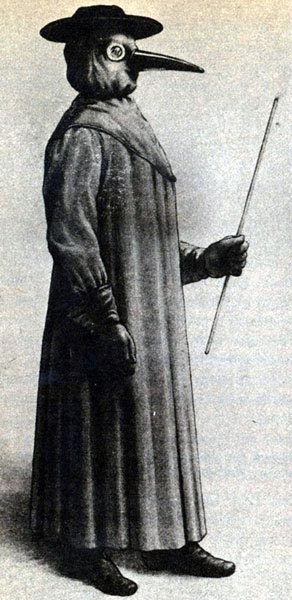
Plague doctor...the "beak" would contain herbs that would help to protect the Doctor from contracting the disease. It was basically useless...of course they didn't realize how disease was spread and the different methods of cross contamination, etc...
Plague doctor
Giovanni Boccaccio (1313–75), the author of the Decameron, a bawdy collection of stories that were told by Italian travelers trying to escape the plague in Florence, wrote, “They generally died the third day after the appearance without fever.” In the bubonic form of the disease, victims were stricken with a headache, nausea, achy joints, high fevers, vomiting, and a general feeling of malaise. It took from one day to one week for the patient to exhibit the characteristic symptoms after being exposed.

The most painful symptom was swelling of the lymph glands in the armpit, groin, and neck. These enlargements would become buboes, painful abscesses; skin infections filled with pus. When the bubo broke and drained, the purulent material inside was infectious and therefore spread to whomever touched the patient or the anything the patient’s clothing, bedding, or items that he handled.

Boccaccio wrote, “... in men and women alike there appeared, at the beginning of the malady, certain swellings, either on the groin or under the armpits, whereof some waxed of the bigness of a common apple, others like unto an egg, some more and some less, and these the vulgar named plagueboils ... to appear and come indifferently in every part of the body; wherefrom, after awhile, the fashion of the contagion began to change into black or livid blotches, which showed themselves in many, first on the arms and about the thighs and after spread to every other part of the person ... a very certain token of coming death ...”

Patients with the bubonic form spread the pneumonic form via fine droplets from a cough or sneeze. Although it was less lethal than the septicemic version, victims suffered from painful coughing episodes and eventually they coughed so much that the lining of their lungs became irritated and they coughed up blood.


People were so fearful of catching the plague that they abandoned their own family members, friends, homes, and public spaces in order to escape contact with anyone stricken with the disease. Doctors who were still willing to treat patients donned hoods with masks, beaks and hats in order to avoid breathing the air around a plague victim. They had no way of understanding the natural history or cause of this disease.

They blamed an unlucky conjunction of astrological influences, such as Saturn, Jupiter and Mars, and poison from the tails of comets, or blamed Jews for allegedly poisoned the wells. But even after the wells had been sealed, people continued to get the plague.

Some of the treatments such as cupping, purging and bleeding, although acceptable in the 14th century, did more harm than good and weakened anyone who remained alive after such insults to their feeble bodies. Amazingly some people survived and because of their illness, developed antibodies that provided immunity against a future attack.

The Spread of the Black Plague

The Black Death ripped through Europe

This second pandemic was facilitated by a number of factors. Populations had reached such high numbers in Europe that there was not enough food to feed everyone. Consequently those who could not afford the rising cost of food lacked adequate nutrition, and became easy targets for any new threat to health. There were trade routes connecting urban centers and increased travel in the form of caravans. Returning crusaders were spreading Christianity and, at the same time, the plague.

The causative organism Pasturella pestis (now called Yersinia pestis) was already present in the burrowing rodents of the Manchurian-Mongolian steppes but did not create a plague until the black rat (Rattus rattus) spread to Europe with a specific kind of flea. Rattus rattus originated in Asia but reached Europe during the early Middle Ages. They thrived in environments where people lived, near water, and traveled by ship.

The black rat’s flea Xenophylla cheopsis would bite the rat, but instead of being satisfied with its blood meal, its digestive tract would get plugged with plague bacteria, thus creating a constant hunger. It would voraciously bite anything in its path, including humans. When it found a human host, it spread the disease through repeated bites.

Europe had eradicated both the opportunity and the infection, but Asia suffered acutely. In the early 1890s an epidemic broke out in southern China, then in the city of Guangzhou in January of 1894, where 100,000 were reported dead. By May it had spread to the Tai Ping Shan area of Hong Kong.

As in any epidemic high population density, poor hygiene, inadequate health education, and the government’s inability to maintain a decent water supply and sewer treatment facility added to the poor defenses of the population. That year, 2,552 people died. Trade was affected and many Chinese left the colony. Plague continued to be a problem in Asia for the next 30 years.

The causative organism of the plague was not isolated and described until the third pandemic in 1894. Shibasaburo Kitasato and Alexandre Yersin simultaneously discovered the bacteria responsible for the plague, soon after they arrived in Hong Kong to assist in the eradication of the plague there.

Originally named Pasturella pestis, the organism responsible for causing the Black Death was renamed Yersinia pestis after it was reclassified into a different genus on the basis of its similarities to other Enterobacteriaceae species.

Afonso de Albuquerque - Portuguese Explorer

Afonso de Albuquerque - Portuguese Explorer

One of the great sea captains in Portuguese history, Afonso de Albuquerque captured the cities of Goa, Malacca, and Hormuz and founded the Portuguese empire in Asia. He was born in Alhandra, near Lisbon. Both his paternal grandfather and great-grandfather had been confidential secretaries to King João I and King Edward (Duarte), and his maternal grandfather had been an admiral in the Portuguese navy.

He grew up at the court of his godfather King Afonso V, and when he was 20 he sailed in the Portuguese fleet to Venice and was involved in the defeat of the Turks at the Battle of Taranto. He then spent 10 years in the Portuguese army in Morocco gaining military experience.

Albuquerque was present when the Portuguese under King Afonso V captured Arzila and Tangier in 1471, and Afonso’s son, King João II, made him a bodyguard and then his master of the horse. He returned to Morocco in 1489 and fought at the siege of Graciosa. When John’s brother Manuel I became king in 1495, Albuquerque returned again to Morocco.


It was during this time that Albuquerque became interested in Asia. The possibility of opening up a trade route was tantalizing to Albuquerque and in 1503 he joined his cousin Francisco to Cochin on the southwest coast of India, where they built the first Portuguese fortress in Asia.

King Manuel appointed Dom Francisco de Almeida as the first viceroy of India with the aim of increasing trade and establishing a permanent presence on the Indian subcontinent. In April 1506, Albuquerque set out on his second (and final) voyage—one that would last nine years. He was skilled in military tactics, seafaring, and handling men and was incredibly ambitious.

However he was only in charge of five of the fleet’s 16 ships. Overall command was given to Tristão da Cunha, who led the expedition up the east coast of Africa, and around Madagascar. They built a fort at Socotra to prevent Arab traders from passing through the mouth of the Red Sea and ensure a Portuguese trade monopoly with India.

In August 1507, Albuquerque was given permission by Tristão da Cunha to take six ships and 400 men. They headed straight for the Arabian and Persian coasts and, heavily armed, they sacked five towns in five weeks. Albuquerque then decided to attack the town of Hormuz (Ormuz), which was located on an island between the Persian Gulf and the Gulf of Oman.

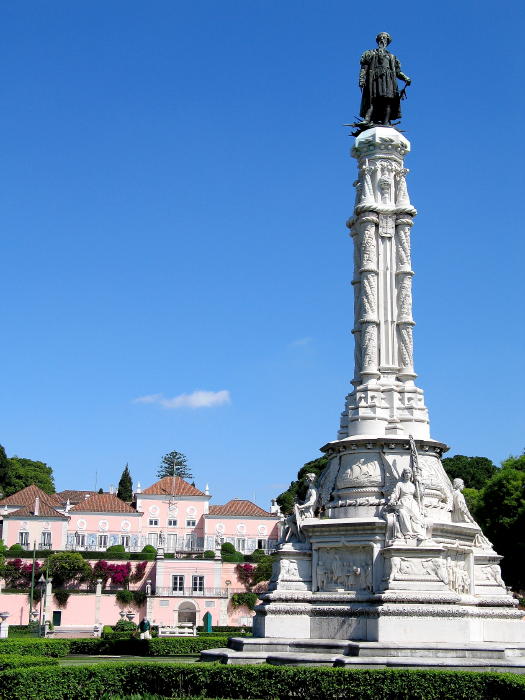
Albuquerque Monument on Afonso de Albuquerque Square in Lisbon

Taking it would cripple Turkish trade with the Middle East as it was the terminus for caravan routes from Egypt, Persia, Turkestan, and India. Even though Hormuz had a population of between 60,000 and 100,000, Albuquerque was able to capture the town and force it to pay him an annual tribute.

Albuquerque, appointed to succeed Almeida, found Almeida reluctant to hand over the office. Almeida was keen to avenge the death of his son, who was killed by an Egyptian fleet. He jailed Albuquerque and then led the Portuguese into a naval battle off the island of Din near Goa in February 1509.

In October 1509 the marshal of Portugal, Fernando Continho, on a tour of inspection, ordered the release of Albuquerque and demanded that Almeida hand over his office. Albuquerque then set out to create the Portuguese empire in Asia.


In January 1510 he attacked the port of Cochin but was unable to capture it. Two months later he attacked and took the town of Goa. After being there for two months he was forced out, but retook Goa in November 1510.

Albuquerque then made for Malacca (now Melaka), the richest port on the Malay Peninsula. It was the center where traders from the Indonesian archipelago brought their spices. It had a population of 100,000 and was well armed.

With 15 ships, three galleys, 800 European and 200 Indian soldiers, in July 1511, he attacked Malacca and after a day, took the city, which his men looted. They loaded their treasure into the Flor do Mar, and the ship was so overloaded that it sank off the coast of Sumatra; the wreck has never been found.

Back in Goa, Albuquerque fought off the attackers and then took a group of Portuguese and Indians to try to take the port of Aden. They failed and they returned to India. In February 1515, he again sailed from Goa, taking 26 ships to Hormuz.

However he was taken ill in September and sailed back to Goa. On the way back he heard that his success had made him many enemies in Lisbon and he had been replaced by an enemy, Lopo Soares. Albuquerque died on December 15, 1515, at sea off the coast of Goa.

Bull of Demarcation

Bull of Demarcation

Christopher Columbus’s first voyage to the Americas threatened to intensify the rivalry between the Catholic kingdoms of Spain (Castile) and Portugal into open warfare. Both kingdoms wanted to claim all newly discovered lands that were not Christian, that is, not Catholic.

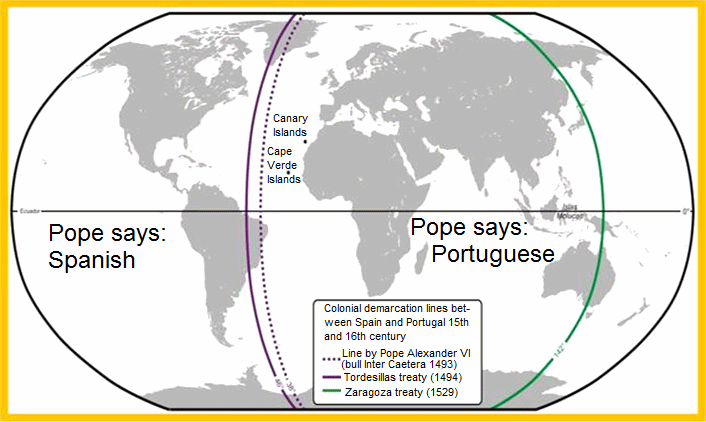
The Line of Demarcation was Pope Alexander IV’s solution to this problem. He issued the Bull of Demarcation to prevent Spain and Portugal from battling over new territories with resources such as gold. The bull successfully prevented a war between Spain and Portugal in the 16th century.

Neither the pope nor the Spanish or Portuguese actually knew what this line was dividing. The knowledge of the lands west of Europe was sketchy, and most people thought that the land Columbus had reached was part of Asia.


The pope may have believed that the Spanish would reach the same lands sailing west over the Atlantic that the Portuguese would reach sailing east around Africa. Previously in 1455, 1456, and 1481, popes had issued bulls about newly discovered land, although they had no knowledge of the actual geography of the earth.

The Roman Catholic nations left out of these bulls, including the French and Dutch, paid no attention to the papal decrees. The power of the Catholic Church in the Middle Ages had guided all international affairs in Europe up to the 15th century. France and Holland ignored the document, showing that the temporal power of the church was waning.

When Columbus returned from the Americas, he stopped in Portugal before going to back to the court of Ferdinand V and Isabella I of Spain. King João II of Portugal claimed the lands Columbus told him about even though the explorer had sailed for the Spanish monarchs.

Ferdinand and Isabella appealed to Pope Alexander VI, a Spaniard, for a solution. He issued the Inter caetera, the papal Bull of Demarcation, which was very biased toward Spain.

This document conferred all non-Christian lands found west of the designated line to Spain to explore and convert to Christianity. Portugal was to have all non-Christian lands east of the line. This decree in principle shut the Portuguese out of the Americas.

Dissatisfied, the Portuguese appealed to both the pope and Spain. Two more papal bulls followed—Examinae devotionis and another Inter caetera. These documents drew a line 100 leagues west of Cape Verde Islands.

Discoveries east of the line were to belong to Portugal, and discoveries west of the line were to belong to Spain. This resulted in Spain’s domination of all of South and Central America except Brazil, which the Portuguese claimed. The Treaty of Tordesillas modified the papal bull in 1494.

The Bull of Demarcation and later decrees gave the rights to colonize, exploit, and convert all non-Christian territory to Catholicism. These decrees treated all newly discovered nations and people as property and disregarded all non-Christian governments the Catholic explorers found.

Later the church realized these bulls were the cause of the enslavement and brutalization of native peoples and tried to emphasize peaceful, noncoerced conversion to Christianity. But it was too late; the system of Europeans’ forcibly taking control of non-Christian lands was already entrenched in the Americas, Africa, and Asia.

There have been modern movements for the revocation of these papal bulls. Indigenous peoples feel they were used for the subjugation of non-Christian indigenous peoples and should be rescinded to reflect modern thinking.

Certainly, the leaders in Rome could not have foreseen the horrendous decimation of native peoples that the conquest by the European powers caused. The Falkland War of the 1980s was in part justified by Argentina’s claim that the Falkland Islands is based on the Inter caetera. However, the Treaty of Madrid in 1750 annulled the boundary line.

Francis Drake - English Explorer

Francis Drake - English Explorer

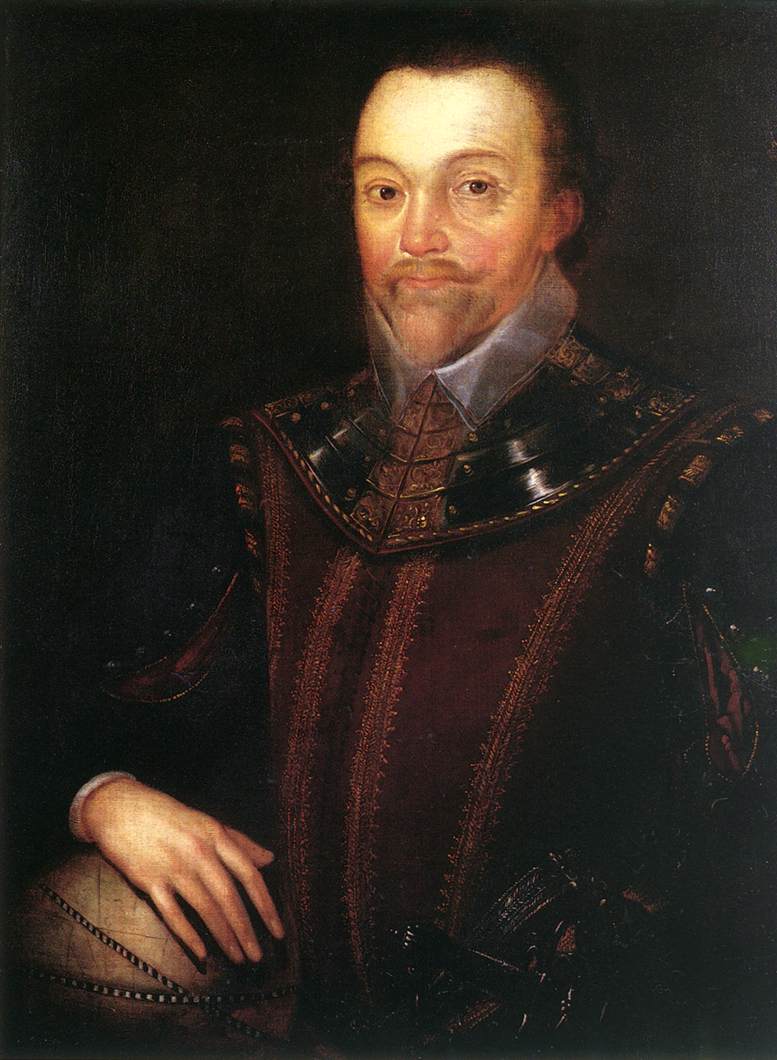
Sir Francis Drake was an English mariner-adventurer, and sometime privateer, who circumnavigated the globe. Drake was born near Tavistock, Devon, England, not far from the important port of Plymouth. He came from a well-connected Protestant farming family, one of 12 children born to Edmund Drake.

At approximately age 13, Francis went to sea on a cargo bark and eventually became the master of the ship at age 20. These early seafaring years spent in the North Sea built his experience as a skillful sailor and navigator and gave him a sense of command. When he was 23 he joined his cousin Sir John Hawkins and for the first time voyaged to the New World. In association with Hawkins, he undertook the initial English slave-trading expeditions to the New World.

Drake discovered the lure of the Spanish Main with all its riches in silver, gold, and slaves. He disliked the Spanish from the onset, no doubt in part for their Catholicism, and in the 1560s, began his campaign against Spanish interests, appearing a pirate to some and a privateer to others. His raids demonstrated his bravado and determination, but almost cost him his life.


Drake’s most famous attack came in 1573 when he took the Spanish Silver Train at the port of Nombre de Dios. Finding the silver too heavy to carry, he took all the gold he could and returned to Plymouth on August 9, 1573, with 30 survivors. Unfortunately, Queen Elizabeth I had undertaken a temporary truce with Philip II of Spain, and Drake’s exploits were not officially celebrated.

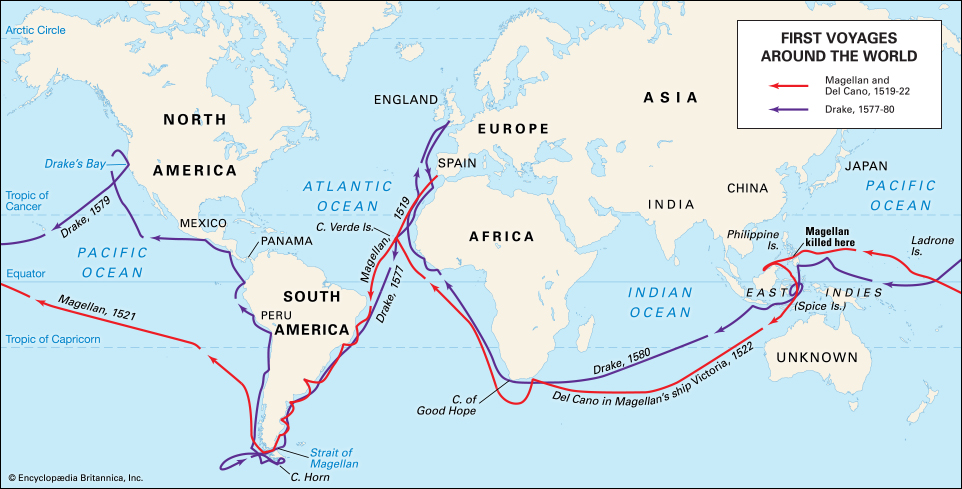
In 1577, Queen Elizabeth, facing new Spanish hostilities, sent Drake with 150 men and five ships on an expedition against the Spanish interests on the Pacific coast of the Americas. Two ships had to be abandoned at Río de la Plata and the remaining three navigated the Straits of Magellan, making Drake the first Englishman to do so.

The voyage continued to be difficult; another ship was destroyed, and still another separated and returned to England. Drake sailed along the coast of South America alone in the Golden Hind, attacking Spanish interests, plundering Valparaíso, and seizing cargo as he moved. He continued along the coast of North America looking for a passage to the Atlantic, possibly as far north as the present state of Washington.

Map that shows the circumnavigation travel of Francis Drake between 1577 and 1580

He stopped for supplies and repairs in San Francisco Bay and named the area New Albion. Drake now made the decision to cross the Pacific. He rounded the Cape of Good Hope and eventually returned on September 26, 1580, to Plymouth, laden with treasure. His exploits could not be denied even in the face of Spanish fury, and Queen Elizabeth knighted him.

War with Spain

Another war with Spain in 1585 put Drake back in his element. He took command of a fleet and launched assaults against Vigo in Spain, São Tiago in the Cape Verde Islands, and the New World ports of Santo Domingo and Cartagena, as well as St. Augustine in Florida.

In 1587, he “singed the King of Spain’s beard” with a preemptive and destructive raid on Cádiz, burning 31 ships and holding the town for three days in the process. This attack delayed the Spanish Armada sailing by a year.


By the time the Spanish Armada sailed to England to invade in 1588, Drake was vice admiral in command of the English fleet. It was at this time that the famous Drake myth first appeared that had Drake enjoying a game of bowls on Plymouth Hoe as the Spanish fleet approached. Here he supposedly stated that he had plenty of time to finish the game before the Spanish arrived.

The English fleet pursued the Spanish through the channel. Drake caught the rich galleon Rosario and Admiral Pedro de Vales in the process. On July 29, 1588, Drake and Lord Howard of Effingham organized the fire ships that broke the Spanish formation, causing damage that forced the Spaniards into the open sea toward Calais. The following day, Drake and the rest of the English fleet defeated the Spanish at the Battle of Gravelines.

Drake’s final expedition against the Spanish occurred in 1595, supported by Hawkins. On this occasion, the Spanish inflicted defeat, particularly against Drake’s raids on San Juan, Puerto Rico. Hawkins died off Puerto Rico and Drake became ill from dysentery and died on January 28, 1596, while in the process of mounting a further attack on San Juan. Placed in a lead coffin, Drake was buried at sea with his crew burning the town of Puerto Bello as a dedication to his passing.

Drake’s life was one of adventure and determination, which helped enrich England with his plunder. He established claims to the New World and made England a recognized naval power.

Ferdinand Magellan - Portuguese Explorer

Ferdinand Magellan
Ferdinand Magellan

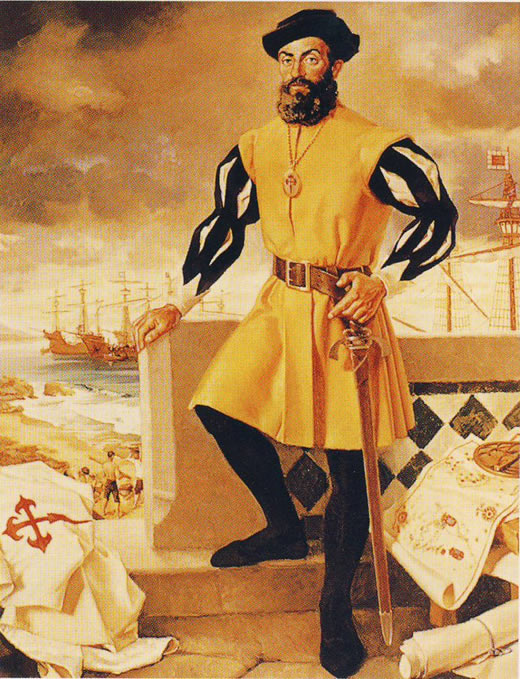
Ferdinand Magellan’s exact date of birth is unknown but is believed to be in 1480. His parents were petty nobles. After the return of Vasco da Gama’s expedition from India, Portugal launched subsequent expeditions there.

When Francisco de Almeida, who would become the first Portuguese Indian viceroy, set out for India in 1505, Magellan joined his expedition. Magellan spent eight years there in a number of different positions. He was also involved with Diogo Lopes de Sequeira’s expedition to Malacca in 1508–09. Magellan returned to Portugal in 1513.

Magellan then served in Morocco, where he was involved in a number of battles and skirmishes. He also served as quartermaster in charge of the spoils of war. Upon his return to Portugal, he requested an increase in pay from King Manuel, but the request was denied because of rumors that he sold cattle to Portugal’s enemies in Morocco.


Magellan returned to Morocco to clear his name so the king would consider his request for more pay. King Manuel still denied the increase. This was apparently one of the main motivations behind Magellan’s decision to approach the Spanish with his idea of finding a passage from Europe to India sailing west, either around or through the Americas.

Magellan convinced the Spanish to back the expedition in 1517. The expedition set out in September 1519 with five ships. They sailed to the South American coast of Brazil.

Magellan voyage
Magellan voyage

From there Magellan explored the bay at Rio de Janeiro and the Rio de la Plata before halting for the winter in Patagonia from March through August 1520. It was during this time that Magellan faced a mutiny and saw one of his ships desert the expedition. With winter over, Magellan continued south along the coast of South America.

Upon reaching the southern tip of South America, Magellan took 38 days to find a passage to the Pacific through the strait that now bears his name, the Strait of Magellan. Having found the way through to the Pacific, the expedition started up the western coast of South America on November 28, 1520.

Magellan took 98 days to cross the Pacific with hopes of reaching China but instead made landfall at Guam. From there, the expedition continued on a western course that brought them to Cebu on April 7, 1521. There Magellan made an alliance with the local leader and agreed to help them attack a neighboring island.


It was during this attack that Magellan was killed on April 27, 1521. The expedition continued west and eventually made its way back to Spain, having rounded the Cape of Good Hope in September 1522, three years after having left.

While Magellan did not actually live to complete the circumnavigation of the globe, the journey was the product of his ambition and determination. More important was his discovery of a way to travel from the Atlantic Ocean to the Pacific Ocean going west rather than around Africa.