Showing posts with label british. Show all posts

Eleanor of Aquitaine

Eleanor of Aquitaine

Eleanor of Aquitaine was born in 1122 to William X, duke of Aquitaine and count of Poitou, and Aenor, daughter of the viscountess of Châtellerault. At the death of her younger brother, Eleanor became the wealthy heiress of Aquitaine. Groomed by her father, she frequently accompanied him on trips throughout his lands as he administered justice and faced down rebellious vassals.

On his deathbed in April 1137, William entrusted her to his feudal lord, the Capetian monarch Louis VI, to arrange her marriage, which he did to his 17-year-old son and heir Prince Louis. When Louis VI died in August 1137 the young prince became King Louis VII of France and Eleanor his queen.

The two were ill-matched. Louis, as the second son, had originally been groomed for a career in the church. Eleanor had been raised in one of the most sophisticated households in all of Europe. Her grandfather William IX is credited with creating the literary genre of courtly love and had welcomed minstrels, poets, and troubadours to his court.


Eleanor was frequently able to convince Louis to intervene in affairs that concerned her own interests, to the detriment of the crown. All of this might not have mattered had Eleanor been able to provide Louis with a male heir who would have inherited the lands of both his parents. Unfortunately Eleanor bore Louis only two daughters, Marie and Alix.

The breaking point in their marriage occurred during the Second Crusade, which both Eleanor and Louis agreed to undertake in 1146 in response to the preaching of St. Bernard of Clairvaux. Their goal was to rescue the crusader-state of Edessa that had fallen to the Muslims.

Presumably Eleanor’s offer of a thousand knights from Aquitaine and Poitou had helped to assuage misgivings about allowing her and numerous other noblewomen to accompany Louis and his warriors on their journey. In March 1148 the French army arrived at Antioch, just to the southwest of the kingdom of Edessa.

Here Louis and Eleanor were greeted by the queen’s uncle, Raymond of Poitiers, ruler of the principality. Rumors began to circulate about an affair between Eleanor and her uncle. When Louis rejected Raymond’s strategically sound plan of taking back Edessa in favor of marching on Jerusalem, Eleanor exploded against the king, and demanded that their marriage be annulled.

Although Louis wrenched her away from Antioch and forced her to march southward on Jerusalem, their marriage was over. The two boarded separate ships and sailed for home in 1149–50. In 1152 their marriage was annulled on grounds of consanguinity, and Eleanor regained control of her lands.

Later in 1152 she married the 18-year-old count of Anjou, Henry Plantagenet, whose extensive land holdings in France also included the duchy of Normandy and the counties of Maine and Touraine. Their marriage created a formidable counterweight to the authority and power of Louis VII of France. Moreover, in 1154 Henry made good his claim to the English throne through his mother Matilda.

In December 1154 Eleanor was crowned queen of England, consort to Henry II (1154–89) of the house of Plantagenet. Over the next 13 years Eleanor bore Henry five sons and three daughters, two of whom, Richard (1189–99) and John, (1199–1216) would rule England.

Initially Eleanor played a substantial role in administering their combined lands in France while Henry secured England, but as his power and authority grew, he had less use for his independent-minded queen. Disenchanted with Henry and perturbed by his numerous affairs, Eleanor left England with her two sons Richard and Geoffrey for Poitiers in 1168.

Here over the next several years she established a flourishing court that became a cultural center for troubadours and poets singing of courtly love. Meanwhile Richard and Geoffrey increasingly chaffed at their father’s unwillingness to give them real authority in ruling lands that they nominally held.

They joined their older brother Henry in revolting against Henry II in 1173, with Eleanor’s backing. Henry crushed this revolt, and for her part in it, he placed Eleanor under close house arrest in England for the next 16 years.

When Henry died in 1189 Eleanor resumed her active role in political and familial affairs. In 1189 her favorite son, Richard, became king of England, and when he departed on the Third Crusade in December of that year, he left Eleanor as regent in England. On his return from the crusade in 1192 Richard fell into the hands of his enemy the German emperor Henry VI (1190–97), and Eleanor took charge of raising his ransom and negotiating his release.

When Richard died in 1199 she supported her youngest son, John, as his successor, undertaking a diplomatic mission to the court of Castile, and coming to his aid when war broke out between him and Philip II Augustus, king of France, in 1201. She died in March 1204 at the age of 83 and is buried alongside Richard and Henry in the nunnery at Fontevrault in Anjou.

English Common Law

English Common Law
English Common Law

Common law developed after the Norman Conquest of England. In 1066 England was peopled with Angles, Saxons, Vikings, Danes, Celts, Jutes, and other groups who were suddenly ruled by French-speaking Normans. Most law at the time was customary law that had been handed down orally from generation to generation.

In addition there were the legal code of Alfred the Great, which was biblical in nature, and the Danelaw of the Vikings and Danes. Most of the courts were communal courts (folk-moot), the hundred and shire courts, and baronial, or manorial, courts administering justice in the interest of the local nobility.

Immediately after the Norman Conquest the king would hear cases coram rege (before the king) that involved royal interests. However, the king with the royal court tended to be on the move in England or away in France. Consequently the legal work was soon delegated to an appointed tribunal, the Curia Regis. From it came the three royal common law courts that were used to unify the kingdom.


The first of the royal common law courts was the Exchequer. Originally concerned with the collection of taxes and the administration of royal finances, by 1250 it had become a court exercising full judicial powers. The second royal common law court to develop was the Court of Common Pleas (or Common Bench), which was probably established during the reign of Henry II (1154–1189).

This court heard cases that did not involve the king’s rights. It was firmly established at Westminster after King John was forced to sign the Magna Carta in 1215. The third royal common law court to evolve from the Curia Regis was the King’s Bench. Eventually this court heard cases involving the king’s interests, criminal matters, and cases affecting the high nobility. It also developed the practice of issuing writs of error for review of cases decided in Common Pleas.

One factor promoting the development of the common law courts was their ability to settle land disputes. All of the land in England belonged to the king by right of conquest. He then awarded it to his vassals to hold and utilize in exchange for loyalty and for services. Because economic production was almost exclusively agricultural, title to the use of land was extremely valuable.

Disputes over who was entitled to possess land created innumerable cases. As the justices in Eyre traveled their assigned circuits to hold court, they would decide cases using the Bible, canon law, and most especially reasoning applied to the customary law of that place. When the judges returned to London they would go to their places of permanent residence in taverns or cloisters.

These residences of the judges, who were often monks or bachelors, eventually became the Inns of Court, where cases were heard and experts were trained in law. In the course of over 200 years the judges “discovered” the law common to all the people of England. The belief was that underlying the thicket of unwritten customary law was a common foundation that could be discovered by reason.

In effect the judges were developing legal principles or laws as they made judicial rulings in particular cases. Among the principles of the common law are stare decisis (let the decision stand). Stare decisis means that a judge in deciding a case should look to similar cases from the past for guidance. The use of similar cases is itself a legal principle, namely, that like cases should be tried alike.

However in the absence of a precedent setting rule the judge would in effect “legislate” and create a new rule. This meant that the common law was case law or judge-made law created by legal reasoning about legal problems. It was well established centuries before the rise of Parliament.

The developing common law had the virtue of stability; however, it lacked flexibility. To bring a case into a common law court was often too costly for common people. The common law courts also moved slowly; that could mean that justice delayed was justice denied. To lodge a complaint in a common law court an appropriate writ had to be obtained.

If the wrong kind of writ were used, of which there were eventually over 100 kinds, the case would be dismissed. In addition some of the rules of the common law were injurious to justice. For example before bringing a suit for an injury to a person or to property in a common law court real injury had to be sustained. The common law lacked a mechanism for preventing irreparable harms from happening.

Since the king was believed to be the fountainhead of justice in England—that is, the person who ruled by divine right and though whom the justice of heaven flowed to the people—equity courts were established to restore fairness or equity to the legal system. People would appeal to the king for justice. In response the kings ordered the court chancellor to issue decrees of equity. Chancery courts developed to hear cases of equity and to correct the common law.

Alfred the Great

Alfred the Great
Alfred the Great

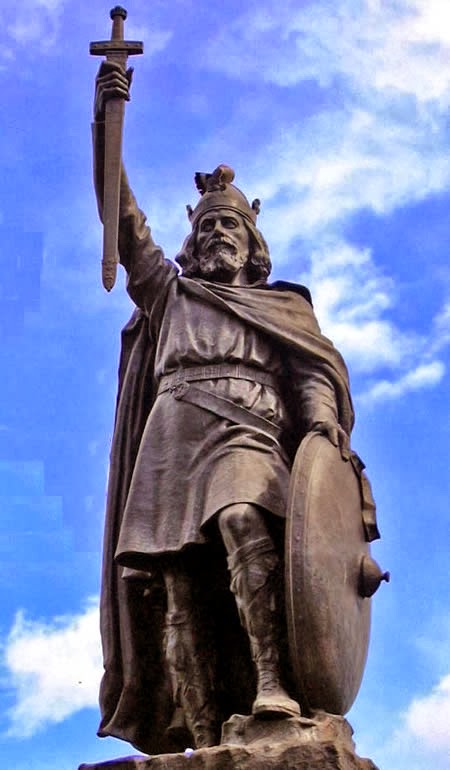
Alfred the Great was the fifth son of King Ethelwulf (839–55) of the West Saxons (Wessex) and Osburga, daughter of the powerful Saxon earl Oslac. When Alfred became king of Wessex in 871, his small realm was the last independent Saxon kingdom in England. A massive Viking force from Denmark, known as the “Great Army,” had landed in East Anglia in 865 and had quickly overrun the Saxon kingdoms of Northumbria, East Anglia, and, eventually, Mercia.

During his older brother Ethelred’s reign (866–871), Alfred had helped fight off an initial invasion of the Great Army into Wessex, but when his older brother died and Alfred inherited the throne, he was forced to gain peace by buying the Vikings off.

In 878 the Great Army returned, led by the Danish chieftain Guthrum. Alfred’s fortunes were considerably augmented at this point by the fact that nearly half of the Vikings in the Great Army had settled down in Northumbria to farm and hence took no part in this new attack.


Even so Alfred and his men were hard pressed to survive. Driven from his royal stronghold at Chippenham in Wiltshire in early 878, he retreated to the marshes around Somerset, where he managed to regroup his forces. In May of that year he inflicted a solid defeat on the Vikings at the Battle of Edington and quickly followed this up with another victory by forcing Guthrum and his men to surrender their stronghold at Chippenham.

By the Treaty of Wedmore (878), which brought hostilities to an end, the Danes withdrew north of the Thames River to East Mercia and East Anglia; together with Northumbria, these lands would constitute the independent Viking territories in England known as the Danelaw.

Significantly, through this settlement Alfred gained control over West Mercia and Kent, Saxon lands that he had not previously controlled. In addition to acknowledging a stable demarcation between Alfred’s kingdom and Viking lands, Guthrum also agreed to convert to Christianity and, shortly thereafter, was baptized. The significance of this cannot be overstated, because it made the eventual assimilation of the Danes into Saxon, Christian society possible.

With this latest Viking invasion having been thwarted, Alfred took steps to ensure the future safety of his people. Across his kingdom he created a series of fortified market places called burhs, which, in addition to aiding the economy of the realm, provided strong points of defense against Viking raids. These were strategically situated so that no burh was more than one day’s march (approximately 20 miles) from another.

Alfred also reorganized his army so that at any one time, only part of the fyrd, or levy, was out in the field or defending the burhs, while the men in the other half would remain home tending their own and their absent kinsmen’s farms and livestock. This enabled Alfred to extend the time of service for which each half of the fyrd could be deployed, because it removed problems of supply and also relieved men from worrying about their families and farms back home.

These measures proved immensely effective, not only allowing Alfred to successfully defend Wessex, but even enabling him to go on the offensive against the Vikings, so that by 879 much of Mercia had been cleared of Vikings, and in 885–886 he captured London.

After the Danes launched a massive seaborne invasion against England in 892, the Anglo-Saxon Chronicle tells us that Alfred also created a new navy, comprised of large, fast ships, in order to prevent any such subsequent overseas invasions from being successful.

Having dealt with the Vikings, in the second half of his reign Alfred took steps to improve the administration of his realm as well as increase the level of learning and culture among his people. In doing so he showed himself to be a competent administrator and possessed of an inquiring and capable mind. He established an Anglo-Saxon law code, by combining the laws and practices of Wessex, Mercia and Kent, and he kept a tight rein on justice throughout his lands.

Like others of his time, the king had a deep respect for the wisdom and learning of the past, and he worked hard to make a variety of works available to his contemporaries for their religious, moral, and cultural edification. He took an active role in improving the spiritual and pastoral qualities of bishops and clerics throughout his realm by personally translating from Latin into the Anglo-Saxon language Pope Gregory the Great’s late sixth-century work titled Pastoral Care.

e showed a similar interest in philosophical and moral issues by rendering Boethius’s early sixth-century treatise The Consolation of Philosophy into his native tongue, while sprinkling throughout his translation numerous personal observations.

Alfred further engaged his passion for ethics, history, and theology by translating from Latin into Anglo-Saxon the work of the fifth-century Spanish prelate Paulus Orosius known as the Universal History. This latter work undertook to explain all history as the unfolding of God’s divine plan.

To help foster a sense of pride and awareness of Anglo-Saxon history, Alfred rendered (rather loosely) the Venerable Bede’s eighth-century work Ecclesiastical History of the English People. To this same end he ordered the compilation of the Anglo-Saxon Chronicle that was continued from his reign until the middle of the 12th century. Around 888 Bishop Asser of Sherborne wrote his Life of King Alfred, celebrating the king as a vigorous and brave warrior, a just ruler, and a man of letters and intellect as well.

The political, military, and cultural accomplishments of King Alfred the Great are significant, especially when viewed within the larger context of late ninth- century European history. As much of the Carolingian dynasty fell into the chaos of feudalism because of the raids of Vikings, Muslims, and Magyars and the infighting among Charlemagne’s heirs, Alfred’s victories over the Vikings, and his subsequent expansion into Mercia and Kent, began a process that would result in his successors uniting all of England under the House of Wessex and in a fusion of Anglo-Saxon and Viking culture. Thus he is credited with establishing the English monarchy and alone among all English rulers bears the title “the Great.”

Henry II - King of England

Henry II - King of England

Henry II was the first of the Plantagenet kings of England, reigning from 1154 to 1189. He was born in 1133 in LeMans, France. From his mother, Matilda, he inherited a claim to the English throne, as she was the daughter of Henry I of England (r. 1100–35). From his father, Geoffrey, he gained the titles of count of Anjou and duke of Normandy, in France.

His power and influence in France were considerably enhanced in May 1152 when he married Eleanor, duchess of Aquitaine, who two months earlier had divorced King Louis VII of France. Eleanor’s lands included Aquitaine, Tourraine, and Gascony. Together, Henry and Eleanor controlled more land in France than did the French king, from whom Henry nominally held the duchy of Normandy as his vassal.

Henry’s ascension to the English throne was not easy because the Crown had been usurped by Stephen of Blois (1135–54) upon the death of Henry I. King Stephen I fought Matilda and Henry vigorously, but when his son and heir died, Stephen agreed to terms that allowed Henry to ascend to the throne after his reign ended.


Henry did so in October 1154 at age 21, and then quickly moved to establish his authority over the feudal lords of the realm, demanding that they tear down their illicit castles and fortification built under Stephen.

Henry’s goal was to restore royal power and prerogatives to what they had been under his grandfather, Henry I. He succeeded in reviving several royal institutions that Henry I had established, most notably the system of royal justice and the exchequer.

In the case of the former, he pushed the system of royal justices riding circuit throughout England into a powerful tool through which he earned the loyalty of the freemen and burghers of the realm. His courts used a standardized or “common” law throughout the realm, providing a welcomed alternative to the courts presided over by the local feudal lords, who were notorious for protecting their own interests.

Philip II August of France and Henry II of England taking the cross

Henry’s judicial system utilized a jury of 12 sworn men who testified concerning criminal activity or contentious issues in their locale. These elements of royal justice were codified by the Assize of Clarendon in 1166. Another major innovation under Henry was the paying of “scutage” or a monetary fee in lieu of military service by a vassal of the king.

Not only did this system enhance royal revenues, it made the king less reliant upon the feudal levy when going to war. While Henry was still very much a feudal king and the government dependent upon his forceful and energetic personality, his reforms put into place a solid royal bureaucracy, which, under his Plantagenet successors, would give a tremendous degree of stability to the English monarchy.

Henry’s efforts to extend royal justice to include the English clergy met with considerable resistance by Thomas Becket, his onetime friend and chancellor. Appointed archbishop of Canterbury in 1162 by Henry, Becket surprised the king by defending the independence of ecclesiastical courts and the immunity of the clergy from royal justice. Henry issued the Constitutions of Clarendon in 1164, which reaffirmed the right of the king to punish “criminous clerks,” and forced Becket to sign the document.


Shortly thereafter, Becket fled the realm (1164) only to return in 1170. When he again began to oppose the king over the issue of royal versus ecclesiastical authority, he was murdered by four of Henry’s vassals. Public sentiment swung against Henry at this point, and he was forced to back down, agreeing to allow clergy to be both tried and sentenced in ecclesiastical courts.

In his later life Henry faced numerous rebellions by Eleanor and his sons, mostly of his own making. His long-running extramarital affairs enraged Eleanor, and his attempts to strip Eleanor and his son Richard of Aquitaine led to open conflict in 1173–74. War again broke out between the king and his sons Richard and John in 1189, which concluded with the defeat of the king. He died shortly thereafter on July 4, 1189.

Henry V - King of England

Henry V - King of England

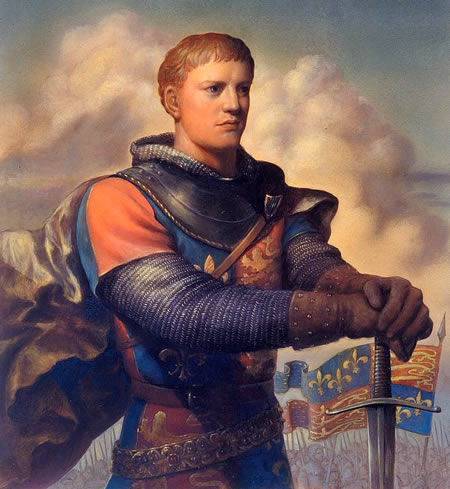
Henry V of England and Agincourt was the son of Henry IV Bolingbroke, from the House of Lancaster, and Mary de Bohun, the daughter of the seventh earl of Hereford. At the age of 12, King Richard II knighted him as duke of Lancaster. In that same year he became heir to the throne of England when his father imprisoned Richard and had himself crowned as his successor.

By 16 years of age Henry was engaged in crushing revolts alongside his father. Provoked by economic discontent and unjust laws, the welsh, led by Owen Glendower, self-proclaimed prince of Wales, revolted against the English Crown. So did the Percys of Northumberland, who had helped Bolingbroke to remove Richard from power, and who were now displeased by the fact that the Cumbrian lands Bolingbroke had promised them were instead given to their rivals.

Though Henry was seriously wounded in the face by an arrow in 1403 at the Battle of Shrewsbury, the confrontation resulted in the death of Harry Hotspur, the leader of the Percy revolt. Much of the success in ending these rebellions had to do with Henry’s military abilities.


By 1410 Henry had gained almost complete control of the English government, as his father, who would live for another three years, suffered from a severe skin condition believed to have been either syphilis or leprosy, and possibly also epilepsy, which prevented him from fulfilling his royal obligations.

Bolingbroke died in March 20, 1413, and Henry officially succeeded him as king of England. Henry immediately took actions to gain the support of his people. He pardoned his father’s enemies and restored their lands, including Edmund Mortimer, fifth earl of March, whom the childless Richard II had named heir apparent to the English throne and whom Bolingbroke had imprisoned when he took the crown. Henry also had Richard II’s body exhumed and reinterred at Westminster cathedral.

His second funeral included all the royal honors he had been denied earlier. With this Henry appeased Richard’s supporters. He was also responsible for introducing English as the language of government instead of Latin and French, which had been used in official documents for centuries. With this, he encouraged the notion of England as an individual nation, with traits distinct from others, including its language.

Upon taking the throne Henry was faced with both domestic and foreign issues. On the domestic front, the Lollards, a heretic religious sect that considered the Catholic Church to be corrupt and who denied the authority of priests, revolted (1413) when Sir John Oldcastle, Henry’s close friend, was brought to trial for professing Lollard beliefs.

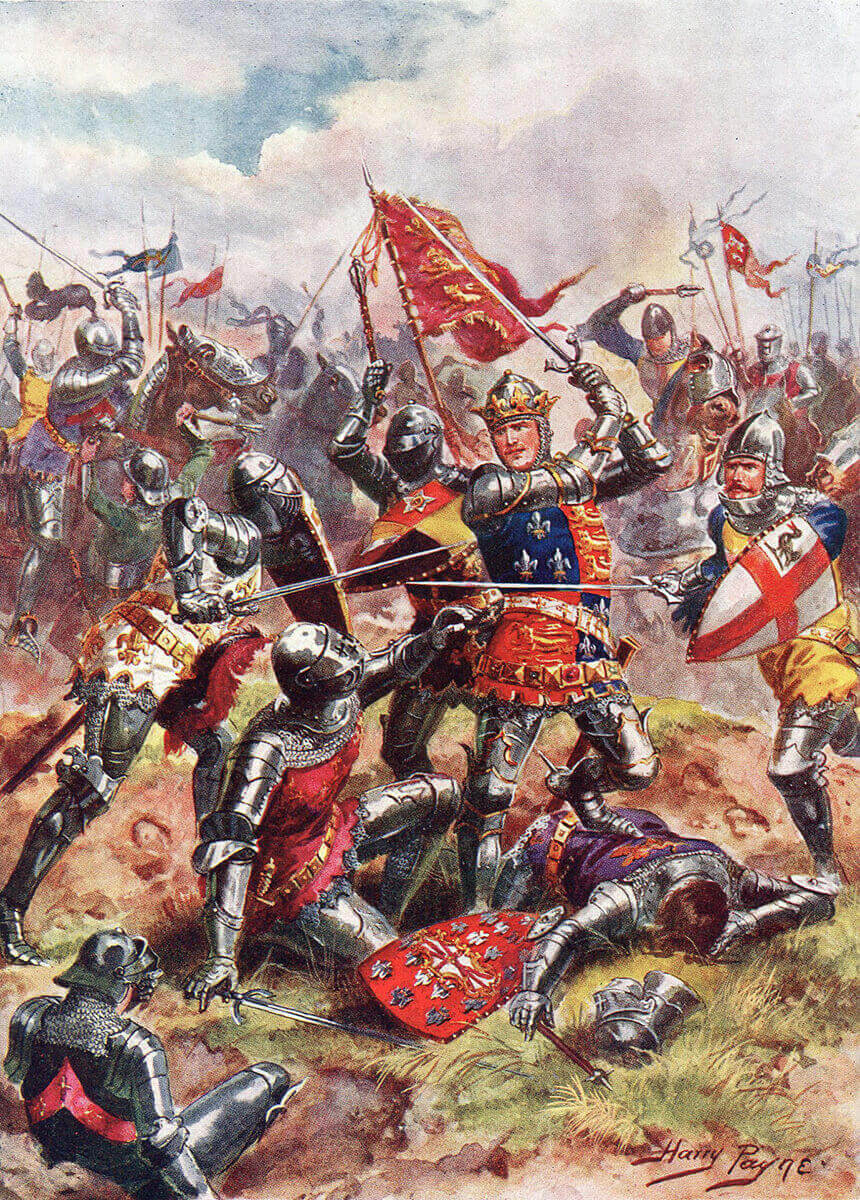
King Henry V at the Battle of Agincourt on 25th October 1415

Oldcastle escaped and led an uprising against Henry. The rebellion failed, and Oldcastle was recaptured and executed. In retaliation, Henry stepped up the persecution of the Lollards, which had begun in the early years of the 15th century.

In 1415 Henry again had to deal with a plot devised against him—the Southampton Plot, meant to murder Henry and replace him with Edmund Mortimer. The plot was discovered, and its leaders—Edmund’s brother-in-law Richard Conisburgh, third earl of Cambridge; Sir Thomas Grey of Heaton; and Henry Scrope, baron of Masham—were executed.

On the foreign front Henry had his eye on the conquest of France. The French king Charles VI suffered from bouts of mental illness, and his kingdom was dealing with strife between the nobles of Armagnac and Burgundy, weaknesses that Henry rightly believed would work to his advantage. Henry played the two factions against each other to achieve his goal. In 1415 he engaged in war against the French, winning the decisive victory at Agincourt.


In 1417–1419 he conquered Normandy and Rouen and in 1420 he forced the French to sign the Treaty of Troyes, which recognized him as heir to the French throne and regent of France and gave him the hand of Catherine of Valois, Charles VI’s daughter. With this union Henry legitimized his claim to the French crown.

The Armagnacs however rejected the treaty and Henry continued his campaign against France. In 1422 during the Siege of Meaux, Henry became seriously ill with dysentery. He died at Bois de Vincennes in August of that year without attaining the French crown. His infant son, Henry VI, eventually succeeded him as king of England, while the French crown went to Charles VII of France, Charles VI’s son.

The twists and turns of Henry V’s life inspired William Shakespeare to write his play Henry V two centuries later. The opinion of historians regarding Henry’s submission of France into signing the Treaty of Troyes is anything but flattering, as is their view of Henry as a cruel and fanatical ruler. However Henry demonstrated great valor in battle and had strong political skills, the ability to forge alliances to appease his opponents, and the intelligence to strategize against his enemies to attain his goals.

Hundred Years’ War

Hundred Years’ War
Hundred Years’ War

In battles fought from 1337 to 1453 primarily by England and France for control of France and the French Crown, England initially had the upper hand, but in 1429 the French, inspired by Joan of Arc, regained all areas of France that they had lost except for Calais. England and France had been at war several times before the Hundred Years’ War because of the landholdings of the English Crown in France.

Through several wars, the French had slowly been regaining control of these lands. With the beginning of the Hundred Years’ War the French found themselves losing ground against the English. Militarily the English longbow proved especially devastating to the French and led to the English victories at Crécy and Agincourt.

The English believed that they were secure in their victory but found the tables turned on them in 1429 by Joan of Arc. The French were able to retake much of the land the English had captured up to that point in the war. The Burgundians switched sides, joining the French, and the English found themselves pushed back even more.


The English would continue to send armies to France and were, at times, able to retake lost territory; the war had definitely turned against them. The final years of the war saw the English lose all their territory in France except Calais. With France’s control over all the previously controlled English lands in France, the war ended in 1453.

Early English Lands in France

The English and the French had been at odds over the relationship of their kings to each other because of the English Crown’s control over lands in France. In England the English king was sovereign, yet in France he was a vassal of the French king and accountable to the French king.

This accountability was used, usually on trumped up charges, by the French kings to try to take land away from the English. The French did this in 1202 and when the English king did not show up at the French court to answer charges brought against him, the French king declared his lands to be confiscated and war followed.

During the war (which lasted until 1204), the French conquered Normandy, Maine, and Anjou from the English. With the signing of the Treaty of Paris in 1259 the English had been reduced to control of just Aquitaine. The English king also reconfirmed his status as a vassal of the French king with respect to his lands in France.

English army in hundred years' war

The French trumped up charges again in 1294 against Edward I and again declared his lands confiscated and launched an invasion of those lands. The war lasted until 1298. This war also saw the Scots allied with the French against the English in 1295. A new peace treaty, the Treaty of Paris, was signed, returning the lands lost by the English during the war to them.

Isabella, the daughter of the French king Philip IV, was married to the English heir, Edward II. At the time this seemed to be a way to create lasting peace between the two kingdoms but ended up causing more problems by later giving the English king a claim to the French throne during the Hundred Years’ War.

In 1324 the French again provoked the English and summoned the English king to the French court. When the king did not show up, the French again declared the province of Aquitaine confiscated from the English and the two countries went to war again.


The war did not last long and in 1325 Edward II’s son, Edward III, and his mother went to France so Edward III could pay homage to the French king, Charles IV. Returning to England in 1327, Queen Isabella had Edward II deposed and Edward III, only 14 years old, crowned king.

With such a young king, the English ended up agreeing to a peace treaty that favored the French, allowing them to keep the land they had conquered. In 1328 the English were forced to make peace with the Scots and Charles IV, third son of Philip IV, died. None of Philip’s three sons had a male heir. Succession ended up going to the cousin of Charles IV, Philip of Valois.

While neither Edward nor his mother made any claim to the French throne at this time, Edward had himself crowned king of France in 1340. In French law, Edward had no claim to the Crown since French law did not recognize any claim by a female, or her offspring, to the throne of France.

The early years of Edward’s reign saw him pay homage to the French king, since he could not afford a war with France. Focusing on Scotland with the death of the Scottish king, Robert I, Edward was able to gain the upper hand there and bring Scotland back under England’s control.

However, being an ally of the Scots, Philip had an interest in what was happening there and tried to link negotiations for continued peace between France and England with the war in Scotland. In 1336 France had put together a fleet that was to take a French crusade to the Holy Land.

However, Pope Benedict XII canceled the crusade because of the problems of the French, English, and Scots. Instead it seemed to the English that the fleet would be used to invade England. While there was no invasion of England, the fleet did conduct raids on parts of the English coast and convinced the English that war with the French was coming.

Using the same ploy they had before, the French king summoned the English king, as the duke of Aquitaine, to turn over the French king’s brother, who had taken refuge in England. In 1337 when Edward did not comply with Philip’s order, Philip declared Edward’s land confiscated again and the Hundred Years’ War began.

Beginnings of the Hundred Years’ War

The war began with the French invading Aquitaine in 1337. The French fleet continued raiding the English coast. The English were finally able to defeat the French fleet at Sluys in 1340, which gave the English control of the English Channel, making it easier for them to move troops to France.

During this time Edward made alliances with the Low Countries and the German emperor and arranged to have his soldiers join theirs for a campaign against the French. However the date for the campaign kept being delayed until 1340.

The Flemish joined with Edward, who had himself crowned king of France on January 26, 1340. While the English laid siege to the town of Tournai, the French moved against the allied army but did not engage it. The war shifted to Brittany in 1341 with the death of the French duke.

Succession to the title was disputed and the English took the chance to support the side the French king opposed. Neither side was able to gain the upper hand and control of the entire province. The fighting continued for several years to come. In 1343 a truce was called, lasting until 1346.

Edward decided to conduct the campaign in 1346 with an English army and not rely on his allies for soldiers. Edward’s army landed in Normandy hoping to draw the French army away from Aquitaine, which it did. Marching first to the Seine River and then along it toward Paris, the English army raided the countryside and towns as it marched.

The French had destroyed most of the bridges across the Seine River and had a chance to trap the English army but instead allowed the English to cross the river and march away. The French would have the same chance again when the English army reached the Somme River and again the French allowed the English to cross the river and escape. Edward finally stopped retreating and chose the area around Crécy to give battle to the French on August 26, 1346.

Edward picked an easily defended spot that forced the French to attack him uphill. He also deployed his archers to have a clear field of fire against the advancing French. The French arrived on the battlefield late in the day, yet chose to attack instead of waiting until the next day.

The French also did not attempt to organize a massed attack against the English; instead, they attacked as they arrived on the battlefield, thus leading to approximately 15 independent assaults on the English position.

The English archers cut down each assault with few of the French knights actually reaching the English men at arms. French casualties were estimated at over 1,500 knights and nobles and up to 20,000 infantry and crossbowmen. English casualties were about 200 men.

With his victory, Edward moved against Calais, which he laid siege to in September 1346 and captured in August 1347. The next several years would see only minor fighting, and even a truce for a short time. Philip VI died in August 1350 and John II became the new French king. Under the new king, the French and English engaged in peace negotiations, but these were broken off in 1355 by the French.

Treatis and Raids

The English responded to the break in negotiations by launching raids into France. The most successful raid was in 1356, led by Edward’s son, Edward the Black Prince (so named because he wore black armor). Launching from Bordeaux, he marched his army toward the Loire River but turned back before crossing the river.

As he moved back to Bordeaux, he was blocked by a French army led by King John at Poitiers. On September 19, using the terrain to his advantage, the Black Prince was able to defeat the French using the terrain and his archers to cut down the attacking French. More important was the capture of the French king by the English.

With his capture, the French found themselves in a civil war between the dauphin and Charles of Navarre over who should control France. In 1359 Edward brought an army to France in an attempt to capture Reims. When he was unable to capture the city, he considered marching on several other cities, including Paris, but in the end decided to return to England.

The English and French signed a treaty on May 8, 1360, that released King John from English captivity and recognized English sovereignty over Calais, Ponthieu, Poitoum, and Aquitaine. Also part of the treaty was a clause where Edward agreed to stop calling himself the king of France. It looked as if the English had won the war. Even with the peace treaty in place, the French and English continued fighting on a low level.

This included the French civil war, which did not end until May 1364 with the defeat of Charles of Navarre. The French and English also found themselves on opposite sides of the fighting in Castile where the English, under the command of the Black Prince, prevailed. Unfortunately the fighting forced the Black Prince to raise taxes in Aquitaine.

The people of Aquitaine then appealed to the French king, Charles V (who had become king in 1364 when his father, John, had died). Therefore in November 1368 Charles V declared the English land confiscated again. Edward tried to negotiate a settlement with Charles, but when that failed Edward again declared himself king of France and the two countries were at war with each other again.

The French made significant gains in recovering territory they had given up in 1360. They were even able to launch raids on the English coast, whose defenses had been neglected after the peace treaty in 1360. This raised concerns that the French might actually invade England. In response, the English launched raids on cities they thought the French might use to stage their invasion.

By the end of 1369 English actions had eliminated the possibility of a French invasion. Over the next several years the English would continue to launch raids into the French-controlled territory, but they also lost territory to the French. Both sides continued to raid each other’s territory and avoid a set piece battle.

In 1376 Edward the Black Prince died; in the following year, 1377, Edward III also died. This left the Black Prince’s son, 10-year-old Richard II, as king of En gland. Small scale fighting continued through the 1380s until both sides agreed upon a truce in June 1389. The truce would last, with the usual intermittent raiding, until 1415.

Henry V and Charles VI

Starting in the early 1400s the French gave support to Scotland and Wales in their struggle against the English. They also launched several raids against English ports. However the French king, Charles VI, who came to power in 1380, suffered from insanity. Because of this, he was unable to keep his nobles controlled and in 1407, a civil war broke out between the Orléanists and Burgundians.

Both sides asked the English for aid. In 1413 Henry V was crowned king of England. While his father, Henry IV, had provided some support to the Burgundians, Henry V determined to take full advantage of the chaos in France. Thus in 1415 an English army of 12,000 men invaded France.

Landing in Normandy, Henry first laid siege to the town of Harfleur, which took over a month to capture. Henry lost about half his men during the siege. Henry then decided to march over land to Calais. Henry left his siege equipment behind so he could move fast. The French set out in pursuit of Henry with an army of 30,000 men.

Although Henry was moving fast, even in the rain, he had trouble finding a crossing to get across the Somme River, which allowed the French to get ahead of him. They chose the area near the castle of Agincourt to try to stop Henry. While the sides tried to negotiate a settlement, neither side was interested in budging from its position.

On October 25, 1415, the two sides fought the Battle of Agincourt. The French commander had originally wanted to fight a defensive battle since the English were short on supplies, but the French nobles convinced him to attack since they had a numerical superiority.

Battle of Agincourt
Battle of Agincourt

The English took up a position with forests on either side of them. They had about 5,000 archers and only 800 men at arms. The archers placed sharpened stakes in the ground in front of them as protection from the mounted French knights. The ground between the two armies was wet and freshly plowed, which made it hard to move across.

The French nobles were unwilling to wait for the English to attack and eventually convinced the French commander to order an attack. With the wet, plowed ground slowing them down, the French took terrible losses from the English archers. Approximately a third of the French troops were in the initial attack and most were either killed or captured.

The next two attacks by the French were also thrown back by the English, although they did not meet the same fate as the first attack since they withdrew before being destroyed. Exact French losses are not known for sure, but estimates put their losses at 6,000–8,000 men. There is also no exact record of English losses, but they were few compared to the French.

Henry’s next campaign started in 1417 and went until 1419. This time he completed the conquest of the Normandy region. The Burgundians, still English allies, were able to gain the upper hand in their civil war and capture Paris.

In May 1420 the Treaty of Troyes was signed; it declared Henry to be Charles VI’s heir and required him to continue to support the Burgundians in their civil war against the Orléanists, who were now supporting the dauphin. Henry died in 1422 and his nine-month-old son became the new king of England. Even with Henry’s death, the English continued their war against the Orléanists. Charles VI died two months after Henry V. With Charles’s death, Henry VI was crowned king of France.

Joan of Arc

The war took a sudden change for the better for the French with the appearance of Joan of Arc in 1429. She led an army to victory against the English, laying siege to the town of Orléans in May 1429. This was the first of many victories that led to the coronation of the dauphin as Charles VII. Joan was captured and turned over to the English in May 1430. The English had her put on trial for witchcraft, convicted, and burned at the stake.

The English had hoped to strike a blow against the French morale but only succeeded in inspiring them. In September 1435 the French civil war was ended and with it the alliance between the Burgundians and the English. The French continued to retake territory from the English, including Paris, which fell in April 1436. Both sides agreed to a truce in 1444, which lasted for five years.

The French used the truce to reorganize their army, so that when the truce ended in 1449 they were ready to end the war. Starting with an invasion for Normandy in 1449 that was completed by 1450, they pushed the English out of France over the next several years. The conquest of Aquitaine would take longer. The initial invasion began in 1451 but was slowed in 1452 when the English sent troops there in an effort to stop the French.

While the English were successful in slowing the French, the French were able to defeat the English army in July 1453 and by October 1453, with the fall of Bordeaux, they completed their conquest of Aquitaine and ended the Hundred Years’ War. The only French soil still controlled by the English was Calais, which they controlled until 1558.