Showing posts with label china. Show all posts

Black Death

Black Death
Black Death

The Black Death (Black Plague, The Plague, Bubonic Plague) was so named because the skin on many of its victims turned black, a result of massive blood clots. Although there have been many plagues throughout history, the three most associated with the term Black Plague are pandemics (epidemics that affect huge geographic areas) that occurred in Byzantium during the sixth century b.c.e., throughout Europe and the British Isles during the 14th century, and in 1894 in Asia. The first outbreak in 540 c.e., often referred to as the Plague of Justinian, began in Egypt, according to Procopius.

The disease spread from the coasts to inland areas, killing thousands of people each day. Allegedly, corpses were put on ships and sent out to sea to be abandoned. The power shift from south to north and from the Mediterranean to the British Isles is attributed to this devastation.

It was the second pandemic—a series of outbreaks that escalated from an early episode in 1331 to the disastrous events in 1346—that is most frequently referred to as the Black Death. In 1346 a Mongol prince and his armies attempted to lay siege to Caffa, in the Crimea. However, the soldiers were stricken with this dreadful disease and withdrew, but not before catapulting infected corpses over the city wall.


The Christian defenders, who thought they were now safe from attack, left to return home but perished from the plague. The few who reached home spread the disease throughout Europe and as far north as Greenland. Within a year 80 percent of Marseille had died. According to various sources, the death rate varied from 12 to 50 percent. It is estimated that in Europe 20–25 million, and throughout the world 42 million people died.

There are three forms or types of the disease: bubonic, pneumonic, and septicemic. The most dramatic is the septicemic version. Immense numbers of bacteria cause DIC (disseminated intravascular coagulation), a condition where there is so much debris in the bloodstream, the blood hemorrhages under the skin and the afflicted person’s body, or parts of it, becomes black. These victims died almost immediately, within one to three days after they showed symptoms of the disease.
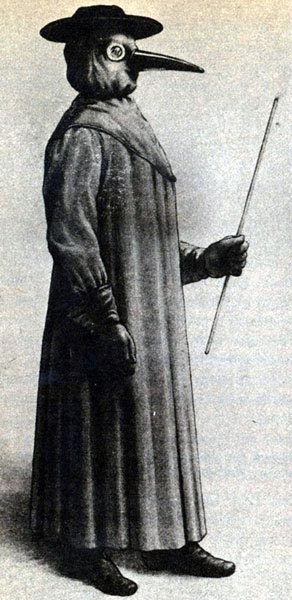
Plague doctor...the "beak" would contain herbs that would help to protect the Doctor from contracting the disease. It was basically useless...of course they didn't realize how disease was spread and the different methods of cross contamination, etc...
Plague doctor
Giovanni Boccaccio (1313–75), the author of the Decameron, a bawdy collection of stories that were told by Italian travelers trying to escape the plague in Florence, wrote, “They generally died the third day after the appearance without fever.” In the bubonic form of the disease, victims were stricken with a headache, nausea, achy joints, high fevers, vomiting, and a general feeling of malaise. It took from one day to one week for the patient to exhibit the characteristic symptoms after being exposed.

The most painful symptom was swelling of the lymph glands in the armpit, groin, and neck. These enlargements would become buboes, painful abscesses; skin infections filled with pus. When the bubo broke and drained, the purulent material inside was infectious and therefore spread to whomever touched the patient or the anything the patient’s clothing, bedding, or items that he handled.

Boccaccio wrote, “... in men and women alike there appeared, at the beginning of the malady, certain swellings, either on the groin or under the armpits, whereof some waxed of the bigness of a common apple, others like unto an egg, some more and some less, and these the vulgar named plagueboils ... to appear and come indifferently in every part of the body; wherefrom, after awhile, the fashion of the contagion began to change into black or livid blotches, which showed themselves in many, first on the arms and about the thighs and after spread to every other part of the person ... a very certain token of coming death ...”

Patients with the bubonic form spread the pneumonic form via fine droplets from a cough or sneeze. Although it was less lethal than the septicemic version, victims suffered from painful coughing episodes and eventually they coughed so much that the lining of their lungs became irritated and they coughed up blood.


People were so fearful of catching the plague that they abandoned their own family members, friends, homes, and public spaces in order to escape contact with anyone stricken with the disease. Doctors who were still willing to treat patients donned hoods with masks, beaks and hats in order to avoid breathing the air around a plague victim. They had no way of understanding the natural history or cause of this disease.

They blamed an unlucky conjunction of astrological influences, such as Saturn, Jupiter and Mars, and poison from the tails of comets, or blamed Jews for allegedly poisoned the wells. But even after the wells had been sealed, people continued to get the plague.

Some of the treatments such as cupping, purging and bleeding, although acceptable in the 14th century, did more harm than good and weakened anyone who remained alive after such insults to their feeble bodies. Amazingly some people survived and because of their illness, developed antibodies that provided immunity against a future attack.

The Spread of the Black Plague

The Black Death ripped through Europe

This second pandemic was facilitated by a number of factors. Populations had reached such high numbers in Europe that there was not enough food to feed everyone. Consequently those who could not afford the rising cost of food lacked adequate nutrition, and became easy targets for any new threat to health. There were trade routes connecting urban centers and increased travel in the form of caravans. Returning crusaders were spreading Christianity and, at the same time, the plague.

The causative organism Pasturella pestis (now called Yersinia pestis) was already present in the burrowing rodents of the Manchurian-Mongolian steppes but did not create a plague until the black rat (Rattus rattus) spread to Europe with a specific kind of flea. Rattus rattus originated in Asia but reached Europe during the early Middle Ages. They thrived in environments where people lived, near water, and traveled by ship.

The black rat’s flea Xenophylla cheopsis would bite the rat, but instead of being satisfied with its blood meal, its digestive tract would get plugged with plague bacteria, thus creating a constant hunger. It would voraciously bite anything in its path, including humans. When it found a human host, it spread the disease through repeated bites.

Europe had eradicated both the opportunity and the infection, but Asia suffered acutely. In the early 1890s an epidemic broke out in southern China, then in the city of Guangzhou in January of 1894, where 100,000 were reported dead. By May it had spread to the Tai Ping Shan area of Hong Kong.

As in any epidemic high population density, poor hygiene, inadequate health education, and the government’s inability to maintain a decent water supply and sewer treatment facility added to the poor defenses of the population. That year, 2,552 people died. Trade was affected and many Chinese left the colony. Plague continued to be a problem in Asia for the next 30 years.

The causative organism of the plague was not isolated and described until the third pandemic in 1894. Shibasaburo Kitasato and Alexandre Yersin simultaneously discovered the bacteria responsible for the plague, soon after they arrived in Hong Kong to assist in the eradication of the plague there.

Originally named Pasturella pestis, the organism responsible for causing the Black Death was renamed Yersinia pestis after it was reclassified into a different genus on the basis of its similarities to other Enterobacteriaceae species.

Five Dynasties of China

Five Dynasties of China

The great Tang (T’ang) dynasty, founded in 618, was wrecked by the Huang Zhao (Huang Ch’ao) Rebellion that lasted between 875 and 884. It was put down only with the help of regional warlords and Turkic allies (the Turks who lived to the north of China were called Shatou), who retained power. In 907 a Shatou chief slaughtered the last Tang emperor and most members of the Tang imperial family and proclaimed himself emperor of the Later Liang dynasty.

Thus began the Five Dynasties Era, 907–960. It was also called the Five Dynasties and Ten States Era, because none of the Five Dynasties controlled lands beyond the Yellow River plains of northern China whereas central and southern China were ruled by 10 regional states, each occupying about one province in that region. Later historians did not give any of the Ten States the status of a legitimate “dynasty” which succeeded one another throughout Chinese history. The Five Dynasties were
  1. Later Liang (16 years, 907–923, three rulers)
  2. Later Tang (T’ang) (13 years, 923–936, four rulers)
  3. Later Jin (Chin) (10 years, 936–946, two rulers)
  4. Later Han (three years, 947–950, two rulers)
  5. Later Zhou (Chou) (nine years, 951–960, three rulers)


The first and last of the five were ruled by Han Chinese families; the remaining three were headed by men of Turkic tribes, but who were largely Sinicized. For example the Later Tang rulers had served the Tang dynasty as provincial governors and had been bestowed with the Tang imperial surname Li.

All five dynasties were founded by military adventurers, and within each dynasty, family members or rivals assassinated many rulers. The wars and rebellions that ended the Tang dynasty had so devastated Chang’an (Ch’ang-an) that it would never be China’s capital again.

The center of political power would shift eastward from Shaanxi (Shensi) province, which was the cradle of Chinese civilization, to Henan (Honan) province, where both Luoyang (Loyang) and Kaifeng (K’ai-feng) (then called Bian or Pien) were located. Both cities were capital of some of the dynasties during this era, Luoyang because of its historic importance.

Kaifeng is east of Luoyang, also on the southern side of the Yellow River, and was easily accessible by roads and the Grand Canal. It would remain the capital under the Song (Sung) dynasty, between 960 and 1126. However Kaifeng was without natural bulwarks and was thus vulnerable to attacks. Chang’an became the capital of the impoverished Shaanxi province and its name was changed to Xi’an (Sian).

The wars and invasions that so disrupted northern China in the ninth and 10 centuries also greatly diminished the long-entrenched leadership of the “eminent clans” that had dominated political and social life since the Han dynasty, because so many other members were killed in the conflicts. This would result in a profound social change and in the creation of a more egalitarian society.

Imperial palace Kaifeng China

Another factor contributing to growing egalitarianism is the invention of printing. Block printing to produce books began in the seventh century (paper was invented in China in the first century). It was during the Five Dynasties, between 932 and 953, that the first complete printed edition of the 11 Confucian Classics (plus two supplementary works) totaling 130 volumes was produced, under government sponsorship of four dynasties.

Luoyang, Kaifeng, and several cities in the south became centers of a vibrant printing industry. Cheaper printed books, as opposed to the expensive hand copied ones, increased literacy and enabled sons of middle-class families to compete in the state exams. This fact also contributed to the breaking of the lock on power by the “eminent clans.”

In contrast to the turmoil North China suffered from the late Tang through the Five Dynasties, southern China was relatively peaceful and continued to prosper. Many great poets and painters of the era came from southern China. This was a trend that would continue during the next 1,000 years.


During the Han and Tang dynasties the frontier that had threatened China’s security had been Central Asia, which included ancient lands called Sogdiana, Bactria, Transoxannia, and Ferghana in ancient Western texts (modern Afghanistan, Tajikistan, Turkmenistan, Uzbekistan, Kirghizstan, and part of Kazakhistan) to the Caspian Sea.

The threat had shifted by the ninth century to a region called “Inner Asia” that extended from the Pacific Ocean westward for 3,000 miles to the Pamir Mountains and from the Great Wall of China northward for 1,000 miles to Siberia in present day Russia; it included modern Mongolia, Chinese Manchuria, Inner Mongolia, Xinjiang (Sinkiang), Tibet, and Russia east of the Pamir Mountains.

In the 10th century two states dominated by pastoral nomads ringed northern China. They were the Khitan state called Liao rooted in the northeast, and the Tangut state called Xixia (Hsi Hsia) rooted in the northwest. The founder of the Later Jin (Chin) dynasty ceded 16 prefectures in northeastern China, including the area around modern Beijing, to the Khitan Liao.

This session bequeathed serious consequences to the Song dynasty; seeking to regain this historically Chinese land the second Song emperor would go to war with the Liao, with disastrous results. Another legacy of the Five Dynasties to the Song was the pivotal role of the army in the founding of each dynasty, since the Song too was founded as a result of a coup d’etat, and seeking to end the cycle, Song Taizu (T’ai-tsu) would reorganize his army and put it under civilian control. The result was no more coups d’etat, but also an incompetent Song army.

An Lushan (An Lu-Shan) Rebellion

An Lushan (An Lu-Shan) Rebellion

The An Lushan Rebellion (755–763 c.e.) occurred at the midpoint of the Tang (T’ang) dynasty, 618–909, and marked a significant turning point in the fortunes of the regime. The rebellion marked the Tang’s irreversible decline after one and half centuries of good governance, economic prosperity, and military success. An Lushan’s (703–757) beginnings were humble.

He was half Sogdian and half Turk, of the Khitan tribe, and was born beyond the Great Wall of China in present-day Manchuria. At an early age he was sold to a Chinese officer of the northern garrison and rose to the rank of general and commander of a region on the northeastern frontier of the Tang empire. By the mid-eighth century c.e. most of the frontier garrisons were under foreign (non–Han Chinese) generals.

An was introduced to the court of the aging Emperor Xuanzong (Hsuan-tsung, also known as Minghuang, or “Brilliant Emperor”) and rapidly ingratiated himself to his young favorite concubine, the Lady Yang (known by her title Yang Guifei, or Kuei-fei; Guifei means “Exalted Consort”) who adopted him as her son. Gross and fat, An became a frequenter at court events, entertaining the emperor and his harem with his clowning and uncouth behavior.


He was rewarded with the title of prince and given command of the empire’s best troops. Protected by Lady Yang and her brother who was chief minister of the empire, reports of General An’s treacherous intentions were not only unheeded by the emperor but the men who reported them were punished.

In 755 c.e. General An rose in rebellion. At the head of 150,000 troops, among them tribal units (he commanded a total of 200,000 troops), he marched from his base near modern Beijing toward the heartland of the empire. His success was immediate. The eastern capital, Luoyang (Loyang), fell.

With the main capital Chang’an (Ch’ang-an), poorly defended by unseasoned troops, Xuanzong and his court beat a hasty retreat, heading for refuge in the southwestern province of Sichuan (Szechwan). En route the dispirited troops escorting the emperor mutinied. They blamed Lady Yang and her brother the chief minister for their plight, killed him, and forced the emperor to hand Yang over to them and strangled her.

These humiliations led to the abdication of Xuanzong and the ascension of his son and crown prince as Emperor Suzong (Su-tsung). The doting, aged emperor’s love for his favorite, his neglect of his duties and indulgence in a sybaritic life with Lady Yang, the disastrous consequences of their love, their flight, and her tragic death have inspired many poems by famous Tang poets and were the subject of many paintings.

An Lushan’s troops entered Chang’an unopposed, and he proclaimed himself emperor, but his rebellion made little progress after that. He soon became blind and was murdered by his son in 757 c.e. The son, too, was murdered by one of his generals, and soon the rebellion degenerated into chaotic civil war as some of his early supporters defected and other rebels bands rose as opportunities offered.

The new emperor rallied loyal troops who outnumbered the rebels, but were scattered in different garrisons. He also obtained help from former vassals and allies, most notably from a Turkic tribe called the Uighurs and others in Central Asia, and even some Arab troops sent by the Islamic caliph.

Some of the help came at a high price, for example the Uighur khan who twice helped to recapture Luoyang was repaid by permission for his men to rampage through and loot the city, including the palaces and Buddhist temples, and which cost thousands of lives.

Peace was finally restored in 766; however, the empire would never recover its previous prestige and prosperity. The following are some important results of the rebellion:
  1. Growing importance of the army and military leaders. The army expanded to over 750,000 men. The military would remain a significant force, and regional commanders would become powerful and able to resist central control.
  2. Restructuring of provincial administrations that became semiautonomous through the remainder of the dynasty. This is especially significant in the decreasing amounts of revenue that local authorities would turn over to the central government, further curtailing its authority.
  3. Ending the land registration and distribution system in effect since the beginning of the dynasty that had ensured economic equity for the cultivators, maintained local infrastructure projects, and provided men for military service.
  4. Accelerating the large-scale shift of population from war ravaged areas in the Yellow River valley in northern China to southern provinces in the Huai and Yangzi (Yangtze) valleys whose productivity became crucial to the economy of the empire.
  5. Grievous loss of territory in the border regions because troops were withdrawn to defend the core of the empire. Central Asia was lost to Chinese control, as were Gansu (Kansu) and Ningxia (Ninghsia) Provinces. Both crucial links to the western regions. were lost to the rising Tibetan state.
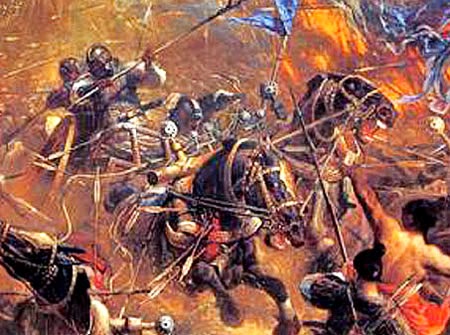
Nothing about the An Lushan rebellion was inevitable. However, it caused enormous disruption to the Tang Empire and acted as a powerful catalyst for the changes that characterized the Chinese world. Although the dynasty survived until 909 c.e. it never regained the prestige and power it had enjoyed before the rebellion.

Grand Canal

Grand Canal
Grand Canal

Next to the Great Wall of China the Grand Canal was the most important engineering feat in ancient China and was undertaken during the Sui dynasty (581–618). Earlier, during the Qin (Ch’in) dynasty and Han dynasty major canals had been built for land reclamation and irrigation and short canals for transportation.

Sui Wendi (Sui Wen-ti), unifier of China after three centuries of division, began the Grand Canal. He rebuilt and extended the old canals to link up the Yellow River with his capital Chang’an (Ch’ang-an) on the Wei River, then southward to the Yangzi (Yangtze) River at Yangzhou (Yangchow) in central China.

His son Yangdi (Yang-ti) expanded the system to Hangzhou (Hangchow) on the coast south of the Yangzi, and northward to near modern Beijing, totaling 1,250 miles. The Grand Canal, completed in 605, symbolized the reunification of the empire, economic growth, and integration. Over the centuries the growing wealth of the south became crucial to the defense of the nation’s vulnerable northern frontier.


China was politically divided during the Song (Sung) dynasty. With the loss of all northern China at the end of the Northern Song in 1127, the Grand Canal fell to disuse. In 1264 Kubilai Khan, grandson of Genghis Khan, proclaimed himself grand khan and ruler of a new Yuan dynasty in China, with the capital city at modern Beijing, which he named Dadu (T’a-tu, meaning Great Capital).

Kubilai needed grain from the Yangzi valley for his capital and had two choices for routes, by sea, where ships were subject to loss in storms, or via a safer inland waterway, the Grand Canal. He chose the canal route, which entailed repairing the old canal including a 135 mile-long section near Dadu.

Three million laborers were drafted for the task, which was completed in 1289. Maintenance was expensive and the canal again fell to disuse as the Yuan dynasty declined. The silted up sections were repaired in the early 15th century under the Ming dynasty.

Somewhere in the Grand Canal China

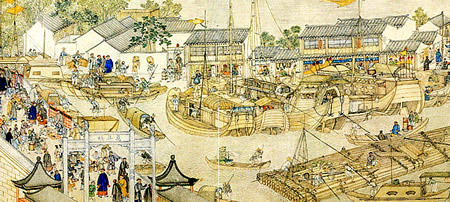
The Grand Canal fulfilled several functions. It brought grains, cloth, tea, wine, and other products of the increasingly developed southeast to the politically dominant north. In integrating the country economically, it also played a vital role in the political unification of China. The Grand Canal was built and maintained at a huge cost.

Sui Yangdi conscripted over a million people for this project during his reign and labor became so short that women were also conscripted. However the million plus number was the grand total of all laborers, not the number at work at any time, because each laborer had to work for the government for only 20 days per year.

Life along side of grand canal

Nevertheless the huge labor demands for Yangdi’s many projects caused widespread discontent that brought down his empire. Silting, currents, and the need to pull canal boats in areas of steep elevation posed difficult problems for supplying Chang’an’s 2 million people during the height of the Tang (T’ang) dynasty.

The fact that boats were fully laden on the journey north but returned south mostly empty posed economic problems that were never solved. The difficulty of supplying Chang’an was a major factor in abandoning it as the capital of China after the 10th century in favor of Luoyang (Loyang), Kaifeng (K’ai-feng), and Beijing.

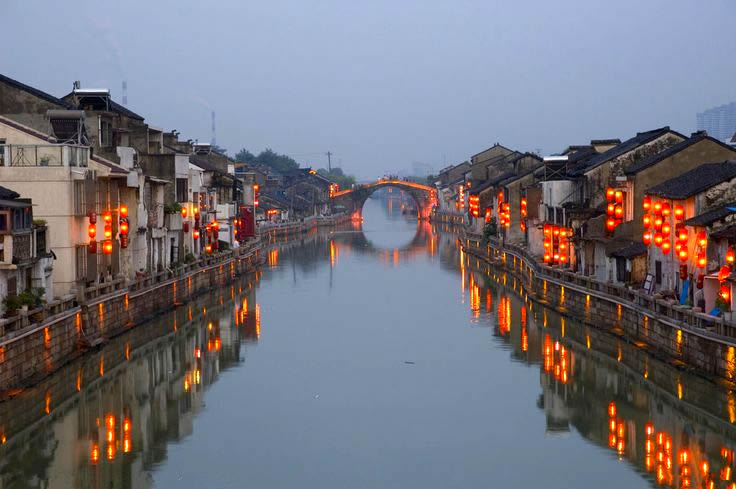
Grand canal nowdays
Grand canal nowdays

Hangzhou (Hangchou)

Hangzhou city walls
Hangzhou city walls

Hangzhou is situated near the West Lake and the coast in southern China. In 605 Emperor Yangdi (Yang-ti) of the Sui dynasty had the Grand Canal extended from Yangzhou (Yangchou) on the Yangzi (Yangtze) River to Hangzhou. As a result an already fast-developing area of the lower Yangzi and the southeastern coast grew by leaps and bounds. Hangzhou became the capital of a prefecture of the same name.

In 1126 Kaifeng (K’ai-feng), the capital of the Song (Sung) dynasty, fell to the Jurchen nomads who had been ruling northeastern China through the Jin (Chin) dynasty. The Jurchen captured the Song emperor and more than 3,000 members of his court, deporting them to the wastes of northern Manchuria.

A Song prince escaped capture and rallied resistance from several temporary capitals, then settled on Hangzhou because of its location south of the Yangzi, and in the midst of numerous lakes, where the nomadic cavalry could not be effectively deployed. Peace was made around 1136 with northern China under the Jin and land south of the Huai and the Yangzi valley under the Song, now called the Southern Song (1126–1379).


Hangzhou was capital city for a century and half; it also became a great commercial center and the most populous metropolis in the world. The existing city wall was expanded, new palaces and public buildings were built, and with the population increase (to over a million by 1275 from under 200,000 before 1126), large suburbs extended beyond the city limits.

As a contemporary writer noted: “The city of Hangzhou is large, extensive and overpopulated. The houses are high and built close to each other. Their beams touch and their porches are continuous. There is not an inch of unoccupied ground anywhere.”

West Lake
West Lake

Marco Polo wrote about Hangzhou (which he called Quinsai) after the fall of the Southern Song, when the city was past its prime, thus: “This city is greater than any in the world.... [It] has twelve principal gates; and at each of these gates at about eight miles are cities larger than Venice or Padua might be, so that one will go about one of those suburbs for six or eight days and yet will seem to have traveled but a little way.” Other descriptions paint a gay life with lamps lighting up places of entertainment such as restaurants, shops, taverns, and teahouses until late in the night. Pleasure boats, some 180 feet long, plied the West Lake.

Numerous canals intersected the city and environs, making transportation of people, merchandise, and provisions easy. Fleets of barges also carried away the waste of the city. Major roads also linked the city and beyond to many scenic spots, where rich men rode on horseback and ladies were carried in sedan chairs.

Hangzhou was also noted as a center of the silk industry, of fine ceramic kilns whose output supplied the court, and of the best teas grown and processed in its environs. The growing economy of the region also began to support the best academies. Many of the activities of this multiple-function city survived the demise of the Southern Song; however Hangzhou never became a national capital again.

hangzhou ancient building

Huizong (Hui-tsung) - Chinese emperor

Huizong (Hui-tsung) - Chinese emperor

Huizong was the reign name of the eighth emperor (r. 1101–1125) of the Song dynasty. His misrule led to the nomadic Jin (Chin) dynasty’s conquest of northern China, ending the Northern Song dynasty (906–1126). Chance brought him to the throne when his elder brother Zhezong (Che-tsung) died without heir in 1100 at age 24. Huizong was a talented painter and noted calligrapher. He brought many artists and musicians to his court at Kaifeng (K’ai-feng) to work in an imperial academy that he established.

His official kilns made the finest porcelains in the world. He was also a voracious collector of paintings, 6,000 of which perished when the Jin sacked Kaifeng. Not only did he neglect his duties in favor of his aesthetic pursuits, he appointed some of the most corrupt ministers to misrule the country until major popular rebellions broke out.

His extravagance in pursuit of his elegant life bankrupted the treasury. For example hundreds of boats were engaged just to transport exotic rocks and rare plants from southern China via the Grand Canal to Kaifeng to decorate his luxurious palaces and gardens. His answer to an empty treasury was to issue more paper money, resulting in high inflation.


He showed no concern about the rise of a new power to the northeast led by fierce nomads called the Jurchen. Then he pursued short-sighted and disastrous diplomacy by offering an alliance with the Jurchen, now called the Jin dynasty, to wage a two-pronged campaign against their mutual enemy, another nomadic state called Liao, which was situated immediately to the northeast of the Song and to the south of Jin.

The terms of the treaty were to destroy the Liao, after which the Song would recover the 16 counties that it had lost to Liao over a century ago. When war began the Jin forces did most of the fighting; the poorly led Song were ineffective.

After Liao was destroyed Song and Jin began to bicker over the spoils. Feeling that they had been treated in a high-handed manner, Jin forces turned on Song and marched on Kaifeng. Huizong hurriedly abdicated in favor of his son Qinzong (Ch’in-tsung) and fled south. Kaifeng was besieged twice in 1126.

In January 1127 Qinzong surrendered unconditionally. After looting the city Jin forces loaded their booty and marched the two emperors (Huizong was captured en route south), most of the Song imperial family, and courtiers, totaling 3,000 people, to their homeland in Manchuria. A younger son of Huizong escaped and eventually rallied Song forces in southern China; he became known as Gaozong (Kaotsung), founder of the Southern Song dynasty.

The march to the Jin capital in Manchuria took one year. Huizong and Qinzong suffered numerous humiliations, including being awarded titles as Duke of Stupid Virtue and Marquis of Double Stupidity, respectively. Huizong’s six daughters were given as wives to men of the Jin imperial household.

The prisoner emperors were kept alive as possible bargaining chips in negotiations with the Southern Song government but were not ransomed. Huizong died in 1135 and Qinzong died in 1156. The Northern Song collapsed quickly despite a large army, mainly because of the degeneration of the government under a quarter century of Huizong’s rule.