Hangzhou (Hangchou)

Hangzhou city walls
Hangzhou city walls

Hangzhou is situated near the West Lake and the coast in southern China. In 605 Emperor Yangdi (Yang-ti) of the Sui dynasty had the Grand Canal extended from Yangzhou (Yangchou) on the Yangzi (Yangtze) River to Hangzhou. As a result an already fast-developing area of the lower Yangzi and the southeastern coast grew by leaps and bounds. Hangzhou became the capital of a prefecture of the same name.

In 1126 Kaifeng (K’ai-feng), the capital of the Song (Sung) dynasty, fell to the Jurchen nomads who had been ruling northeastern China through the Jin (Chin) dynasty. The Jurchen captured the Song emperor and more than 3,000 members of his court, deporting them to the wastes of northern Manchuria.

A Song prince escaped capture and rallied resistance from several temporary capitals, then settled on Hangzhou because of its location south of the Yangzi, and in the midst of numerous lakes, where the nomadic cavalry could not be effectively deployed. Peace was made around 1136 with northern China under the Jin and land south of the Huai and the Yangzi valley under the Song, now called the Southern Song (1126–1379).


Hangzhou was capital city for a century and half; it also became a great commercial center and the most populous metropolis in the world. The existing city wall was expanded, new palaces and public buildings were built, and with the population increase (to over a million by 1275 from under 200,000 before 1126), large suburbs extended beyond the city limits.

As a contemporary writer noted: “The city of Hangzhou is large, extensive and overpopulated. The houses are high and built close to each other. Their beams touch and their porches are continuous. There is not an inch of unoccupied ground anywhere.”

West Lake
West Lake

Marco Polo wrote about Hangzhou (which he called Quinsai) after the fall of the Southern Song, when the city was past its prime, thus: “This city is greater than any in the world.... [It] has twelve principal gates; and at each of these gates at about eight miles are cities larger than Venice or Padua might be, so that one will go about one of those suburbs for six or eight days and yet will seem to have traveled but a little way.” Other descriptions paint a gay life with lamps lighting up places of entertainment such as restaurants, shops, taverns, and teahouses until late in the night. Pleasure boats, some 180 feet long, plied the West Lake.

Numerous canals intersected the city and environs, making transportation of people, merchandise, and provisions easy. Fleets of barges also carried away the waste of the city. Major roads also linked the city and beyond to many scenic spots, where rich men rode on horseback and ladies were carried in sedan chairs.

Hangzhou was also noted as a center of the silk industry, of fine ceramic kilns whose output supplied the court, and of the best teas grown and processed in its environs. The growing economy of the region also began to support the best academies. Many of the activities of this multiple-function city survived the demise of the Southern Song; however Hangzhou never became a national capital again.

hangzhou ancient building

Hanseatic League

Hanseatic league port

The Hanseatic League, or Hanse, was an association of German merchants, and later of towns, that dominated trade in northern Europe from the 13th through the 15th century. During this time the Hanse comprised around 75 member towns plus around 100 associate towns. The word hanse means an association, but the entity called the Hanse was far more. Its members were middlemen, both geographically and economically.

They controlled trade between the Baltic and North Seas, in part because their ships, called cogs (depicted on the seals of many Hanseatic towns), were much superior to earlier ships. Using this technological advantage German merchants were able to exact economic privileges from rulers along the Baltic and North Seas who came to depend on their trade. But as their economic power grew, they also took a more active military and diplomatic role in shaping the politics of northern Europe.

Eventually the structural weakness of this loosely organized transnational community became apparent, as witnessed by the growing divergence in the interests of the member towns. The Dutch, English, Spanish, and Portuguese merchants, who traded not only throughout Europe, but also throughout the world, had already long eclipsed the Hanse when it finally dissolved in the mid-17th century.


Frisians, Flemings, Scandinavians (Vikings were traders as well as raiders), and the Slavic and Baltic peoples living along the south and east Baltic littoral dominated long-distance trade on the Baltic and North Seas before the arrival of German merchants. The main centers of trade were Haddeby in Schleswig-Holstein, Birka in Sweden, Truso on the Vistula River, and Stettin and Jumne on the Oder River. These trading centers provided the groundwork for the later Hanse.

By the 12th century Visby, on the island of Gotland, had emerged as the main emporium in the Baltic Sea. Its merchants established a trading outpost in the important Rus town of Novgorod, and they were granted extensive privileges by Emperor Lothair II (1125–37) to trade throughout his realm. This emperor’s grandson, Henry the Lion, duke of Saxony (1142–80), was also interested both in developing trade and in pushing the bounds of his lordship farther east.

Along with Albert the Bear, margrave of Brandenburg (1134–70), Henry played an important role in what has come to be known as the Drang nach Osten, or “push to the east.” This involved not only the military conquest and conversion of the Slavic pagans to the east of the Elbe River, but also the colonization of the conquered lands with peasants and burghers from overpopulated western lands.

They were aided in this project by other nobles, including Count Adolf II of Holstein, who in 1143 founded a town, Lübeck, at the confluence of the Trave and Wakenitz Rivers, at almost the narrowest point of the isthmus dividing the Baltic and North Seas.

The native Slavs had long recognized the strategic and economic importance of this site, whose town a few miles downstream (from which Adolf took the name for his own town) had been destroyed in 1138. Henry the Lion complained that the town’s success was causing his own economic projects to fail, as the chronicler Helmold relates.

In 1157 Henry forced Adolf to give him the town, and Henry endowed it with expansive privileges and encouraged foreign merchants to trade there. In 1180 Emperor Frederick I Barbarossa (1152–90) stripped Henry of his possessions for failing to submit to his judgment.

Frederick I confirmed the town’s privileges in 1188, and in 1226 Emperor Frederick II made Lübeck an imperial city, free from the jurisdiction of local lords. This status as the only imperial city east of the Elbe, along with Lübeck’s geographical position, heralded the future greatness of the city that would become the capital of the Hanse, displacing Visby as the center of Baltic trade.
Hanseatic league route map

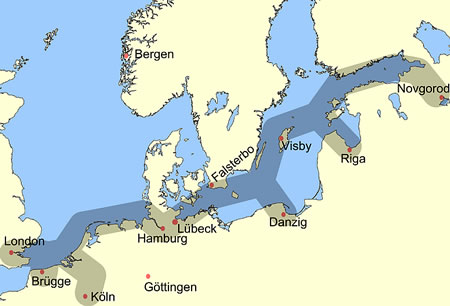
Because of the privileges granted to the Gotlanders, German merchants, especially those from Lübeck, were permitted to trade in Visby. These merchants formed an association and were recognized by authorities as “the merchants of the Roman Empire frequenting Gotland.” They elected leaders to speak on their behalf and in time established trading posts, or Kontore, in Novgorod, Bergen, Bruges, and London, four of the most important markets in northern Europe.

During the 13th century dozens of towns were founded beyond the Elbe River according to “German law.” Many of these towns were new settlements, but there were also a large number of preexisting towns, like Gdansk and Kraków in Poland, that were reorganized according to the new social (“Stadtluft macht frei,” or “town air makes you free”) and spatial (a checkerboard pattern of streets around a market square) ideals of their mother cities.

As more merchants from these new towns became involved in trade, they became wary of the other merchants’ leadership of the Kontore, and they wanted towns to take over the leadership of the Hanse. During the late 13th century a transformation took place—this association of merchants became an urban league.


The Hanse was not the first urban league. Others emerged in the empire during the 13th century, as imperial power declined and towns looked to each other for protection from predatory lords, pirates, and other threats. But these other leagues proved ephemeral, dissolving after the immediate threat had passed.

With Lübeck at its head, the Hanse continued to display its economic and military might throughout the 13th and 14th centuries. It forced the surrounding rulers, including the kings of Norway, Denmark, England, and France, to grant the Hanse ever more extensive privileges, allowing them to monopolize trade between the Baltic and North Seas.

In 1356 the first Hansetag, or general assembly of all the Hanseatic towns, was held in Lübeck. The Danish king Valdemar IV had been jeopardizing their trade routes by conquering lands throughout the Baltic, including Visby. The Hanse resolved to put an end to this. In 1362 they financed a fleet to oppose the king through the imposition of a toll on merchandise, called the Pfundzoll.

This venture, however, ended in defeat for the Hanse, and its leader was executed in the Lübeck town square for his failure. In 1367 a new Hansetag convened, this time in Cologne, because the Hanse needed the help of the Dutch in defeating the Danes. This “Cologne Confederation” of the Hanse, the Dutch, and Sweden sacked Copenhagen and forced Denmark to accept the Peace of Stralsund in 1370.

The confederation won the right to occupy all Danish fortresses guarding access between the Baltic and North Seas for 15 years as well as the right to choose the next king. In 1388 the Hanse authorized an embargo of England, Flanders, and Rus and won privileges in all three lands, taking control of the Kontore in these lands. These however would prove to be pyrrhic victories.

The late 14th century marked the apogee of the Hanse’s power. It monopolized trade between the Baltic and North Seas and had imposed its will on lands in which it traded through a combination of military and economic measures. Yet even at the height of its power, it was the beginning of the decline of the Hanse.

Many inland towns and some coastal towns did not take part in the “Cologne Confederation.” It was expensive to send representatives there, and the goals of individual towns were not always in line with those of the general assembly. The interests of the eastern towns and the western towns as well as those of the coastal towns and the inland towns continued to diverge.

Next because the Hansetag met so infrequently, the Lübeck town council functioned as the de facto head of the Hanse. When a revolt broke out in 1408 against its rule by the Lübeck burghers, it demonstrated not only the institutional weaknesses of the Hanse, but also the fact that frictions existed between the town councils and the burghers they were representing. In an organization as amorphous as the Hanse, there existed the problem of “freeriding,” that is, merchants from towns who did not belong to the Hanse trying to claim its privileges.

In addition to this internal fragmentation, the Hanse also faced external challenges. The rulers of Hanse lands sought to develop their sovereignty by limiting the Hanse’s privileges or forcing towns to withdraw from the league. In 1442 the margrave of Brandenburg forced Berlin-Cölln’s withdrawal. Also English, Dutch, and south German merchants began to take a larger share of the northern European trade.

The Hanse continued to decline throughout the 16th century, and in the first half of the 17th century the Thirty Years’ War (1618–48) decimated central Europe to an extent not seen since the Black Death. Two decades after the Peace of Westphalia (1648), argued by many political theorists to be the origin of the modern state system, the association convened its last Hansetag.

The extent of the Hanse’s economic and political power has led some historians and political theorists to draw comparisons to the European Community, forerunner of the European Union. These scholars suggest that because a transnational polity like the Hanse presented serious challenges to the emerging territorially sovereign states of the late Middle Ages, useful examples might be found for the future of the sovereign state in a world in which transnational organizations are once again challenging its supremacy.

Hanseatic league building

For nearly four centuries the Hanse was a major economic, political, and social factor in the formation of Europe—it facilitated the exchange not just of commodities, but also of people and ideas. Dozens of preserved medieval marketplaces in towns around the Baltic littoral, from Tallinn, Estonia, to Gdansk, Poland, to Lübeck, Germany, bear witness to the greatness of the Hanse during its heyday.

Harsha Vardhana - Indian King

Harsha kingdom map
Harsha kingdom map

Harsha Vardhana was a king of northern India who reunited some of the small city-states that had become independent after the fall of the Gupta dynasty and who used his position to reinvigorate the practice of Buddhism throughout his territory.

Harsha Vardhana was a son of Prabhakaravardhana, the king of Thanesar in the eastern Punjab, and was not fi rst in the line of succession. At the age of 16 his elder brother Rajyavardhana was assassinated on the orders of the king of Gauda, Sasanka, and, inspired by the bodhisattva of Avalokitesvara, he assumed the position of regent and eventually of king.

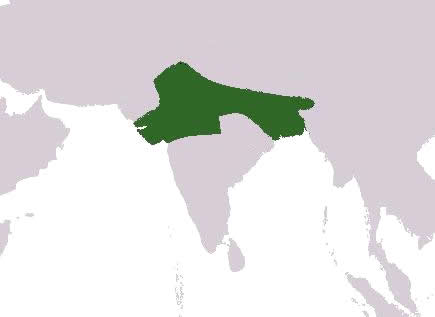
He spent a number of years fighting against Sasanka and although he was not fully successful in defeating Gauda he was able to expand his territories across five countries bordering his base in what is now Uttar Pradesh. The identity of the five countries may have equated to Sind, Magadha, Kashmir, Valabhi, and Gujarat. This would represent a considerable expanse of territory, and the labor and potential for taxation that it yielded had enormous potential for development.


Harsha Vardhana’s rule is often identified as the time at which the ancient Indian world gave way to the medieval world, in which a system of centralized comparatively small kingdoms gave way to larger, decentralized empires composed of multiple centers with diverse ethnicities and religious and cultural practices.

Harsha Vardhana’s attempts to improve his state included the establishment of diplomatic relations with China and the creation of numerous Buddhist institutions. Notable among these were the monastic center or university at Nalanda, to which Harsha Vardhana made some sort of contribution. The Chinese pilgrim Hsuan-Tsang visited and studied at Nalanda during his journey to India.

Harsha Vardhana - Indian King
Establishments aimed at helping the sick, the poor, and those traveling across his territory were created. Harsha also convened national meetings at the confluence of the rivers Yamuna and Ganges at which the fruits of his rule could be distributed among the people. After his death, Harsha Vardhana’s territory was fragmented and parts of it came under control of the Guptas. The golden age that is considered to be his rule soon came to an end.

Harsha Vardhana is one of the best known early Indian kings, largely because accounts of his life and times have been preserved. These include the chronicler Bana and the Chinese pilgrim Hsuan-Tsang. The king acted as a patron of the arts and fostered an environment in which literature could flourish. He himself is believed to have written three plays in Sanskrit that expound Buddhist beliefs.

Despite all that is known about him, interpretation of Harsha Vardhana’s life and times remains controversial. Bana’s description contains convincing personal details of his character and life but is also composed in a very flowery style suitable for the depiction of the kings and great people of the time, with numerous encomia and exaggerations.

Harun Al-Rashid - Abbasid Caliph

Harun Al-Rashid - Abbasid Caliph
Harun al-Rashid (r. 786–809) came to power as the fifth Abbasid caliph after his brother Musa al-Hadi died under mysterious circumstances, perhaps on the order of al-Khaizuran, al-Rashid’s mother. While still in his teens al-Rashid had led successful military advances against the Greek Byzantine empire in Anatolia.

He ruled at the zenith of Abbasid power and wealth. The Abbasid capital, Baghdad, with 1 million inhabitants, was a center for learning, the arts, and conspicuous consumption. A keen patron of the arts, especially poetry, al-Rashid maintained a lavish court with vast palaces and gardens adorned with jewel-encrusted tapestries and fountains.

The lavish lifestyle of the royal court was popularized in the long series of fanciful tales in The Thousand and One Nights, known in the West as the Arabian Nights. Although his court enjoyed poetry, music, and sumptuous feasts, Harun al-Rashid was a practicing Muslim who made the pilgrimage to Mecca accompanied with a large entourage.

According to legend, he also went out on the streets of Baghdad in various disguises to talk with his subjects and learn their opinions and reactions to the government. His mother, Khaizuran, who had been a Yemeni slave, exerted considerable influence in the political life of the court and was a rich landowner in her own right. His favorite wife, Zubaidah, dominated palace life, holding enormous parties and celebrations.


Harun al-Rashid also received ambassadors from the Holy Roman Empire and China and showered them with exotic and expensive gifts. But amid the luxury there were signs of economic decline, as agricultural productivity in Iraq slowed and the farming out of tax collecting to private individuals led to corruption and inefficiency.

As caliph, Harun al-Rashid put down rebellions in northern Iran and Syria and led his forces deep into Anatolia in 791 c.e. where he demanded and received huge monetary tributes from the Byzantine Empire. When these payments ceased in 802 c.e. Harun al-Rashid quickly moved against the Byzantine emperor, defeating him on several occasions. These conflicts increased the religious enmity between these two great empires.

Tribute of Caliph Harun Al Rashid to Charlemagne

In 789 c.e. after a palace scandal, Harun al-Rashid imprisoned and killed key members of the important Barmakid family. Of Persian origin, the Barmakids had often acted as extremely able viziers (ministers) for the Abbasid rulers. Over his North African territories (present-day Tunisia and Algeria) al-Rashid appointed Ibrahim ibn al-Aghlab as governor in 800 c.e.

He went on to establish the Aghlabid dynasty, ruling until 909 c.e. when the Fatimid dynasty based in Egypt replaced it. Harun al-Rashid died on military maneuvers to quell a rebellion in northern Iran in 809 c.e. After his death his sons immediately began to fight over power and territory, thereby marking the beginning of the decline and disintegration of the Abbasid empire.

Hausa City-states

Hausa City-states
Hausa City-states

The early origin of the Hausa people is shrouded in mystery. Some scholars believe they originally came from the Sahara, as did the Bantu, while others feel that they migrated from the region of Lake Chad. Still another school believes they were the region’s original inhabitants.

The rise of the Hausa city-states dates from approximately 500 to 700 c.e. In a unique arrangement, the city-states were centered on their place in the general Hausa society and did not owe their prominence to specific political power as in the Bantu (Bantu) Mutapa kingdom.

Cotton grew readily in the great plains of these states, and they became the primary producers of cloth, weaving and dying it before sending it off in caravans to other states within Hausaland and to extensive regions beyond. Biram was the original seat of government, while Zaria supplied labor.


The region was largely united between Lake Chad and the Niger River to the west, opening up to Hausa traders a vast part of Africa. Daura is the first known truly unified kingdom. It was around the 12th century that the Hausas became the dominant nation in this region, although they were threatened by Kanem Bornu, which had replaced the earlier realms of Ghana, Mali, and Songhai.

Dominant in Kanem, the Kanuri people embraced Islam and began a series of jihads, or Islamic holy wars, to widen their kingdom. Among the Hausas, Islam appeared at the same time but was spread peacefully by traders and missionaries, unlike the jihads of the Kanem empire. At the same time, native Hausa beliefs continued to be held by the majority of the population.

Because of their wide trading influence, Hausa became the common language of West Africa as Swahili did on the east coast. Hausa trade caravans would stop at places called zongos, which eventually developed into centers of Hausa habitation throughout West Africa. Zongos also became the Islamic centers of each town, associated with mosques, madrassas (schools), and waqfs (charities).

However strong an influence culturally, the Hausas in modern Nigeria came under increasing pressure from the Fulanis, a militarized Islamic society determined to conquer by jihad. The Fulanis appeared in the region by the fifth century, apparently also after a long migration from the Sahara, as it became a desert.

They reached Mauretania by the beginning of the first century, and from the fifth to the 11th centuries in what was then the Senegambia region. The Fulanis, also known as the Fulbes, were one of the first African cultures to convert to Islam, formed their own class of Muslim imams or and clerics, the Torodbe. This occurred between the eighth and 14th centuries in the Takrur region.

The Fulanis set their imperial goals on conquering the Hausas. By the early 1800s, the Hausas had become absorbed politically—but not culturally or socially—into the Fulani Kingdom in Nigeria. The Fulanis went on to found the Islamic caliphate of Sokoto. Under the rule of Usman Dan Fodio, Sokoto would become perhaps the most powerful Islamic state in the region.

Heian

Heian building
Heian building

The term Heian is derived from modern-day Kyoto’s previous name of Heian-kyo, a city founded in 794. The literal translation of Heian-kyo is “Capital of Peace and Tranquility” and was meant to reflect its peaceful and protected surroundings. The literal translation of Heian is “peace” in Japanese.

Located near the village of Uda, between the Katsura and Kamo Rivers, and with Mount Hiei providing spectacular natural geographical protection, the new capital was similar in design to the Chinese city Chang’an and was built according to Chinese feng shui principles. Heian-kyo was the center of political power and the capital of Japan until 1868, when the Meiji Restoration saw Emperor Kammu move to the city of Edo.

Edo was then renamed as Tokyo (Eastern Capital) to illustrate the shift in power. The Imperial Court remained at Heian-kyo. The Heian period witnessed the emergence of a Japanese identity that was distinct from Chinese influences and is often regarded as a golden age of Japanese culture.


The Heian period can be broken into three distinct eras. The first period, referred to as the Early Heian era, witnessed the foundation of Heian-Kyo in 794 b.c.e. and extended to around the late 960s b.c.e. The Middle Heian period extended to 1067 c.e. and was characterized by the rule of the Fujiwara clan and their courtly behavior. The Late Heian period extended to 1192 and is known for the insei (cloistered government) and for providing the framework for the establishment of the feudal system in Japan.

The move to Heian-kyo from the capital Nagaoka was necessary to curb the increasing struggles over the throne. The ongoing clan struggles resulted in Emperor Kammu taking drastic political and social reforms to try to stabilize the situation. As a result the Heian period experienced one of the longest periods of sustained peace in classical Japanese history.

Four noble families attempted to control the political scene during the Early Heian period. The Minamoto, Tachibana, Taira, and Fujiwara families all tried to influence the political atmosphere for the benefit of their own interests and pursuits. During the Middle period the Fujiwara family clearly dominated the government and because of familial ties influenced the imperial family.

The families required the services of the warrior classes to provide protection (much like security guards) thus creating the initial surge in the samurai and bushi numbers. Another important family that emerged during the Late Heian period, the Taira, eventually overthrew the Fujiwara family. The Minamoto clan then overthrew the Taira.

The Early period was also defined by the start of a clear religious doctrinal change. There was movement away from the Chinese influenced Neo-Confucianism toward a Buddhist religious perspective that echoed aspects of Japan’s indigenous religion Shinto. The imperial court adopted Mahayana Buddhism relatively quickly and it in turn merged with aspects of Shinto to create an essentially Japanese religion (called Shinbutso Shugo) that flourished.

It was during this period that Shinto architecture and art started to transform and mass temple building began. Buddhist artisans were abundant and produced sculptures as religious objects, but also as art objects for wealthy families. Stoneware and bronze were used by both the imperial households and the lay people, while the emperor preferred silver for monastic and royal events.

Metal craft reached its pinnacle during the Heian era, particularly during the Middle to Late periods, where samurai armor incorporated various motifs (according to the house that they served) and sword-smiths began to engrave their swords with their names. Armor was held in such high regard that the most powerful families and warlords offered them to Shinto shrines as holy relics.

The Early period also witnessed the introduction of new Buddhist sects called the Tendai (Heavenly Terrace) in 805 b.c.e. by Saicho and the Shingon (True Word), and in 806 b.c.e. by Kukai. The introduction of these sects contributed to stylistic changes in architecture—for example, Shingon temples adopted the use of the pagoda.

Pure Land Buddhism also began to take root within Heian society and around the same time Korean monks started introducing the now well-known Zen (or Ch’an) Buddhism. Gardens were used as contemplative areas and there was a movement toward meditative practice. Cultural festivals (Buddhist, Shinto, and Confucian) shaped the whole Heian period, and more festivals were introduced and conceived, including the Cherry-Blossom Feast and the Feast of Red Autumn Foliage.

The concept of art underwent a transformation during the Heian periods—it was used for aesthetic as well as religious purposes, and new art practices were created. Art for art’s sake was encouraged and artists, poets, and writers began to create and recognize a distinct Japanese identity.

Secular paintings and art have been referred to in literature of the day; however very little survived to the present. Japanese artists would paint sutras (Buddhist writings) or intricate landscapes onto folding fans, which became highly desirable and exported items during this period.

Heian painting
Heian painting

Literature also started to become fashionable, especially diaries of court providing details of life inside the palace. The most popular book of the early era was Makura no soshi (The Pillow Book) written by Sei Shonagon. Sei came from a literary family, her father Kiyohara Motosuke (a poet) and her great-grandfather the well-known Fukayabu.

It in turn influenced many other writers to pen their experiences in the imperial household, thus creating a distinct phase of early Japanese literature. Monogatari-e (illustrations for novels) emerged during the late 10th century and was viewed as the perfect coupling of prose and painting. It became the preferred pastime of those in the imperial household and during the Late Heian period, art competitions and shows were commonplace.

The Heian Middle to Late period is generally viewed as the most productive sociocultural period in Japanese history, as it marked a move away from Chinese influence on culture, society, and religion toward the creation of an essentially Japanese identity. The Middle Heian period witnessed a flourishing of literary and artistic pursuits and is often described as the “early” history of Japan.


During the late stages of the Early Heian period and blossoming during the Middle period, a new writing system was developed. Based upon syllables (hiragana and katakana), the new kana writing system allowed for the creation of Japanese literature and texts without depending upon kanji. It initiated a new sociocultural identity, a unique Japanese perspective that would profoundly influence Japanese life.

Calligraphy and calligraphers were attached to imperial offices and were required to provide calligraphy for things as diverse as imperial temple walls and hanging scrolls. New calligraphy styles such as “Women’s Hand” became widely recognized because of their use in calligraphic poems. It was also popular to determine one’s character by the style of writing, and use of medium.

A favorite pastime of imperial ladies was to swap poetry in elaborate folded pieces of paper, using different fasteners to convey hidden meanings. Decorative paper was highly prized and paper collages became an art form that has continued to the present time. The majority of lay people (other than the warrior classes) were not exposed to such hobbies as most were illiterate.

Literary forms experienced change with the advent of court diaries and their tendency toward long sections of prose and observation. The Middle to Late Heian period witnessed a further flourishing of literature. The establishment of an office of poetry by the imperial court in 951 accounted for the initial explosion of interest in waka (tradtional Japanese poetry).

Diplomatic ties were increasingly cut with the Chinese Tang (T’ang) dynasty during the Middle Heian period and thus there was a movement away from the Chinese style of poetry (kanshi). There were frequent poetry contests between noble contestants—the imperial palace often acting as a backdrop to the proceedings. Although the Heian court demanded its subjects write in Chinese, they compromised by writing sections of their poems with Japanese script toward the end of the prose.

A popular literary writer of the Middle to Late Heian period was Murasaki Shikibu, who created a sensation with her novel Genji Monogatari (Tale of Genji). Written around 1000 to 1008, it is often credited as the world’s first novel. The novel relates the customs and practices common to the Heian era. Men and women of high status powdered their faces white.

The imperial households wore stately robes, which were modeled on Chinese state robes. Several types of hats were worn, depending upon rank and the formality of the events. Women in the court would wear white silk with heavy brocade jackets and wore their hair long, often with the aid of wig attachments. It was fashionable to leave it unfastened so it flowed freely.

The Late Heian period witnessed what could be described as an elitist form of social hierarchy; it was highly formalized and exclusive. Although the Heian period underwent enormous social and cultural change it was economically stagnant; thus the majority of people were poor and uneducated.

Little social or cultural change occurred within this class with the exception of the rise of the warrior class, which was able to exist on the fringes of both classes with relative ease. Despite this, the Heian period left a great cultural heritage and contributed toward the social and cultural psyche of modern Japan.

Henry II - King of England

Henry II - King of England

Henry II was the first of the Plantagenet kings of England, reigning from 1154 to 1189. He was born in 1133 in LeMans, France. From his mother, Matilda, he inherited a claim to the English throne, as she was the daughter of Henry I of England (r. 1100–35). From his father, Geoffrey, he gained the titles of count of Anjou and duke of Normandy, in France.

His power and influence in France were considerably enhanced in May 1152 when he married Eleanor, duchess of Aquitaine, who two months earlier had divorced King Louis VII of France. Eleanor’s lands included Aquitaine, Tourraine, and Gascony. Together, Henry and Eleanor controlled more land in France than did the French king, from whom Henry nominally held the duchy of Normandy as his vassal.

Henry’s ascension to the English throne was not easy because the Crown had been usurped by Stephen of Blois (1135–54) upon the death of Henry I. King Stephen I fought Matilda and Henry vigorously, but when his son and heir died, Stephen agreed to terms that allowed Henry to ascend to the throne after his reign ended.


Henry did so in October 1154 at age 21, and then quickly moved to establish his authority over the feudal lords of the realm, demanding that they tear down their illicit castles and fortification built under Stephen.

Henry’s goal was to restore royal power and prerogatives to what they had been under his grandfather, Henry I. He succeeded in reviving several royal institutions that Henry I had established, most notably the system of royal justice and the exchequer.

In the case of the former, he pushed the system of royal justices riding circuit throughout England into a powerful tool through which he earned the loyalty of the freemen and burghers of the realm. His courts used a standardized or “common” law throughout the realm, providing a welcomed alternative to the courts presided over by the local feudal lords, who were notorious for protecting their own interests.

Philip II August of France and Henry II of England taking the cross

Henry’s judicial system utilized a jury of 12 sworn men who testified concerning criminal activity or contentious issues in their locale. These elements of royal justice were codified by the Assize of Clarendon in 1166. Another major innovation under Henry was the paying of “scutage” or a monetary fee in lieu of military service by a vassal of the king.

Not only did this system enhance royal revenues, it made the king less reliant upon the feudal levy when going to war. While Henry was still very much a feudal king and the government dependent upon his forceful and energetic personality, his reforms put into place a solid royal bureaucracy, which, under his Plantagenet successors, would give a tremendous degree of stability to the English monarchy.

Henry’s efforts to extend royal justice to include the English clergy met with considerable resistance by Thomas Becket, his onetime friend and chancellor. Appointed archbishop of Canterbury in 1162 by Henry, Becket surprised the king by defending the independence of ecclesiastical courts and the immunity of the clergy from royal justice. Henry issued the Constitutions of Clarendon in 1164, which reaffirmed the right of the king to punish “criminous clerks,” and forced Becket to sign the document.


Shortly thereafter, Becket fled the realm (1164) only to return in 1170. When he again began to oppose the king over the issue of royal versus ecclesiastical authority, he was murdered by four of Henry’s vassals. Public sentiment swung against Henry at this point, and he was forced to back down, agreeing to allow clergy to be both tried and sentenced in ecclesiastical courts.

In his later life Henry faced numerous rebellions by Eleanor and his sons, mostly of his own making. His long-running extramarital affairs enraged Eleanor, and his attempts to strip Eleanor and his son Richard of Aquitaine led to open conflict in 1173–74. War again broke out between the king and his sons Richard and John in 1189, which concluded with the defeat of the king. He died shortly thereafter on July 4, 1189.