Showing posts with label india. Show all posts

Bhakti Movements (Devotional Hinduism)

Bhakti Movements (Devotional Hinduism)

The word bhakti is derived from a Sanskrit word for “sharing.” It was used to describe a new type of path to moksha (“liberation from the cycle of reincarnations”).

Bhakti devotees (bhaktas) usually committed themselves to one of the Trimurti of Brahman (“the supreme spirit reality”). The three gods of the Trimurti are Brahma, Vishnu or Shiva, or in many cases bhaktas devoted themselves to some avatar, like Krishna, of the Trimurti in an emotional way. This emotional commitment marked the bhaktas as followers of bhaktimarga.

Bhakti movements called people to ardent devotion to a god or goddess as a thankful expression of gratitude for benefits received. Or it could express the hope for aid to be received. Most commonly it took the form of a passionate love of the deity.


As they developed the bhakti movements became the bhaktimarga, or one of the three Hindu paths (margas) for escaping from the wheel of reincarnation. The margas were “paths” or “roads” or “ways” for achieving the final liberation of the soul from the karma-caused cycle of repeated reincarnations. The basic problem of human life was suffering.

To escape the repeated cycles of reincarnation was the goal of life. Until the development of the bhaktimarga there were only the two paths of karmamarga (“religion of rituals and ethical deeds”) and the gyanamarga (jnanamarga, or “religion of the head through meditation”). The path of bhakti was the religious way of the heart, the way of loving devotion.

The bhakti movements arose in South India among Tamil-speaking people at some time in the seventh to ninth centuries. It provides its devotees salvation through loving devotion to the ultimate deity. The Alvars (“one who had dived” or “one who is immersed”) were Tamil-speaking poets whose works promoted bhakti worship in South India. The Alvars are counted as 12 poets of the bhakti movement who lived in South India between 650 and 940.

They promoted the worship of Vishnu using poetry as a vehicle for expressing a passionate love of the god. The object of the writing was to show how any bhakta could express deep devotion to the god as a path to the god’s or goddess’s heaven. The Alvas and other wandering singers of the times included people from all castes. They used the inclusion of outcasts to show the potential for universal salvation (universalism).

Monotheistic challenges from Islam with its firm emphasis on the unity of God may have influenced bhakti movements in northern India. However, Hinduism, while not Vedic religion, takes its starting point from the Vedas, so bhakti scholars have found their roots in the Vedic worship of the Rig Veda god Veruna. Vedic knowledge was passed from guru to disciple through the centuries. This spiritual lineage is called sampradayas.

Others see bhakti in portions of the Sanskrit texts the Ramayana or the Bhagavad Gita or in other portions of the Mahabharata. Still others see its origin in the Padma Purana.

Bhakti worship tended toward monotheistic practice. Bhakti also suppressed the numerous iconographic expressions of the multiple expressions of the Brahma, which outsiders regarded as idolatry. Some bhakti movements were connected with Shiva, the god of sexuality, fertility, and destruction. Others are connected with Krishna worship. The defining characteristic of Tamil Bhakti was its expression of devotion in songs sung in vernacular languages.

Singing in the languages of the common people was not only very egalitarian but also very emotional. Those who advanced in devotion became bhakti saints. Around them communities (satsang) of good people would gather. It was believed that the gathering together of goodness would overcome evil and would also have the power to transform lives.

Bhakti movements combined songs (bhajan) with devotion. Two groups of singer-saints, the Alvars and the Nayanars, flourished in South India after the 600s. These two groups, the Alvars and the Nayanars, were devoted to promoting the worship of Shiva and the other the worship of Vishnu. At times the singing was chanting that continued for a very long period of time.

Many of the bhajans contain elements of love expressed passionately and may be compared to the passionate love expressed in the Song of Solomon. Others are more explicitly sexual deriving their themes from the stories of Krishna cavorting with the gopis (cow girls) or Krishna as a divine lover.

Some bhakti devotees have produced love poetry. For example, Jayadeva produced the Gitagovinda (Song of Govinda) in the 12th century. Women have been heavily involved in bhakti movements since the beginning, with some becoming poetesses. Other bhakti practices have included recitation of the name of the devotee’s God.

During the medieval period the bhakti schools developed devotional practices based upon the emotions of relationships. These emotional expressions were interpreted as analogous of the relationship of the devotee with the god. Among these emotional expressions is that of a woman’s love for her beloved. A feature of the bhakti movements was the making of bhakti saints.

For example, Purandaradas (c. 1540) was a great literary figure of the bhakti movement. He was revered as the father of Carnatic classical that is called Karnataka music of South India. His classification of swaravali, jantivarase, alamkara, and lakshana factors are the standard today throughout South India.

Most Hindus chose the Trimurti gods of Vishnu or Shiva. Few chose Brahma. Those who chose Vishnu or his avatars are called Vaishnavites. Among Vishnu’s avatars were Krishna, Rama, and Buddha. Consorts included Radha the beloved of Krishna, and Sita an incarnation of Lakshmi. In the Ramayana Sita and Rama are presented as the perfect couple. Their mutual devotion in love is offered as the example to follow.

Bhaktas who follow Shiva are called Shaivites. They are devoted to the lord of the dance who in Kapalakundala’ hymn in Bhavabhuti’s Malatimadhava has Shiva engaged in a mad dance that destroys worlds, but also renews them. Shiva’s consorts include Parvati who is kind and gentle, Kali who spreads disease and death, and Durga who is a warrior goddess that seeks sacrifices, including human sacrifices.

Another form of bhakti is yoga bhakti. In yoga bhakti the yogin meditates in order to find release into a meditative absorption with the deity. Many ascetics (sadhus) and yogins are devotees of Shiva because he is known as the great yogin. In the 16th century the famous saint Chaitanya (1486–1533) added devotional singing, chanting, and dancing in the streets.

Along with his followers numerous Krishna temples were built. Chaitanya promoted Vishnu bhakti widely across northern India, particularly in Bengal. From this group came the International Society for Krishna Consciousness that is popularly known as the Hare Krishnas.

Brahma

Brahma
Brahma

Brahma is one of the three major gods of the Hindu religion, together with Shiva and Vishnu. Worship of Brahma began in the Vedic Age of Indian history and its importance was gradually outweighed by the worship of Shiva and Vishnu over time.

Brahma the god should be distinguished from Brahman the embodiment of the universal spirit—the two words derive from a common source, but have been attached to separate concepts subsequently. Temples dedicated to either Shiva or Vishnu must contain a representation of Brahma, but temples specifically dedicated to him are rare, with only two still active in modern India. He is often remembered in rites for other deities.

Brahma is the creator god of the Hindu Trimurti (a triune of gods). He is commonly identified with the Vedic deity Prajapati, and the two share similar features. Brahma is most commonly represented with four faces and arms. Each face speaks one of the four Vedas, which are the most sacred of the Indian scriptures and is further redolent of the four ages of the world and the four classes in Indian society.


His consort Saraswati, a female deity associated with learning, frequently accompanies him. His mount is a swan, which represents a spirit of discrimination and of justice. Brahma is also considered the lord of sacrifices and, by reference to the Puranas, to have been self-creating; without parents.

The Vedic deity Prajapati had become identified as the lord of creation and all of the creatures within it, through the performance of ascetic rites and feats known as tapas. The worship of Brahma eventually saw that god supersede the role of Prajapati, who became identified with a series of 10 children born from the mind of Brahma.

Brahma is represented in the great Sanskrit epics of Indian literature, although his role in intervening within the realms of humanity or the gods is limited. Once he created something, Brahma tended to permit the preservative force of Vishnu and the destructive force of Shiva to take the foreground.

Modern scientists have used this conception as a metaphor for the nature of the universe, which exists according to particle physics in a form of stasis in which creative and destructive forces contend.

Chola Kingdom

Chola Kingdom
Chola Kingdom

The Chola kingdom was a medieval Indian state, which saw most of southern India being brought under a united government for the first time. At its greatest extent, Chola covered not just the south of India but also Sri Lanka, peninsular Malaya, western Borneo, and other islands of archipelago Southeast Asia.

The Chola used the Tamil language and religious and cultural concepts. The origins of the state are unclear, although the Chola King Raja Raja I invaded the southern Deccan region in 993 in a series of campaigns that lasted for nearly 30 years.

This contributed to the downfall of the Calukya dynasty and provided opportunities for Chola and Deccan rulers to contest former Calukya territory. In 1070 Chola King Rajendra II united the existing holdings into a unitary state, which was then free to expand its holdings across the trade routes that stretched across the Indian Ocean to Southeast Asia.


The next centuries were something of a golden age for southern India, with religious and artistic expression reaching high levels of achievement. Although caste-based societies such as that of the Chola are often thought of as lacking social mobility and the ability to innovate, this was not the case. Instead, creation of new crafts and skills enabled the reordering of society and the classes within it to a considerable extent.

The fact that so many different sets of people from many different homelands were a part of the Chola kingdom contributed to this mobility. The social mobility extended to women as well as men and a number of new occupations and ranks were made available to them. Specific areas of achievement included literature, bronze statuary and works, and architecture, particularly in terms of temple architecture.

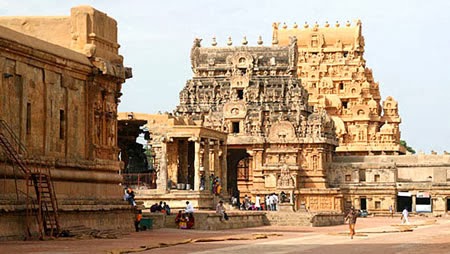
The temple of Shiva at Thanjavur, which was completed in 1009, is regarded as a noted masterpiece demonstrating characteristic styles of southern India. The pantheon of Hindu gods provided numerous opportunities for artistic creativity, and the combination of creativity and incoming influences helped to create a number of exquisite creations.

Inscriptions found on Southeast Asian islands show the progress of Chola domination across the ocean. Raja Raja and Rajendra both persecuted a fierce campaign against the Srivijaya Kingdom and ultimately destroyed it. This allowed Chola to take over a monopoly of trade in the region and to gain greater access to Chinese markets and the burgeoning city-states of mainland Southeast Asia.

However, as in the case of the Indian homeland, evidence concerning the actual nature of who governed where and when is unclear. Inscriptions make grandiose claims, which in some cases are not substantiated. The end of the Chola empire is variously given as either in the 12th or 13th century, most often in 1279.

The arrival of Mongol Yuan troops in Southeast Asia radically changed the balance of power in the region while, in India, the rise of Hosalya and Pandya polities ultimately eroded the economic basis of the Chola empire and it was subsumed by successors.

Delhi Sultanate

Delhi Sultanate under various dynasties

The influx of Muslim Turks into the Indian subcontinent began in the 11th and 12th centuries. It was spearheaded by a series of military dynasties, including the Ghaznavids, who ruled parts of Persia and invaded northern India, and the Ghurids, who started off as allies of the great Ghazanavid ruler Mahmud of Ghazni, but broke away after his death in 1030 and conquered much of northern India for themselves.

Aibak, a Turk born in Central Asia and taken to Nishapur as a slave of the Ghurid ruling house, served as a Ghurid administrator from 1192 until 1206, when he was freed and named sultan, or ruler, of a new dynasty based in the city of Delhi by his former masters.

While in the service of the Ghurids, he led a series of military campaigns in India, expanding the empire’s territory significantly and subjugating most of the land between the Indus and Ganges Rivers. Aibak’s reign, during which he spent the majority of his time trying to establish political institutions and geographic boundaries, was relatively short and he died in 1210.


Aibak was succeeded by his son, Aram in Lahore, who had little experience in politics and was overthrown and killed in 1211 by Aibak’s son-in-law, Shams ud-Din Iltutmish, who was favored by the army. Immediately upon assuming control of the sultanate, Iltutmish was faced with military challenges from both the neighboring Ghaznavids and the Muslim state in Sind. In a series of wars against them, Iltutmish reasserted his authority and by 1228 had conquered all of Sind.

According to the Muslim historian Ibn Batuta, Iltutmish was the first ruler of Delhi to reign independently of a larger state and in 1228–29 he received emissaries from the Abbasid Caliphate in Baghdad, the premier Muslim state, at least in name, of this period. Under his leadership, the Delhi Sultanate escaped destruction when the Mongol leader Genghis Khan swept westward through Central Asia.

Iltutmish died in 1236 and was succeeded by a series of weak rulers and the Turkish nobility, nicknamed “the Forty,” who controlled the sultanate’s most important provinces. His son Rukn ad-Din Firuz Shah ruled for seven months before being deposed by his sister, Raziyya, whom their father had initially chosen as the new ruler before his death.

Qutb Minar or Kutb Minar (both: kŭ`təb mē`när), minaret near New Delhi, India. One of the earliest Muslim monuments in India, it was erected (c.1230) by Iltutmish of the Delhi Sultanate Delhi Sultanate, refers to the various Muslim dynasties that ruled in India (1210–1526). It was founded after Muhammad of Ghor defeated Prithvi Raj and captured Delhi in 1192.
Qutb Minar, minaret near New Delhi, India.
It was erected (c.1230) by Iltutmish of the Delhi Sultanate

The sultana had been trained in political administration during periods when her father went off on military campaigns and left her in charge of maintaining the government. Raziyya encountered stiff opposition from many of the sultanate’s officials, and she was overthrown in 1240. Iltutmish’s youngest son, Mu‘izz ad-Din Bahram Shah, ascended the throne and worked to strengthen the northern frontier against the Mongols.

He stopped an attempt by his sister to regain control of the sultanate. However he too was overthrown in 1242 by senior government officials and was subsequently executed. The new sultan, Nasir ud-Din Mahmud, was a recluse and granted political authority to Ghiyath ad-Din Balban, his slave and future son-in-law.

Under Balban, the sultanate continued to ward off Mongol raiding parties and stopped revolts by rebellious Hindu rulers. When Sultan Nasir ud-Din, who had no children, died in 1265, Balban formally assumed the title of sultan, ruling for two decades until 1286.

The sultanate’s army was reorganized and improved under Balban and he ordered the construction of forts in and around Lahore in order to present a defensive line against the Mongol leader Hulagu Khan, who had invaded Iran in 1256 and was actively campaigning throughout Persia and the Arab Middle East during the second half of the 1250s. Between 1280 and 1283 one of the sultanate’s governors, Tughril, rebelled against Balban and the sultan led a military campaign against him, which resulted in the governor’s death during a raid by Balban’s forces on his camp.

The early period of the Delhi Sultanate came to an end in 1290 when Balban’s son, Bughra Khan, refused the throne and Malik Firuz Khalji overthrew Balban’s teenage grandson, Kaiqubad. The Turk Khaljids adopted Afghan customs after occupying Afghanistan and oversaw the rapid expansion of the sultanate, conquering Gujarat and Deccan during their reign from 1290 to 1320.

Sultan Ala ud-Din Khalji (r. 1296–1316) enlarged the army and introduced economic and tax reforms. Upon his death, he was succeeded by a series of inept rulers and internal strife led to the downfall of the Khaljids soon after his death.

The Tughlaq dynasty (1320–1412) rose to power and Sultan Muhammad Ibn Tughlaq (r. 1325–51) founded a second capital city at Deogir in order to control an increasingly vast empire. By moving the active capital south, the sultan could oversee the continued military campaigns in Deccan.

Under Muhammad a system of currency was introduced and taxes were increased to meet the sultan’s military expenditures. Much of the later years of his reign was spent dealing with revolts, trying to head off dissension from the clergy (ulama), and handling external threats, which resulted in the reduction of the empire’s territory.

Sultan Firuz Shah Tughlaq (r. 1351–88) was not as militarily successful as his predecessors, but was perhaps the dynasty’s greatest administrator-ruler. He reintroduced the jagir system, which paid army officers in grants of land rather than cash salaries, and introduced a justice system that rigorously enforced the laws.

Firuz Shah also focused on improving social services and opened up a large hospital, Dar us-Shafa, in Delhi and founded bureaus of employment and marriage. During his reign the state financed the expansion of existing cities, the construction of new ones, and the building of mosques, bathhouses, and canals. The religious policy of the sultanate under Firuz Shah was strictly Sunni and non-Muslims were required to pay the jizya tax and Shi’ite Muslims were placed under restrictions.

Upon Firuz Shah’s death in 1388, a succession crisis led to the downfall of the Tughlaq dynasty. In the midst of this crisis, Timurlane (Tamerlane) the ruler of Samarkand who was forging an empire in Central Asia, invaded India and captured and sacked Delhi in 1398.

Famine and the spread of disease followed the Timurid invasion, with thousands of slaves and much of the city’s wealth being taken back to Central Asia. The Tughlaq dynasty was no longer a single entity and several competing states were left to squabble over Muslim India. With the fall of the Tughlaqs, the Turkish sultanate of Delhi began its steady decline.

Despite periods of revival under the Sayyid dynasty (1414–1451) and the Lodi dynasty (1451–1526), the centralized sultanate no longer existed and both dynasties were faced with opposition from India’s Hindu population and rival Indian Muslim states. The sultanate was formally ended in 1526 when Zahir ud-Din Muhammad Babur, a Chaghatai Turk who ruled in Kabul, ushered in the period of the great Mughal Empire.

Harsha Vardhana - Indian King

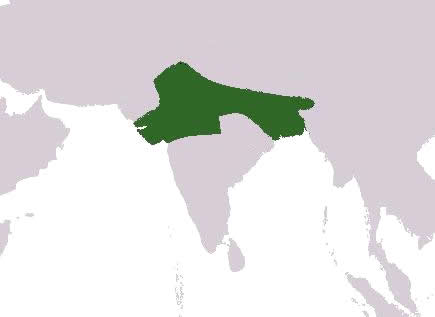
Harsha kingdom map
Harsha kingdom map

Harsha Vardhana was a king of northern India who reunited some of the small city-states that had become independent after the fall of the Gupta dynasty and who used his position to reinvigorate the practice of Buddhism throughout his territory.

Harsha Vardhana was a son of Prabhakaravardhana, the king of Thanesar in the eastern Punjab, and was not fi rst in the line of succession. At the age of 16 his elder brother Rajyavardhana was assassinated on the orders of the king of Gauda, Sasanka, and, inspired by the bodhisattva of Avalokitesvara, he assumed the position of regent and eventually of king.

He spent a number of years fighting against Sasanka and although he was not fully successful in defeating Gauda he was able to expand his territories across five countries bordering his base in what is now Uttar Pradesh. The identity of the five countries may have equated to Sind, Magadha, Kashmir, Valabhi, and Gujarat. This would represent a considerable expanse of territory, and the labor and potential for taxation that it yielded had enormous potential for development.


Harsha Vardhana’s rule is often identified as the time at which the ancient Indian world gave way to the medieval world, in which a system of centralized comparatively small kingdoms gave way to larger, decentralized empires composed of multiple centers with diverse ethnicities and religious and cultural practices.

Harsha Vardhana’s attempts to improve his state included the establishment of diplomatic relations with China and the creation of numerous Buddhist institutions. Notable among these were the monastic center or university at Nalanda, to which Harsha Vardhana made some sort of contribution. The Chinese pilgrim Hsuan-Tsang visited and studied at Nalanda during his journey to India.

Harsha Vardhana - Indian King
Establishments aimed at helping the sick, the poor, and those traveling across his territory were created. Harsha also convened national meetings at the confluence of the rivers Yamuna and Ganges at which the fruits of his rule could be distributed among the people. After his death, Harsha Vardhana’s territory was fragmented and parts of it came under control of the Guptas. The golden age that is considered to be his rule soon came to an end.

Harsha Vardhana is one of the best known early Indian kings, largely because accounts of his life and times have been preserved. These include the chronicler Bana and the Chinese pilgrim Hsuan-Tsang. The king acted as a patron of the arts and fostered an environment in which literature could flourish. He himself is believed to have written three plays in Sanskrit that expound Buddhist beliefs.

Despite all that is known about him, interpretation of Harsha Vardhana’s life and times remains controversial. Bana’s description contains convincing personal details of his character and life but is also composed in a very flowery style suitable for the depiction of the kings and great people of the time, with numerous encomia and exaggerations.

Hindu Epic Literature

Hindu Epic Literature

The most famous Hindu epic literature arose in India during the Vedic period (c. 1000–c. 500 b.c.e), which helped define the essentials of Indian belief and culture. While Hinduism is not the sole religion in the region, these texts set forth many of the ideas and practices held sacred by many people throughout the world. Hindu epic literature is still very much treasured in modern times.

It was during the Vedic period that four of the most treasured sources of Hindu spiritualism arose. In the ancient language of Sanskrit, veda means truth or knowledge. The Vedic library, which lends its name to this era, contains hundreds of texts.

Four of the main texts of Hindu epic literature are the Upanishads, the Mahabharata, the Ramayana, and Puranas. While the Upanishads are in fact religious texts, when combined with the other two, the foundations of Hindu beliefs are firmly expressed.


The Upanishads was written between approximately 600 to 300 b.c.e. The word Upanishads means sitting down near, or sitting reverently at the feet of, and contain over 300 pieces. These texts defined the core of Hindu beliefs, while not being philosophical texts themselves.

The Upanishads are the cornerstone of Hindu spirituality, exploring the interaction of humanity with the universe. The overall concepts involved in the Upanishads consider how people can discern what is truth, knowledge, and inner peace. The many sections of the texts address the attainment of wisdom, consciousness, and the operation of the universe.

In ideas that would especially being addressed in future texts, attaining a true, perfect self was paramount. In the idea of reincarnation, what actions a person performs in his current life will determine what happens in his future existence.

The idea of the self, and attaining sense of the self, is especially important in these scriptures. Performing selfless acts for the benefits of others is what helps one to achieve knowledge of the self. Good and evil acts are addressed, as are examples of proper and improper behavior.

The Mahabharata and the Ramayana are considered to be the two greatest epics in Hindu literature, carrying on the ideas first expressed in the Upanishads. The Mahabharata is an epic poem with over 90,000 verses, close to 2 million words. It is more than 10 times the length of the Christian Bible.

Considering the length of the epic, the amount of time spent in composing it is under scrutiny. The composition has often been subscribed to Maha Rishi Veda Vyasa, but the time span that many believed was used in creating this piece ranges from 6 b.c.e. to the first century c.e.

The Mahabharata, which can be translated into the Great Book of the Bharatas, is a tale of two warring families, both of whom claimed to be descendants of Bharat, believed the founder of the Indo-Aryans. The events described in the Mahabharata most likely took place somewhere around the time of the 12th century b.c.e.

The story both begins and ends on the battlefield, although along the way there are numerous digressions. Many of the ideas and the spirituality in texts such as the Upanishads are related again in the Mahabharata.

One of the important aspects of the Mahabharata is often separated as its own text called the Bhagavad Gita, which translates into the Song of the Lord. The much revered Hindu God Krishna is mentioned prominently in the Mahabharata, while previously left out of other Hindu texts. Krishna is one of the 10 avatars of the Hindu god Vishnu, who often assumes a new form in order to descend to earth in times of troubles.

In the Gita, Krishna is a charioteer to Arjuna, a central character. Krishna previously kept his divinity a secret from Arjuna. The Gita begins on the field of battle when Arjuna is preparing for what will be an incredibly violent and devastating conflict.

There, on the field of battle, Arjuna reflects upon his sadness upon having to fight, and kill, members of his own family, as well as friends in his attempt to defend the claim his elder brother had to the throne of the Kurus. Krishna serves Arjuna as both a charioteer and adviser. As the battle is about to begin, the blind king Dhritarashtra learns of the entire exchange through Sanjaya, who is able to relate what is going on.

In revealing his true self to Arjuna, Krishna enlightens Arjuna about the nature of the self, life and death, and the importance of proper behavior. First and foremost, Krishna describes how the body may die but the self does not. The soul is eternal and will assume a new form in the next lifetime. While people may face bodily death, the soul will never die. Again the concept of how what one does in his current life will affect what happens in the next is related.

Krishna also describes to Arjuna the concept of duty. One has a responsibility to action, but not to enjoy the fruits of those actions, similar to the idea that Jesus later related in Christianity, that is, one does good not for reward but because of how it benefits others.

Krishna also relates to Arjuna the importance of choosing the right path, being self-controlled, and having the desire to serve others. Those who can detach themselves from the desires of the world will attain the perfection of the self.

When Krishna reveals his divinity to Arjuna, he also instills the concept of devotion and love. Those who devote themselves to him, and seek true reality, will achieve the best state possible. Krishna especially tells Arjuna the power and importance of meditation, which will help one both renounce the results of actions as well as attain immediate peace. One should never waver in the desire to achieve spiritual perfection.

Krishna is still, to this day, one of the most popular of the Hindu gods. One of the misunderstandings of Hinduism is that of the number of gods. Quite often, it is simply one god merely manifested in different forms. There are some who argue that Krishna and Jesus Christ are one and the same. Many of the messages presented in the Gita are identical to those in the New Testament, such as devotion, and doing good for its own sake and not for any reward.

Alongside the Gita, Mahabharata, and Upanishads is the epic tale the Ramayana which translates often into, The Travels of Rama, or The Story of Rama. Written in Sanskrit, the Ramayana is believed to be work by the poet Valmiki, who produced the tale around 300 b.c.e. Over the following centuries, even into contemporary times, the story of Rama has been told and retold in various forms and languages. As in the Gita, and like Krishna, Rama is an avatar of the god Vishnu.

The principal characters in the Ramayana are Rama; his wife, Sita; his brother, Lasksmana; Hunaman the monkey king; and the demon Ravana. Ravana had received a boon from Brahma, the principal Hindu god, that he could not be killed by any other divinity or demon, in return for his penance of 10,000 years.

Immortality could not be granted to Ravana, and since he did not believe a man could kill him, this was left off of his requested boon. Ravana, with 10 heads and 20 arms, becomes a feared demon, the king of Lanka, and begins to lay waste to the earth. Vishnu again returns to earth in the form of a man, Rama, in order to kill the demon.

When Rama is born and grows into a man he is immensely popular both within his household and within the kingdom of his father, Dasaratha. Rama is to be the next king. Rama is wed to the beautiful Sita, who herself is a reincarnation of Laxmi, the wife of Vishnu.

Dasaratha is tricked by one of his wives to exile Rama to the forest for 14 years. As is revealed, Dasaratha once accidentally killed a man and was told that he himself would be separated from his own son. Rama accepts the exile and leaves along with Sita and Laksmana, who refuses to abandon his brother.

Ravana sees Sita and immediately falls in love. Sita, however, is faithful. In using trickery of his own, Ravana kidnaps Sita and takes her to Lanka. Despite being held captive, Sita never wavers in her love and devotion for Rama. The rest of the story is how Rama, Laksmana, and eventually Hunaman track down Sita and rescue her. There are numerous epic battles along the way, and eventually Rama slays the demon Ravana.

Although they are reunited, Rama banishes Sita to the very forest where they were once exiled together, where she maintains her innocence and devotion to Rama and gives birth to twins. At the end of the tale the two are reunited as they shed their mortal bodies and return to their celestial world.

The Ramayana still plays an important part in contemporary religious beliefs. This is a tale of love, devotion, and the battle between evil and good, as well as accepting the consequences of one’s actions. Devotion to Rama remains as strong as ever for many, as are the moral lessons embodied in the tale. In some places the Ramlila, The Play of Rama, is an important annual event.

In terms of devotion to specific gods, Puranas takes the concepts and characters explored in previous texts and expands upon them. Puranas is believed to have been composed between 300 and 1200 c.e. When compared to the other texts, the historical content in these writings may not be as accurate or factual historically, but many of the concepts remain the same, especially the epic battles between good and evil. Not just gods are described, but also kings and sages. Some gods may have from one to 12 different pieces dedicated to them.

Many parts of Hindu epic literature continue to be performed throughout the world. The Mahabharata and Ramayana remain as popular as ever. New translations of these works continue to be produced, although in the case of pieces such as the Ramayana, finding a definitive text from which to work is often a difficult chore. These works continued to be enjoyed, and revered, by people everywhere. These writings help spread, and preserve, Hindu beliefs throughout the centuries.

In fact many believe that it was not so much the Upanishads as it was the Mahabharata and Ramayana that promoted Hindu spiritual beliefs and kept them alive for so long, even though the historical accuracy or factuality is often in question, something that is part of any religion’s background. Regardless of these issues, Hinduism continues to be a major religious presence with millions of followers worldwide.

Sultan Muhammad of Ghur

Sultan Muhammad of Ghur

The victory of Muhammad of Ghur over the Rajput king, Prithviraj Chauhan III (r. 1178–92), was a turning point in the history of South Asia. Islam began to pervade the northern portion of the Indian subcontinent, in present-day India, Bangladesh, and Pakistan.

It was Muhammad of Ghur who prepared the groundwork of the establishment of political power. Muizuddin Muhammad of Ghur, also known as Shahbuddin, came from the Ghur region located in modern Afghanistan. In the rivalry between the house of the Ghaznavids and Ghurids, the latter under the leadership of Alauddin Husain (r. 1149–61), emerged victorious.

Muhammad’s early career began with the conquest of Ghazni in 1173. He was ambitious and bent upon a career of territorial aggrandizement. Muhammad could not expand toward the west because of the presence of the powerful Khwarizm dynasty of Persia.


He found the Indian subcontinent ruled by regional kingdoms, with no unity among themselves to check external aggression. Prevailing social tensions, apathetic attitude of the common people, and advanced military technology facilitated his conquest.

In 1175 Multan fell into the hands of Muhammad, and afterward he occupied Uch and the lower Sind. Three years afterward he faced defeat at the hands of the Chalukyas of Gujrat. Bhimdev II defeated Muhammad near Mount Abu. Muhammad planned an attack through the Punjab region, where Ghanazvid king Tajuddaula Khursav Malik (r. 1160–86) ruled. By 1179 he was master of Peshawar, Lahore, and Silakot. Most of the areas in present-day Pakistan were under his sway. His territorial border was contiguous with Prithviraj III, the Chauhan ruler of Delhi and Ajmer. At the first Battle of Tarai in 1191, he defeated Muhammad.

The latter was captured and brought before Prithviraj, who released the vanquished as an act of magnanimity. Prithviraj was not friendly with the Gaharwar ruler of Kannauj, Jaychandra (r. 1170–93), and Muhammad exploited it. Jaychandra sided with the Ghur ruler, as he was bitter over Prithviraj’s forced marriage with Princess Sanjukta.

The Rajput control over North India was over after Muhammad defeated Prithviraj in the second Battle of Tarai of 1192. The defeated Rajput ruler was taken as a captive to Ghur and ultimately he was blinded and killed.

The rule from the northwest began, which culminated in establishing the political kingdom of the Delhi Sultanate. Muhammad controlled much of northern India and parts of Gujarat and Gwalior.

Qutubuddin Aibak (r. 1206–10), the general of Muhammad, was put in charge of Delhi and Ajmer. He made Delhi capital and conquered Ranthambhor, Bulandshahr, Aligarh, and Meerut. Muhammad returned to the Indian subcontinent in 1194. He defeated his erstwhile ally Jaychandra in a decisive battle fought on the banks of the Jamuna River near Chandawar.

Within a year Muhammad was master of northern India after occupying Bayana, Varanasi, and Gwalior. He returned to Ghur leaving his generals, who consolidated and further expanded the territory of Muhammad. Even outlying provinces like Bengal, Bihar, and Gujarat felt the onslaught of a new rule.

While Muhammad’s lieutenants were busy on the Indian subcontinent, he returned to settle the affairs of his parent kingdom. His elder brother Ghiyasuddin had died in 1202 and Muhammad became the ruler of Ghur. After three years Alauddin Muhammad (r. 1199–1220), the Khwarizm Saha ruler, defeated him in the Battle of Andhkhud.

Muhammad came to India again in 1205 to suppress the rebellion of the Ghakkar tribe in the Punjab. On his way back home during the next year, Muhammad made a stop at Dhamyak on the banks of the river Jhelum.

He was stabbed and killed while offering evening prayers in the Ghokkar territory. Some authorities believe that the Isma’ili sect were responsible for his death. Qutb ud-Din Aibak took control of Muhammad’s territory in India, declaring independence from the Ghurids.

The Ghurids continued to rule the Ghurid kingdom until 1211, when Alauddin annexed their kingdom. The territorial extent of the Khwarazm dynasty extended from Turkistan in the east to the borders of Iraq in the west. The Mongols conquered part of Ghurid territory in Afghanistan.

Earlier victories of Muhammad bin Qasim (712) and the raids of Mahmud of Ghazni (1000–25) had not resulted in establishment of political power. Major areas of present-day India, Bangladesh, and Pakistan came under the reign of the Delhi Sultanate, who ruled after Muhammad.

Nalanda

Ruin of Nalanda

Nalanda was the most renowned center of Buddhist learning in India in the fourth–12th centuries. A Buddhist monastic center and major university were located at Nalanda, which is in Baragaon, Bihar state, in east central India, about 90 miles southeast of the state capital of Patna.

The village’s association with Buddhism predates the establishment of the university and monastery: Legend has it that the Gautama Buddha visited the Nalanda village several times and delivered sermons there, and that one of his principal disciples, Sariputta, was born near Nalanda village.

Nalanda University was established in the fifth century and grew, with more than 10,000 students from many different countries attending the university at the time of its destruction in the 12th century.


The Chinese pilgrim and scholar Xuanzang (Hsuan-tsang) studied at Nalanda University in the seventh century and left detailed accounts of it in his writings. Besides Theraveda and Mahayana Buddhism, instruction was offered in medicine, astronomy, and art.

Nalanda, along with many other Buddhist monasteries and temples, was sacked by Turko-Afghan Muslim invaders led by Bakhtiyar Khalji in the 12th century. The monastery and university were destroyed and many of the monks either were killed or fled to other parts of Asia, in particular Nepal and Tibet.

This invasion marked the virtual end of Buddhist culture in India until the 1950s, although Buddhism continued to flourish in other Asian countries such as Tibet, China, Japan, and Southeast Asia. In fact Buddhism in those countries was partly nourished by monks from Nalanda who sought refuge.

Another view of Nalanda's ruins

Many historians also believe that destruction of Buddhist centers of higher learning at this time caused the abrupt demise of ancient Indian scientific thought in areas such as mathematics and medicine.

The ruins of Nalanda are frequently studied by scholars today because of their central importance in the history of Buddhist history, culture, and art. Currently excavated ruins cover an area of about 150,000 square miles, and it is estimated that this constitutes only 10 percent of the total area that was developed in the 12th century, as described by Xuanzang.

Nalanda is also the name of the administrative district where the ruins are located. The name Nalanda means “the place that confers the lotus” and survives as the name of a Buddhist monastery near Lavaur, France, and two colleges, one in Toronto, and one in Sri Lanka.

Pallava Kingdom

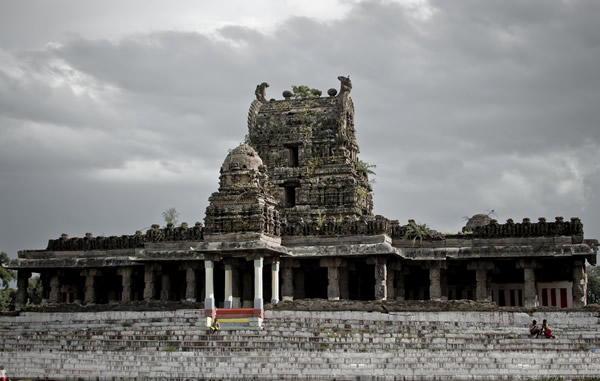
Ruin of Pallava kingdom

Pallava was a state based in Southeast India that flourished between approximately the fourth and the ninth centuries c.e. The Pallava dynasty was Hindu but also supported Buddhism and Brahmanism and was known as a patron of the arts. Under its rule, trade grew with Sri Lanka and with Southeast Asia and the state appears, so far as can be determined, to have been quite prosperous.

It established its capital at Kanchi, close to modern Chennai (previously known as Madras). Tamil influences and cultural institutions grew in importance throughout the course of the Pallava dynasty and continued with its Chola successors.

Various theories have been put forward for both the origin and the demise of the Pallava state. The Pallava people may have been a part of the Parthians, the Dravidians, the Cholas, or several other distinct ethnic groups.


It is most likely that the majority of the people were a mixture of different ethnic groups interacting together within a common territory. Migration was a notable feature of the ancient world and even if social mobility was rendered very difficult by the caste system, geographical mobility was often possible on either an individual or a group basis.

The first named Pallava ruler was King Visnugopa, who appears in local records in the common Prakrit version of Sanskrit. Other kings and rulers appear in subsequent records but few meaningful details are available beyond their names. The lives of ordinary people can only be reconstructed from archaeological excavation.

Pallava Map

Pallava rulers appear to have expanded their territories in the early centuries of their existence, but it is possible that this expansion was the discovery of other peoples involved in similar cultural practices and not the result of conquest at all. However, territorial expansion ended and subsequent Pallava rulers were persistently harried by the Chola feudatory allies of the Calukya dynasty to the west.

Chola rulers gradually supplanted Pallava influence throughout its territory and gradually brought its rule to an end. It is difficult to determine whether this change of rulership made any real difference to the lives of the mass of the common people.


The sculptures and inscriptions of the Pallava state are notable in the development of the Indian artistic tradition. One of the centerpieces of this architecture may be found at the Shore Temple located at Mahabalipuram.

This combines Dravidian styles with other influences and was formerly a port. Ports are notable for the ways in which cultural institutions of various ethnicities interact and interrelate, sometimes creating entirely new combinations.