Showing posts with label africa. Show all posts

Averroës

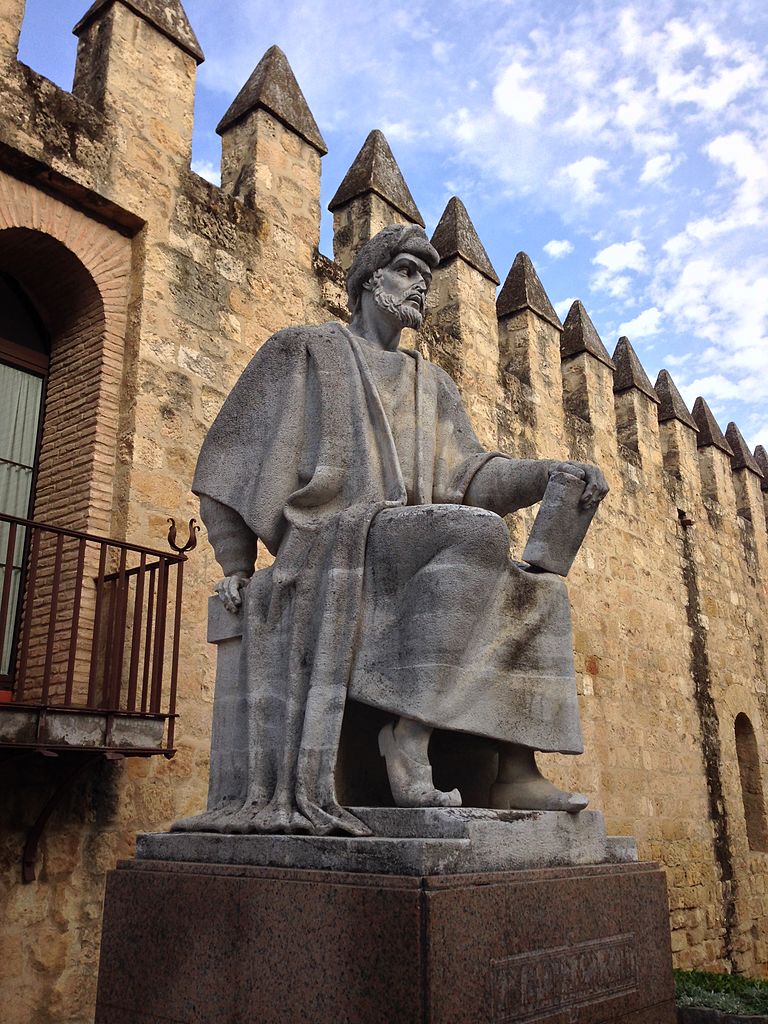
Averroës statue in Cordoba, Spain

Abu Al-Walid Muhammad Ibn Ahmad Ibn Rushd, Ibn Rushd for short, or Averroës, as he is known to the West, was born in Córdoba (Qurtuba), Spain, in 1126 to a family of distinguished Andalusian scholar-jurists. Ibn Rushd was to become a famous philosopher, theologian, physician, and royal consultant. He was a scholar of the natural sciences, namely biology, astronomy, medicine, physics, and the Qur’anic sciences.

His grandfather, after whom he was named, was a renowned chief justice (qadi) in Córdoba and an authority on Malikite jurisprudence, having written two famous books on the subject. At the same time, he was the imam of the Great Mosque of Córdoba. Ibn Rushd’s father was also a judge. Having grown up in a family of scholars, Ibn Rushd received an excellent education in Córdoba in linguistics, Islamic jurisprudence, and theology.

He became very knowledgeable in these subjects, evident through his many writings. He was especially competent in the subject of khilaf, which dealt with controversies in legal sciences. Ibn Rushd had profound knowledge of Aristotelian philosophy, possibly introduced to the subject by one of his teachers or one of the leading scholars in Córdoba.


He was educated in medicine and accomplished a major work known as the Al-Kulliyat fi‘l tibb translated as General Medicine in 1169. Ibn Rushd’s writings were so widely celebrated at one time that it was claimed that medieval Islamic philosophy was an earlier version of the European Enlightenment.

In 1153 Ibn Rushd moved to Marrakech, where he met the Almohad ruler Abu Ya’qub Yusuf, who was very impressed with the young Ibn Rushd’s intellect and deep knowledge of philosophy. It is interesting to note that Ibn Rushd was initially reluctant to reveal the extent of his knowledge to the prince because at the time strict Muslim leaders frowned on philosophy, which was considered anti-Islamic.

Ibn Rushd had to fight against this prevalent belief by asserting that philosophy could be compatible with religion, if both were properly understood. He had nothing to fear with regards to the Almohad prince, who admired his wide knowledge.


In fact, the ruler consulted Ibn Rushd on philosophical matters from then on and became his patron. It was also because of Abu Ya’qub’s prompting that Ibn Rushd summarized the works of Aristotle in a clear manner. During this time he also provided detailed commentaries of his Aristotelian philosophy, such that he is popularly known as the Commentator of Aristotle.

In Marrakech, Ibn Rushd remained active in other areas beside writing and philosophy. He also made astronomical observations. In 1182 he was appointed chief physician in Marrakech. He then became the chief justice in Córdoba. In 1195 Ibn Rushd fell out of favor with the new Almohad prince during the latter years of his reign. His works were considered contrary to religion, and the Caliph passed edicts forbidding their study. He was banished to Lucena near Córdoba but later returned to Marrakech. He died soon after in December 1198.

Al-Azhar

Al-Azhar
Al-Azhar

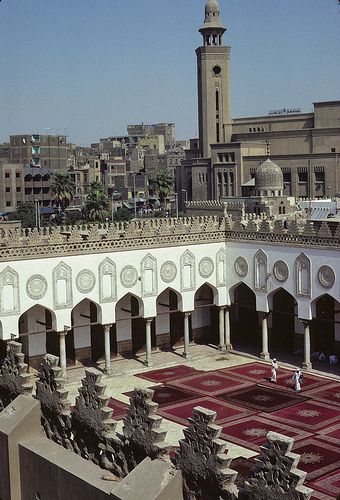
The Fatimids established al-Azhar, one of the oldest universities in the world, in Cairo in 970. Built around a large mosque with an open courtyard surrounded by columned walkways where classes were taught, al-Azhar quickly became one of the premier educational centers in the entire Islamic world, attracting students from Asia, Africa, and, in subsequent centuries, the Western Hemisphere.

Originally, the university focused on the tenets of the Isma’ili sect of Islam followed by the Fatimid rulers, but over the following centuries the university became a center for orthodox Sunni belief. By the 1600s the Shaykh al-Azhar, leader of al-Azhar, was chosen from among the shaykhs of the university.

A peek inside Al-Azhar Mosque and University
A peek inside Al-Azhar Mosque
and University nowdays
Generations of legal scholars and judges were educated in theology and Islamic law at al-Azhar. In the 15th century c.e., the Mamluk sultan Qaitbey financed the construction of an inner gate and elaborate minaret overlooking the courtyard.

Following sultans added further buildings and ornamentation to the sprawling complex, including living quarters for students, libraries, and the mosque. After the 1952 c.e. revolution in Egypt, Gamal Nasser modernized and instituted major reforms including the creation of a College of Islamic Women and the addition of colleges in medicine and engineering.

Benin

kingdom of Benin
kingdom of Benin

Extending at its peak from the Niger River in the east to the port of Lagos on the western coast, Benin was a dynastic kingdom in what is now southern Nigeria, in the West African forested region. Present-day Benin City (called Ibinu; it was founded in 1180) was once where the kingdom was centered, and the modern Benin kings trace their lineage to its original dynasties.

Early southern Nigeria had been inhabited since 9000 b.c.e., with the Iron Age beginning around the second century b.c.e. Ironworking appears to have displaced Neolithic techniques without an intermediate bronze period, suggesting that iron smelting was probably introduced by outsiders, perhaps the Berbers of early antiquity.

There is little information about the first millennium c.e. in the area, other than the prosperity and subsequent disappearance from the historical record of the Nok people in what is now northeastern Nigeria. The founders of the Benin kingdom were the Bini (an ethnic subgroup of the Edo language group to which many modern inhabitants belong), but they or their ruling dynasties had a significant relationship to the Yoruba people of Ife.


According to one version of the founding of Benin, people called for the Ife prince Oranmiyan to come to their aid and displace the tyrannical rule of the Ogisos dynasty, which founded the city of Ibinu and had ruled the area for the previous few centuries or more (36 Ogiso dynastic rulers are known). Another version omits the plea for help, painting Oranmiyan as a simple invader.

At the time of the Ife incursion—whether it was invited or not—most of the power in Benin rested in the hands of the council of chiefs, the uzama. Beginning with Oranmiyan’s son Eweka (1180–1246), the uzama was presided over by the oba, a war leader who over time became a more powerful monarch with religious significance. As the oba became paramount, the kingdom became an empire.

Beginning with Ewuare (1440–73), the title of oba became a hereditary one, while Ibinu was rebuilt with military fortifications in order to protect the Benin center of power, as Ewuare’s forces expanded to conquer the lands surrounding them. The port of Lagos was established around this time, and diplomatic and trade relations began with Europe, beginning with the Portuguese. Early trade was primarily in ivory, pepper, and palm oil, before the slave trade became prominent.

The kingdom of Benin is not related to the modern day Republic of Benin, except insofar as that nation took its name in 1975 from the Bight of Benin, the bay along which both entities are or were situated.

Bantu

Bantu village
Bantu village

The Bantu people of the African continent include some 400 different ethnic groups that cover most of sub-Saharan Africa and speak a tongue from a common language group. The first time the word Bantu (meaning “people” in many Bantu languages) was used in its current sense was by Dr. Wilhelm Bleek in his book A Comparative Grammar of South African Languages (1862).

Up to that point, few linguists had tried to draw similarities between the different languages in Africa on such a wide scale. Much of what is known about Africa before the 11th century has been surmised by linguistic analysis, which, along with recent archaeology, has shown a clear picture of society and life in prehistoric Africa.

Before the spread of the Bantu much of central and southern Africa is believed to have been populated by the Khoisan-speaking people who still exist around the Kalahari Desert in modern-day Namibia and Botswana, and also in some isolated pockets of modern-day Tanzania.


There were (and still are) pygmies in Central Africa, and the northern and northeastern parts of Africa were dominated by people who spoke Afro-Asiatic languages, who have retained their identity from the Bantu. Gradually from the first millennium b.c.e. to the first millennium c.e., the Bantu spread out throughout much of the African continent.

The origins of the Bantu were first raised by Joseph H. Greenberg (1915–2001) in 1963, based on linguistic theories. Using dictionaries and work lists of these languages, he was able to isolate the 500 different distinct languages of the Bantu subgroup.

Many showed regional and geographical variations—including the names of crops and/or animals not found elsewhere in Africa— and Greenberg’s thesis was that there was an original language, which he called Proto-Bantu, from which the others were derived. As the languages spoken in the southeastern part of Nigeria, and along the border with Cameroon, contain more words similar to those used elsewhere in the continent, and that the Bantu languages spoken further away have more variations, he concluded that the Bantu had their origins along the modern-day Nigeria-Cameroon border.

Bantu
Bantu
However, the theories of Greenberg were quickly challenged by Malcolm Guthrie, whose research pointed to the Bantu language having originated in Zambia and the southern part of modernday Democratic Republic of the Congo.

If the origins of the Bantu are disputed, the reason for the migration of the Bantu throughout Africa is generally accepted. George P. Murdock (1897–1985), an American scholar, argued that it was influenced by the availability of crops. Murdock felt that it was the Bantu acquisition of crops from the East Indies—through trade with Madagascar—such as banana, taro, and yam, which helped a spread westwards from the first millennium b.c.e. onwards.

It was the cultivation of these crops, Murdock felt, that enabled the Bantu to start settling in the previously largely impenetrable tropical rain forest of central Africa, and from there southwards, establishing the civilization of Great Zimbabwe in the 10th century c.e. Others saw the migratory route, following the ideas of Greenberg, lay in the move east across the southern area of what is now the Sahara, into southern Sudan, and from there south past the Great Lakes.

If the Bantu originated in the area of southeastern Nigeria and the borders with Cameroon, they would have gradually spread eastwards to the Great Lakes, where, on Lake Victoria, the settlement of Katuruka has been dated to the fifth century b.c.e. A separate group also spread southwards through Gabon and the Congo and to modern-day Angola—the settlement at the Funa River, in modern-day Democratic Republic of the Congo, dating from 270 b.c.e.


That group gradually spread south into modern-day Angola, while the eastern migration split south of Lake Victoria, with some heading for the coast and establishing a settlement near Kwale, near Mombasa. Another group moved south, along the eastern shores of Lake Nyassa, forming the civilization of Great Zimbabwe by the 10th century c.e., with a third group heading inland, into modern-day Zambia.

The result of this migration was that, by about 1000 c.e., the Bantu dominated central and southern Africa, except for much of modern-day South Africa, Namibia, and Botswana. The survival of the Khoisan people in these places is pointed to as further evidence of this migration.

Knowledge about the divisions within Bantu tribes is known from archaeological evidence. The existence of tribal chiefs can be assumed from early settlements where wealth inequality was seen through the existence of larger and smaller residences.

Similarly the objects that were found, made from precious metals, and pots of intricate design, were too few to sustain an entire village with the view adopted by archaeologists that poorer members of Bantu tribes would have had wooden objects that have not survived. However, it is also clear that some tribes, such as the Kikuyu in modern-day Kenya, did not have hereditary chiefs but, rather, a person who assumed the role of an elder and was responsible for tax collection and family counseling.

Unlike the Khoisan and pygmies, the Bantu fought in conflicts and maintained armies. Many of the tribal chiefs maintained large numbers of wives and hence had many children who were often assimilated with commoners. The nature of the rule of the tribes has been surmised through linguistic evidence of the Bantu kinship terminology.

Although some groups, such as the Masai, use the standard patrilineal system, many others follow matrilineal traditions. In addition the Mayombe people of modern-day Democratic Republic of the Congo believe that their “blood,” and hence their descent, goes through a woman, with villagers tracing the origin of their village to an ancestress.

This is also believed to be the system used by the Bantu in the Kongo (modern-day Angola and the Democratic Republic of the Congo). As a result the chief in wartime was often the husband of the senior woman, with the government operating through the female line.

Few archaeological remains have been found of early Bantu civilization, when compared to Europe of the same period. This may have been because of the Bantu use of wood for their buildings. Some 85 million Bantu people now exist in Africa, with most divisions of the Bantu being largely linguistic.

Although the term has been used for 150 years, because of its pejorative use by the apartheid government in South Africa—whereby blacks were designated as “Bantu”—it is not used much today except as a cultural term to describe the great migration that took place in ancient and medieval Africa.
Berbers

Tariq ibn al-Ziyad, a berber commander

The Berbers are the earliest known inhabitants of northwestern Africa’s Mediterranean coast, plains, and mountain ranges. Living as nomadic herders or farmers in Morocco’s Atlas and Rif mountain ranges, Algeria, the Sahara Desert, east into Libya and Egypt, the exact ethnic and cultural origins of the Berbers is unknown, though their languages, called Tamazight, belongs to a family of Afro-Asiatic languages. In ancient times, Berber religions were polytheistic.

Although ancient Berber history is sketchy because of the fact that there was no written form of their langu ages, references to them do exist in chronicles from ancient Egypt, Greece, and Rome. Beginning around 600 b.c.e. some Berber regions of North Africa came under foreign occupation, first by the mighty city-state of Carthage, and then by the Roman republic. Under Carthaginian and Roman rule, Berber merchants linked the Mediterranean coastal settlements with West Africa, trading in slaves, gold, and ivory.

Under the Roman Empire, some Berbers residing on the Mediterranean coast became imperial citizens, though Berber communities living in the North African interior mountain ranges and other rural areas remained largely independent. After the collapse of the Roman Empire in the West, large sections of North Africa’s seacoast remained under the control of the Byzantine Empire of Asia Minor.


After the rise of Islam in the first half of the seventh century c.e. Arab Muslim expansion into North Africa began in earnest, beginning in 642 during the reign of the second al-Rashidun caliph, ‘Umar ibn al-Khattab. The new religion slowly spread among segments of the Berber tribes, replacing Byzantine Christianity, which many Berbers practiced in some form, and Judaism.

Although many Berbers accepted the basic tenets of Islam, their method of practice generally remained unorthodox. This led to a growing level of tension between them and the Arab Umayyad Caliphate of Syria by the middle of the eighth century.

A large number of Berbers joined the fundamentalist movement of the Kharijites, who opposed the Umayyads and preached that any qualified Muslim could lead the community. Berber opposition to the centralized power of the caliphate continued after the collapse of the Umayyads in 750 by the Abbasid Revolution.

The Fatimids, an Isma’ili Shi’i movement that arose in 969, received substantial Berber support in their takeover of Egypt and parts of North Africa from the Abbasid caliphs in Baghdad, Iraq. During the Fatimid dynasty, there is evidence that there was an attempt to instill Arab culture within Berber societies, which had largely retained their own cultural practices and languages.

Berber warriors
Berber warriors

In 711 during the reign of the Umayyad Caliph ‘Abd al-Malik, the first Muslim expeditions to the Iberian Peninsula were launched under the command of a Berber, Tariq ibn al-Ziyad, and other Berber Muslims. A mixed party of Arabs and Berbers under the Umayyad commander Musa ibn Nusayr followed al-Ziyad’s landing the next year and Berber soldiers continued to play a major role in Muslim expansion throughout Iberia and southern France for centuries.

The first major Berber political-military state to emerge was the Almoravid Empire, which was founded in Mauritania and the Sahara around 1050 and practiced a more orthodox form of Sunni Islam. With the founding of their capital city, Marrakesh, in Morocco in 1062, Almoravid expansion continued under the joint rule of Yusuf ibn Tashfin and his cousin, Abu Bakr.

In 1086 Almoravid armies landed in Iberia, where Yusuf defeated Alfonso VI, the Christian king of Castile, which allowed the Berber empire to establish a fundamentalist Sunni Muslim state with control over much of southern Iberia, all of Morocco, and parts of West Africa.


By 1150 another Berber movement, the Almohads, under ‘Abd al-Mu’min overthrew the Almoravids, taking over Morocco and southern Spain while expanding east across North Africa. Like their predecessors, the Almohads founded a fundamentalist and militaristic Sunni Muslim state.

Unlike the Almoravids the Almohad Empire slowly broke apart into smaller states, and the last Almohad caliph, Idris II, ruled only the city of Marrakesh before his murder in 1269. Under the Almoravid and Almohad periods, the majority of the Berber tribes converted to Sunni Islam, following the Maliki School of Islamic jurisprudence.

Although the Berbers continued to hold onto aspects of their culture and continued to speak Berber languages, many also adopted some Arab cultural practices. Berbers continue to live throughout present-day North Africa and form a large segment of the populations in Morocco and Algeria, with some tribes continuing to reside in Mauritania, Tunisia, and Mali.

East African City-states

East African City-states

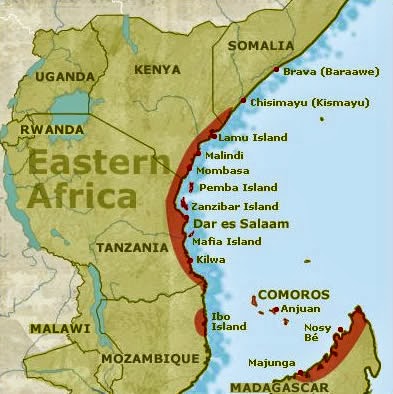
The Bantu migration from the central Sahara, perhaps the defining event in the history of Africa south of the Sahara, brought people to the region of East Africa as the nucleus of the emerging city-states. From the 10th century, Arab traders noticed the importance of such settlements to their trade.

From the onset the city-states were fiercely independent, and no East African empires emerged in the way that Ghana, Mali, and Songhai did in the west. As Richard Hooker wrote in Civilizations in Africa: The Swahili Kingdoms: “The major Swahili city-states were Mogadishu, Barawa, Mombasa (Kenya), Gedi, Pate, Malindi, Zanzibar, Kilwa, and Sofala in the far south.

These city-states were Muslim and cosmopolitan and they were all politically independent of one another; nothing like a Swahili empire or hegemony was formed around any of these city-states. In fact they were more like competitive companies or corporations each vying for the lion’s share of African trade.”


However while the Arabs provided much of the impetus for economic and cultural development, the original settlements were definitely rooted among Africans. Joseph E. Harris writes in Africans and Their History that “the most important pre-Islamic commercial town on the coast seems to have been Rhapta, about which little is known except that it was the center for the export of ivory that Arab merchants controlled. Rhapta was probably located on the northern coast of Tanganyika [now Tanzania].”

The culture of the region became increasingly diverse, as Persians and Indians would join the Bantu Africans and the Arabs in the city-states. When Idi Amin Dada drove the Indians from what is now Uganda during his rule (1971–79), he was ending an Indian presence in his country that had its roots in the first traders from India hundreds of years before.

Kilwa ruins located in Tanzania

While ivory, sandalwood, and gold were important exports, tragically the largest part of the economy was the slave trade. Zanzibar and Mombasa became the eastern terminus points for slaves the Arabs took out of Africa for shipment to Arabia and Yemen.

Kilwa emerged by the 12th century as perhaps the most powerful of the city-states, containing a mosque made from coral. The great Arab traveler Ibn Batuta stopped in Kilwa in 1331. It was ruled, as Harris notes, by the Shirazis, who had originally left the Persian city of Shiraz and intermarried with the Bantu population. Kilwa spread its influence south into the region of Zimbabwe and became a decisive factor in the trade in southern Africa as well.

Symbolic of the wide-ranging trade was the voyage from Malindi to China in 1414. On that trip, the ruler of the city-state of Malindi sent a live giraffe to the Ming emperor of China, Emperor Yongle (Yunglo). It was the early 15th century that saw the great Ming dynasty exploring fleets sailing from China, perhaps even as far as the Americas, under Admiral Zheng He.


Admiral Zheng would ultimately make seven historic expeditions from 1405 to 1433. The Chinese fleets made several stops on the East African coasts, making the Swahili city states part of a vast panoceanic trading economy. Trade was determined by the prevailing winds of the monsoon seasons. From November to March, Arabs, Indians, and Persians would sail south toward the Swahili coast and make their return voyages north between July and September.

The Indian Ocean trade would be monopolized by Arabs until the arrival of the Portuguese in 1498. It would mark the beginning of the end of the prosperous East African city-states. Mocambique, spelled also as Mozambique, would not be free from Portugal’s imperial rule until 1975.