Showing posts with label Mongolia. Show all posts

Chagatai Khanate

Chagatai Khanate
Chagatai Khanate

Genghis Khan (c. 1167–1227) had four sons by his principal wife, Borte. The eldest son, Juji, and second son, Chagatai, were such fierce rivals that Genghis decided to bypass both in favor of his third son, Ogotai Khan as his successor khaghan (Grand Khan), and all of his sons agreed with his choice.

Genghis also assigned territories to each son to govern, although all would acknowledge the leadership of the khaghan and cooperate with him in expanding the Mongol Empire. Juji received land farthest from the paternal homeland—the western territories that would include Russia and eastern Europe; his followers were called the Golden Horde.

Chagatai received west Turkestan, the Tarim Basin, and the western Tian Shan (T’ien Shan) region. Ogotai received Dzungaria and part of Central Asia, while the youngest son, Tului, received the Mongolian homeland. This arrangement was confirmed just before Genghis Khan died in 1227. Two years later the Kuriltai (council of nobles) elected Ogotai the next khaghan.


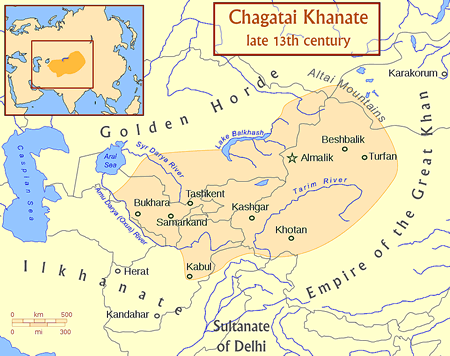
Chagatai’s allotment, which was enlarged later, also included the Ili River valley, Kashgaria, Turfan and Kucha in present-day northwestern China, and Transoxiana, including the towns of Bukhara and Samarkand. These disparate lands became known as the Chagatai Khanate. Except for the oasis towns most of the khanate was steppe land inhabited by various nomads, most of Turkic ethnicity.

Chagatai was a warrior and also a staunch upholder of Mongol traditions. Genghis had appointed him guardian of the Mongolian law code called “Yasa” which he had sternly administered. Chagatai and his successors kept up a seminomadic lifestyle, changing from winter to summer camp as the seasons dictated.

Whereas the Mongol realms under Kubilai Khan and his heirs in China, the Yuan dynasty (1279–1368), and the il-khanate of Hulagu Khan and his successors in Persia and the Middle East had fixed boundaries, rich resources, large sedentary populations, and long established traditions of governance, the Chagatai Khanate had shifting boundaries, tribal populations with weak state institutions, and relatively sparse resources.

Chagatai statue
Chagatai statue

It was hemmed in by other Mongol dominions ruled by branches of Genghis Khan’s descendants in three directions—the Yuan dynasty, the Il-Khanate, and the Golden Horde in Russia. The only direction for expansion was into Afghanistan and India. Beginning in the 1290s Chagatai Khanate forces took control of eastern Afghanistan from which they raided northwestern India.

In 1303 an expedition of 120,000 men besieged Delhi for two months and devastated a wide area. Another force of 40,000 horsemen returned to India in 1304 but was defeated and 9,000 prisoners were trampled to death by elephants. A similar fate befell the men of the last attacking army in 1305–1306.

Not able to expand outward the heirs of Chagatai were constantly embroiled in wars and rivalries of the other three branches of the family, and among themselves. Although the Chagatai Khanate was poor in resources, its central location along the Silk Road allowed it to collect abundant taxes and tolls. Frequent wars and predatory policy toward trade and sedentary people often resulted in the breakdown and ultimately decline in international trade by land routes.


Major differences and incompatibilities divided the eastern and western halves of the khanate. The western part, originally part of the Khwarazm kingdom, was Islamized, urbanized, and more advanced than the eastern region, which was more pastoral, nomadic, and animistic. Lacking a cohesive government, each went its own way.

Chagatai died in 1242 and was succeeded by his grandson Kara Hulagu. Interference by the khaghan and involvement by the Chagatai Khanid rulers in the dynastic struggle of other branches of the family resulted in many upheavals.

Leaders of the Chagatai Khanate became involved when Mongke Khaghan died in 1259 and a succession struggle erupted between his brothers Kubilai and Arik Boke; they sided with the winner Kubilai. Later they supported Kaidu Khan, a grandson of Ogotai, who challenged Kubilai for the throne of the khaghan. The destructive wars continued until Kaidu’s death in 1301.

Although Kubilai won against his rivals, the unity of the Mongol Empire was fractured forever, and even though the Chagatai rulers were not in contention for overall leadership, their central position in the line of communications between the different branches of the family played a significant role in the breakdown of unity of the Mongol Empire.

The frequent civil wars and changes of rulers (there were 30 khan up to 1230) fatally weakened the central authority at the expense of local leaders. As the Chagatai Khanate was disintegrating in 1369, there rose in Samarkand a Mongol-Turkic leader who claimed descent from Genghis Khan.

His name was Timurlane (Tamerlane), meaning Timur the Lame. His military career that ended with his death in 1403 would replicate that of his famous ancestor. In the 14th century Chagatain rulers converted to Islam, the religion of many of the Turkic peoples they ruled. The official language of the khanate was changed from Mongolian to Chagatai Turkic. It continued to be used in the region they ruled until modern times.

Genghis Khan

Genghis Khan
Genghis Khan

Genghis or Chinggis Khan means “universal ruler.” He was born Temuchin, the son of a minor Mongol chief, and overcame early obstacles to conquer the greatest empire of the world to date, which he bequeathed to his sons. Some believe he was a greater military strategist than Alexander the Great, Hannibal, Julius Caesar, and Napoleon Bonaparte.

At the time of his birth the varied people of the steppes (Turkic, Mongol, and others) lived in mutually warring tribes, raiding one another for animals and women and looting nearby sedentary populations. The harsh environment of the steppes where they lived provided little opportunity for agriculture, limiting the peoples to a nomadic lifestyle of herding and hunting.

His father, Yesugei, died of poisoning at the hands of foes when Temuchin was eight years old, en route home after betrothing him to a girl from his mother, H’oelun’s, tribe. H’oelun and her sons were cast out to fend for themselves after Yesugei died; thanks to Temuchin’s cunning and ruthless determination, they survived.


Eventually he married his betrothed, named Borte; received help from his father-in-law in establishing himself with followers and animals; and won allies. Borte was the mother of four sons (Juji Khan, Chagatai Khan, Ogotai Khan, and Tului Khan) and a daughter. Juji was born around the time his mother was rescued from captivity (she had been captured in a raid by Temuchin’s enemy), casting doubt on his paternity. These four sons became Temuchin’s principal heirs.

From Temuchin to Genghis Khan

In complicated wars Temuchin and his allies won against tribes named the Naiman, Merkid, Oyirad, Tartar, Kereyid, and others, becoming master of the Mongolian plateau by 1205. A great council or khuriltai was convened in 1206 to signal the formation of a confederation at Burkan Khaldan, the holy mountain of the Mongols under Temuchin, and to give him the title Genghis Khan.

From this point on all his followers, regardless of tribal affiliation, were called Mongols. In Mongol ideology the elevation of Temuchin to Genghis Khan was blessed by heaven and therefore it was his right to conquer and to bequeath his conquests to his family.

Genghis Khan’s first great achievement was to organize his men into a unified army. He used the decimal system: Each 10-man group had a leader; 10 of these formed into a 100-man unit under a leader, and so on up, each commander being responsible for 10 men under him.

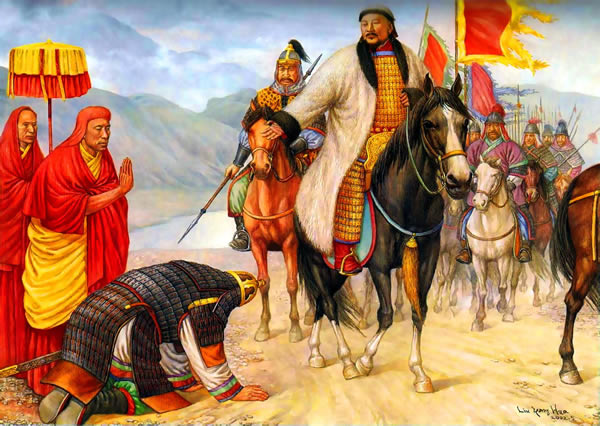
Surrender to Genghis Khan

In time the Mongolian component of his army grew to between 105,000 and 129,000 men. As his empire expanded, subject peoples incorporated into his infantry and cavalry followed the same organizational rules. The Mongolian army did not possess weapons or technology superior to those of its enemies. Its superiority lay in its discipline, mobility, coordination, and maneuverability.

Records were necessary to administer his people, so in 1206 he ordered the creation a script for the Mongol language, and since the man designated for the task was an Uighur, he used the Uighur alphabet for that purpose. Genghis did not learn to read but ordered his sons to learn the written language.

He also promulgated a code of laws and regulations in 1206, called yasa or yasaq, that provided severe punishment, for example, the death penalty applied to murder, major theft, adultery, malicious witchcraft, and other offenses. The severity of the laws resulted in an obedient society, which visitors observed with awe.


Conquest of Xixia, Jin, and Khwarazm

Genghis Khan’s conquests began in 1209 and his first target was the Tangut kingdom to his southwest called Xixia (Hsi Hsia), leading his army personally. After withstanding a siege of their capital city the Xixia accepted peace terms: submission to Genghis Khan and a pledge to support him in future campaigns, and the king’s daughter given to Genghis as wife. After this demonstration of force two sedentary Turkic peoples, Uighurs and Qarluks, came to offer surrender. Both would go far under Mongol rule.

Genghis Khan’s next victim was the Jurchen Jin (Chin) dynasty in north China. He set out against it in 1211 with three of his sons and 50,000 cavalrymen. Although no longer the ferocious fighters of a century ago, the Jin still had a 150,000 strong cavalry of Jurchen soldiers and an infantry of 300,000 to 400,000 Chinese men.

Moreover the Jin Empire had over 40 million people, three million of whom were Jurchen, opposed to the Mongol nation of not much over a million people. In 1211–14 the Mongols devastated much of northern China and looted three of Jin’s five capitals, until Jin submitted to a humiliating peace. Among the captives taken during this campaign was Yelu Chucai (Yeh-lu Ch’u-ts’ai), a learned man of Khitan background who had served in the Jin government.

He would later play an important role in the government of Genghis and his son Ogotai that benefited their Chinese subjects. North China suffered enormously between 1214 and the final fall of Jin in 1234, the result of Mongol raids, uprisings against Jin, and war between Jin and Southern Song (Sung).

Meanwhile commanders under Genghis conquered the state called Khara Khitai, situated to the west of Mongolia, in 1218. This cleared the way for Genghis to march against Khwarazm (or Khwarizm), a Muslim state that included Afghanistan and northern Iran, in 1219.

It involved taking heavily fortified cities such as Harat and Samarkand, for which Mongols used the bloody tactic of using captured prisoners as human shields and moat fillers for their assaulting forces. By 1223 Khwarazm had been subdued and Mongol governors had been installed and garrisons put in place.

While his generals proceeded westward across the Caucasus and into western Eurasia, defeating the Russian princes, Genghis returned to Mongolia in 1225. There he planned the destruction of Xixia, which had earlier promised to supply Genghis with men and supplies in his future campaigns but had refused when he began his war against Khwarazm.

Never forgiving anyone who had betrayed him, Genghis personally led the campaign against Xixia in 1226, destroying cities and the countryside and wrecking the irrigation works that rendered the land cultivable, and besieging its capital. Genghis Khan died in August 1227 because of complications from a fall while hunting in 1225.

According to his wishes the war against Xixia continued until its destruction. His last orders were “The Tangut people are a powerful, good and courageous people, but they are fickle. Slaughter them and take what you need to give to the army.... Take what you want until you can take no more.” Genghis Khan’s body was returned to Mongolia; en route anyone who saw his cortege was killed.

He was buried on Burkhan Khaldun; the exact burial place was kept secret and has not yet been found. Before his death he had divided his conquests among his four sons, who were his principal heirs, and other relatives, and appointed his third son, Ogotai, his successor as Grand Khan, subject to confirmation by the Khurialtai.

The Brutal Military Leader

Genghis Khan was unequaled as a military leader and conquered the largest empire yet seen and with unprecedented cruelty. He was a shrewd strategist who used many means to achieve his goals. He was a good psychologist who used terror and precedence to induce his enemies to surrender because any city that resisted would be razed and its people killed. He was a good organizer who militarized his whole people and saw to the logistical side of campaigns.

He was adept at using spies and probing actions to take the measures of his enemies. He also used diplomacy to prevent his enemies from uniting or forming alliances. Finally he learned new military technologies and adapted to new needs, for example employing Middle Eastern siege engineers to help him take walled cities.

To Christian Europeans he was the anti-Christ and Scourge of God. China had never experienced such brutal conquerors, who threatened to turn the agricultural country into pastureland for their horses. He was especially cruel to cities and city dwellers.

In his sweep across north China in 1212–1213 over 90 cities were left in ruins. The Jin capital in modern Beijing burned for three months. Those persons his forces let live because they had skills became Mongol slaves or were allowed to return to their ruined homes to serve their new lords.

Hulagu Khan

Hulagu Khan with his wife

In 1251 Mongke Khan, a grandson of Genghis Khan, became the grand khan of the Mongols and convened his three brothers and close relatives in a meeting to divide the vast territories that had been conquered. To his brother Kubilai Khan, who would eventually play host to Marco Polo, he gave southern China.

Mongke gave northern Persia to his brother Hulagu, with instructions that the area from Persia to Egypt should be subjugated to Mongol rule. Although Mongke was the supreme leader of the Mongols, he parceled out regional control to others, who would rule as lesser khans or il-khans with their states being known as il-khanates or lesser khanates.

Hulagu set off with an army of at least 100,000 troops in early January 1256, heading first for the mountain fortresses of the Assassins, a feared and radical Ismaili Shi’i Muslim sect that had terrorized other Muslim rulers for over a century.


After besieging the Assassins’ fortresses of Mazanderan, Meimundiz, and Alamut, the Mongols captured the sect’s leader, Rukn ad-Din Kurshah, who was later murdered. By late December the last Assassin fortress of Alamut surrendered to Hulagu. Hulagu then turned his attention to Iraq. He sent a message to the Abbasid caliph al-Mustasim that demanded his acceptance of Mongol supremacy.

Hulagu was enraged when the caliph, the symbolic head of Sunni Islam, refused. Mongol forces headed toward Iraq, receiving support from some of the Abbasid Caliphate’s Shi’i Muslim subjects, who had been angered by disrespect shown toward their community by al-Mustasim. Cities with substantial Shi’i populations, such as Mosul, Najaf, and Karbala, surrendered without a fight and were spared by the Mongols as a result.

By November, segments of Hulagu’s army had begun arriving outside the Abbasid capital city of Baghdad and on January 17, 1258, his entire army had arrived. That same day the small Abbasid army was destroyed in battle outside of the city and the siege of Baghdad commenced. Within two weeks the Mongols had overrun sections of the city’s defenses after battering down the walls with massive siege engines.

On February 10 after Hulagu had refused to negotiate a peaceful handover of the city al-Mustasim came out of Baghdad and surrendered. Ten days later, the caliph was executed by being rolled up in a carpet and trampled to death. The Mongols were superstitious and wary of shedding the blood of a monarch.

Hulagu Khan leading his army

Baghdad, which had stood for six centuries, was sacked, with many of its architectural marvels, including the caliph’s palace and the grand congregational mosque, burned to the ground. The city’s libraries, which were filled with thousands of scholarly manuscripts on subjects ranging from the sciences to literature and philosophy, were also destroyed and their holdings were either burned or tossed into the Tigris River.

The majority of Baghdad’s citizens were massacred, with most sources placing the number of deaths between 90,000 and 250,000. Hulagu spared the city’s Christians and Shi’i Muslims. He reportedly was sympathetic to the former group, possibly because both his mother and his favorite wife were Nestorians, members of an eastern Christian sect considered heretical by the Roman and Byzantine churches.

As news of the fall of Baghdad and the slaughter that followed spread throughout the Middle East, many neighboring Muslim states surrendered without resistance to Hulagu, hoping to avoid the fate of al-Mustasim. The Mongols’ next target was Syria, which was ruled by the waning Ayyubid dynasty, which had been founded in the late 12th century by the Kurdish Iraqi Sultan Saladin (Salah ad Din, Yusuf).


Although the Ayyubid sultan An-Nasir Yusuf had submitted to Mongol authority, Hulagu still entered Syria with his army. He first defeated al-Kamil Muhammad, a young Ayyubid commander, whose city was captured and who was then tortured to death.

On August 11, 1259, Mongke died while campaigning against the Southern Song (Sung) in China. A succession crisis in the Mongol east pitted Kubilai against his brother Arik Boke, the ruler of Mongolia. Although Hulagu did not claim the position of grand khan for himself, he supported Kubilai. Thereupon he set out for China with the bulk of his troops, leaving a small garrison in the Middle East. In return Kubilai confirmed Hulagu as the il-khan, ruling over Persia and the Middle East.

A greater threat to Hulagu was his cousin Berke, the Khan Kipchak, who some sources claim converted to Islam or, at the very least, was heavily sympathetic to the religion and was angered at Hulagu’s destruction of Baghdad. Fearing an invasion by Berke, Hulagu withdrew back into Persia with the bulk of his army. In Syria, he left behind between 10,000 and 20,000 troops under the command of Naiman Kitbuqa, his best general and a Nestorian Christian.

After negotiating an alliance with the remaining European crusader states along Syria’s Mediterranean coast, Kitbuqa then proceeded to besiege or capture other Syrian cities, including Aleppo, which fell on February 25, 1260.

The northern Syrian cities of Hama and Homs surrendered to Hulagu soon thereafter, as did Damascus after Sultan an-Nasir had fled toward Egypt. By early April the last vestiges of Ayyubid resistance in Syria had been crushed and the Mongols proceeded to conquer much of Ayyubid Palestine in the following months.

The inexorable wave of Mongol expansion, however, began to wane soon after Kitbuqa’s conquests in Palestine. Later in 1260 his alliance with the crusader states ended after European nobles from the city of Sidon attacked a Mongol scouting party. Kitbuqa responded by besieging and then sacking that city.

When news of this rift reached Cairo, the capital city of the Mamluk Turks, their sultan, Qutuz, sent one of his generals, Baybars, to Palestine with a large army. On September 3, the Mamluk army, which was made up of professional and highly trained troops, unlike that of their adversaries, defeated Kitbuqa’s smaller force.

The Mongol general was captured and executed. The Mamluks recaptured Palestine and Syria and repulsed a Mongol invasion force in December. Hulagu’s dreams of a Middle Eastern empire that reached Egypt were dashed, though he was able to solidify his control over Persia before his death in February 1265.

The dynastic line he founded, the Il-Khanids, would remain in power over Persia and parts of Central Asia until 1335. Within a few generations after Hulagu’s death, his successors converted to Islam and became some of history’s greatest patrons of Islamic art, architecture, and literature.

Kubilai Khan

Kubilai Khan
Kubilai Khan

Kubilai or Khubilai was born in 1215, the second son of Tului Khan (youngest son of Genghis Khan) and Sorghaghtani Beki, who was a Kerait (a tribe that Genghis had conquered) and a Nestorian Christian (his principal wife, Chabi, was also a Kerait and Nestorian Christian).

His mother was very influential in all her four sons’ upbringing; she had them learn to read Mongol (but not Chinese) and to administer as well as ride, hunt, and fight. When Ogotai Khan (Tului’s elder brother) became khaghan (grand khan), Sorghaghtani Beki obtained appanages (fiefs) for both herself and Kubilai in north China.

While his elder brother Mongke Khan participated in the great Mongol campaign to conquer Europe that began in 1236, Kubilai remained behind, learning to administer his appanage and learning about Zen (Ch’an) Buddhism and Confucianism from prominent scholars in both fields.


These experiences marked him as a different kind of leader from most of his relatives. He also realized the harm that the wars and Mongol plundering armies had done to the Chinese economy and society, and how granting appanages to Mongol lords harmed the authority of the central government.

The election of Mongke as the fourth khaghan in 1251 became Kubilai’s stepping-stone to power. In his quest to expand the Mongol realm, Mongke appointed one brother, Hulagu Khan, to conquer the Middle East, and Kubilai to conquer a kingdom called Nanchao or Dali (T’a-li) in present day Yunnan province in China.

Kubilai completed his task in 1254, and Dali was put under Mongol control. In 1258 Mongke launched his main campaign against the Southern Song (Sung) dynasty in which he and Kubilai each led a wing of the invading army.

Mongke’s death in the next year precipitated a succession crisis. Traditionalist Mongols and supporters of Arik Boke, Tului’s youngest son, convened a khuriltai or council that had representatives from the other branches of Genghis Khan’s clan, which elected him khaghan.

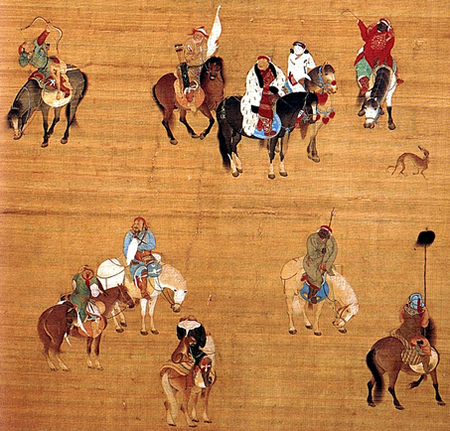
Kublai Khan on a hunting expedition

Kubilai also convened a khuriltai, in his appanage, attended by his supporters that elected him to the same position. In the ensuing civil war Kubilai had the support of Hulagu and also the greater resources of China. Arik Boke surrendered in 1264 and died two years later under Kubilai’s supervision.

Kubilai’s ascension marked his transition from Mongol khaghan to emperor of China. In 1254 he had chosen a site in northern China located 200 miles north of present-day Beijing as his capital, arguing that it was logical to be located where he governed. It was called Shangtu meaning “supreme capital” in Chinese.

It became the secondary capital in 1264 when he moved the seat of his government to the former Liao and Jin (Chin) capital, which he rebuilt and renamed Datu, or Tatu (“great capital” in Chinese); its location is present day Beijing. As a result Karakorum, built by Ogotai Khan as capital of the whole Mongol Empire, was relegated to the backwaters.


From this time on Kubilai chose a Chinese reign name, proclaimed a calendar, adopted many Confucian rituals of state, and in outward form at least became a Chinese-style ruler. In 1271 he proclaimed himself the founder of the Great Yuan dynasty (1279–1368) and claimed that it had received the Mandate of Heaven as the latest in the succession of Chinese dynasties. Between 1267 and 1279 his forces finished off the Southern Song, capturing its capital Hangzhou (Hangchou) in 1276.

Several campaigns occupied the remainder of Kubilai’s reign. One was to subjugate Korea, whose king had been subservient until a coup in 1269 brought in an independent leader. It ended in 1273 with Korea back in the Mongol fold. Kubilai also launched two expeditions to force Japan to accept tributary status.

The first one in 1274 landed at Hataka on the eastern coast of Kyushu island and met with resistance and disaster because of a gale-force storm. A huge second expedition, two armadas of 140,000 men, mostly Koreans and Chinese plus a Mongol cavalry, were devastated by a typhoon.

A naval expedition against Java in 1292–93 was also a fiasco. Land invasions of Burma and Vietnam were more fortunate and secured their vassalage. The wars against Kaidu Khan (1235–c.1301) were more difficult and reflected the division between the different branches and ideologies among Genghis Khan’s descendants.

Kaidu was Ogotai Khan’s grandson and his cause showed the resentment of that branch of the family on its eclipse. Kaidu’s allies were princes from the Chagatai and Tului families who objected to Kubilai’s identification with his sedentary Chinese subjects. Their causes failed but they continued to be troublesome.

Kubilai needed to be accepted as sovereign of China while remaining leader of the Mongols. Therefore he continued the shamanitic practices of his ancestors while turning to Tibetan Buddhism and ordered the creation of a new alphabet based on Tibetan for writing the Mongolian language (an earlier script was based on Uighur).

While favoring non-Chinese Central Asians in top posts in his government, he also honored Confucius and continued Chinese traditions such as authorizing historical writings and cultural activities. Kubilai Khan’s administration was by Mongols and for the benefit of Mongols.

The death of his wife Chabi in 1281 and son and heir Prince Zhenjin in 1285 was a personal and dynastic loss, because Zhenjin had been given a good Chinese education and had he lived there might have been improved relations between Mongols and Chinese. Kubilai increasingly took to feasting and heavy drinking in his last years and died in 1294.

Mongke Khan - Mongol Leader

Mongke Khan

Mongke Khan was the eldest son of Tului Khan (fourth son of Genghis Khan) and Sorghaghtani Beki and fourth khaghan or grand khan of the Mongol empire. He was a famous warrior and commander and was also noted for his devotion to the Mongol way of life. He had served on the campaign in eastern Europe under his cousin Batu Khan’s leadership and gained the latter’s goodwill.

The good relations between Batu’s (leader of the Golden Horde) and Tului’s families were reinforced when Ogotai Khan’s son and successor Guyuk Khaghan (r. 1246–48) planned to ambush Batu, and Mongke’s mother secretly warned Batu of the plot, even though nothing came of it because Guyuk soon died.

In the struggle among the grandsons of Genghis Khan to be his successor, Batu successfully sabotaged regent Oghul Khaimish’s (Guyuk’s widow) attempt to have the Mongol council elect one of her sons the next khaghan.


Batu was not interested in being khaghan, but as the descendant of the eldest son of Genghis, he wanted the role of kingmaker and was successful in having Mongke elected the fourth khaghan in 1251.

Mongke immediately consolidated his position by ruthlessly purging and killing his cousins and other relatives from the Ogotai and Chagatai (Genghis’s second son) branches of the family and their supporters.

Anticipating his election, Mongke established a shadow government. Thus he was able to move quickly to fulfill his grandfather’s mandate to conquer the world. Ruling from Karakorum in Mongolia when not on the move, Mongke relied on Mongols in top positions in his government, assisted by people from the conquered ethnic groups.

He made important reforms needed to mobilize resources and manpower by unifying the tax collection system, stopping many abuses, and rebuilding the economies in some already conquered lands. Starting in 1252 he began a census of the peoples and resources of his lands from China to Iraq to assess taxes, control resources, and identify skilled craftsmen.

Mongol Empire during the reign of Mongke Khan

In 1252 Mongke began a three-pronged campaign. One brother, Hulagu Khan, commanded an army that headed west, successfully targeting Kashmir, the Assassins in the Caucasus, Iran, and the Abbasid Caliphate, and taking Baghdad in 1258.

A relative from the Golden Horde headed for Korea, subduing it in 1259. Another brother, Kubilai Khan, set out to conquer the Nanchao or Dali (T’a-li) kingdom located in modern Yunnan Province in southwestern China, securing its surrender in 1253.

His youngest brother, Arik Boke, remained in Mongolia. In 1256 Mongke announced his goal of conquering the Southern Song (Sung) in which he would take personal command with a threepronged attack from the north, west, and south.


In the midst of the campaign, Mongke died in August 1256, of either wounds or dysentery. Mongke’s death gave the Southern Song a 20-year reprieve because Kubilai immediately halted the campaign to secure his succession as khaghan.

The ensuing civil war between Kubilai and his brother Arik Boke involved his other brother, Hulagu, and various cousins. The Mongol empire reached its apogee under Mongke and would never recover from the succession crisis.