Showing posts with label muslim world. Show all posts

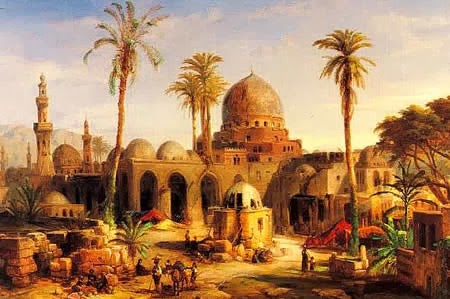
Baghdad

Baghdad
Baghdad

The Abbasid dynasty founded the city of Baghdad as a new capital in 762, shortly after the overthrow of the Umayyad dynasty. This shift of the center of power in the Muslim world from Syria toward the Abassid support base in Persia allowed the young dynasty to establish its dominance under the leadership of the caliph, al-Mansur.

However, the move from Syria also saw the caliphate’s influence in Mediterranean affairs decline and rival dynasties emerge as far away as Spain, where the Umayyad dynasty regrouped, and as near as Egypt, from where the Fatimid dynasty dominated much of North Africa from the 10th through the 12th century.

The first two centuries of Baghdad’s history were marked by political strife as the Abassids repressed revolts; the dynasty underwent civil war from 811 to 819. During this civil war the caliph Amin besieged the city. Despite this unrest, Baghdad found itself at the center of a Muslim cultural golden age during these centuries.


In the 940s a group of soldiers, the Buyid princes, who had been gaining in strength for a decade, took power in Baghdad; lacking legitimate claim to rule, they become protectors of the caliphate and ruled through Abbasid puppet caliphs.

In 1055 the Seljuk Turk Toghrulbeg came to Baghdad and ultimately relieved the caliph of the Buyid protectorate. Toghrulbeg was named sultan, and the caliph was again reduced to little more than a puppet. But the Seljuk leader’s ambitions led him to rule from outside of Baghdad, visiting only on occasion, and this would give future caliphs at least some small measure of freedom.

The Crusades and internal turmoil challenged the Seljuks’ control of the region, and the caliphs began to challenge their overlords. The breakup of Turkish rule in the late 12th century saw a renewal on a regional scale of the city’s importance, but the city and the region were continually plagued by conflicts between Sunnis and Shi’i.

The Mongols

In faraway Mongolia, warring Turko-Mongol tribes were uniting under the leadership of one man, Temuchin. In 1206 an assembly of tribal nobility awarded him the title Genghis Khan—Universal Ruler. From central Mongolia, Genghis set out on a mission of world conquest.

He immediately began consolidating his power for an attack against the Chinese kingdoms to the south, but full control of China was far off. The Mongols would invade western Asia and establish a dynasty in Iran before they unified China under their rule.

During the early years of Mongol expansion Genghis Khan led armies against the sultan Ala ad-Din Muhammad, Khwarazm Shah, as a punishment for his challenge to Mongol authority in the region of Central Asia. Genghis’s punishment of the Persian leader helped establish a reputation for Mongol brutality.

The caliph in Baghdad, al-Nasr, felt threatened by the onslaught against Sultan Muhammad and appealed to the Ayyubids in Syria for aid. The Ayyubids were battling the crusaders and did not send aid, but the threat of Genghis Khan never materialized. Genghis died in 1227, and Ogotai Khan, his son, succeeded him.

In 1232 Mongol forces had penetrated as far as Azerbaijan, and the caliph annexed Arbela in Upper Mesopotamia, possibly as a defensive measure. In 1236 the caliph mobilized his armies against the Mongols, who were moving south into Upper Mesopotamia, and in 1238 the caliph went to Baghdad’s great mosque and called for holy war against the invaders.

This time Ayyubid reinforcements arrived, but the ensuing battle was a defeat for the caliph. The Mongols withdrew deep into Persia, and terms were reached, though raids into Mesopotamia continued with accounts of the period reporting various Mongol harassments of Baghdad.

The Mongol conquest of the Middle East began during the reign of Mongke Khan. In 1252 Mongke dispatched his brother Hulagu Khan to take control of the region. Some sources suggest that the arrival of Hulagu in Azerbaijan was instigated by a mission by the Qadi of Qazvin, in an attempt to subdue the Isma’ilis, known as the Assassins for their frequent tactic of the same name.

The Isma’ilis operated from their stronghold in the mountainous region of northern Iran. The repression of the Isma’ilis was one of Hulagu’s first goals. Hulagu dispatched Baichu to the west to repress the Seljuk’s in Rum, and in 1256 Mongol forces defeated the sultan and recognized his younger brother, establishing Mongol overlordship of Rum. In the same year, the Mongols completed their mission against the Isma’ilis, destroying the last of their mountain strongholds and executing their leader, Khurshah.

Having secured his base and the vicinity to its west, Hulagu focused his attention on the caliphate in Baghdad. Hulagu sought to dominate both Baghdad and its caliph, despite their dramatic decline in prestige. The court of the caliph, al-Musta‘sim, was divided over how to respond.

The caliph, presented with an ultimatum, could surrender—saving his life, his position, and his city—or resist. Indecision left al-Musta‘sim largely unprepared for the onslaught that would follow his disregard and disrespect of Hulagu and his armies. The Mongol forces besieged the city for several weeks before storming it on February 6, 1258.

The damage to the city was extensive. Al-Musta‘sim, his sons, and much of their entourage were killed; as it was against Mongol belief to shed royal blood on the ground, the caliph was rolled into a carpet and trampled to death by horses. Al-Musta‘sim was the last Abbasid caliph of Baghdad.

From Baghdad, Hulagu’s forces moved into northern Syria, taking Aleppo in January of 1260. The Ayyubid ruler in Damascus, An-Nasir Yusuf, fled his capital, and the city surrendered to Hulagu’s general Kitbuqa. Hebron, Jerusalem, and Ashkalon were raided, and various Ayyubid princes submitted to the invaders. Again, much of the Mongol army was unilaterally withdrawn to Azerbaijan, where Maragheh was chosen as the capital of the new Il-Khanate (one of four khanates of the Mongol Empire).

The Ayyubids’s conquest by the Mongols marked the end of their dynasty, as they had already been replaced in Egypt by the Mamluk dynasty. General Kitbuqa remained to solidify the new conquests in Syria, while Hulagu became embroiled in the Mongol succession crisis and began to battle the Golden Horde to his north.

In the eastern Mediterranean region the crusaders in Jerusalem were not prepared to surrender to the Mongols and issued calls for reinforcements to the western European kingdoms, while they temporarily tried to appease Kitbuqa. When the crusaders did not dismantle their fortresses, however, Kitbuqa retaliated, sacking Sidon in August 1260.

The crusaders responded by allowing the Mamluks of Egypt to dispatch troops through their territory and even provided the Muslim forces with supplies to battle the Mongols. In September 1260 the Egyptian army defeated the Mongols in Galilee, and Kitbuqa was either killed in the battle or executed after his defeat.

The Il-Khanid Mongols retreated beyond the Euphrates to their power base. Within the Il-Khanate, Hulagu and his son Abaqa would enjoy stability despite threats at the border. The Il-Khanids continued to work diplomatically against their Mamluk enemies in Syria, at times approaching the crusaders to propose coordinated attacks.

In 1299 Ghazan Khan, a Muslim convert, attacked the Mamluk forces, which retreated to Egypt in defeat. Syria and Palestine were briefly reoccupied until Ghazan withdrew to Mesopotamia, and it was not until 1320 that the Mongols made peace with the Mamluks. After the death of Abu Sa‘id in 1235, the Il-Khanate disintegrated into rival, mostly non-Mongol, dynasties.

The Mongol leader Timurlane emerged as a great force in the region at the end of the 14th century, regaining Mongol control of Persia and doing battle as far east as the Ottoman Empire. But Timurlane’s death in 1405 saw the Mongolian empire in Persia again disintegrate and effectively ended Mongolian influence in the region of the Middle East.

The immediate and lasting effects of the Mongols in the Middle East are varied in degree. The Mongol conquest of Hulagu ended two institutions of Islamic rule, finally ending the Abbasid Caliphate of Baghdad and Ayyubid dynasty, the realm of which was already confined to Syria and parts of Palestine. This allowed Mamluk rule to fill the power vacuum.

A century and a half later that power vacuum would be re-created by Timurlane’s temporary conquests and the subsequent disintegration of Mongol rule in the Middle East following his death, only to be filled by the Ottomans. Culturally, the impact of the Mongols was minimal, with the exception of Persia, to which area their lasting presence in western Asia was confined. It is in the period of the Il-Khanate that the greatest impact of far eastern culture on Persia is witnessed.

Averroës

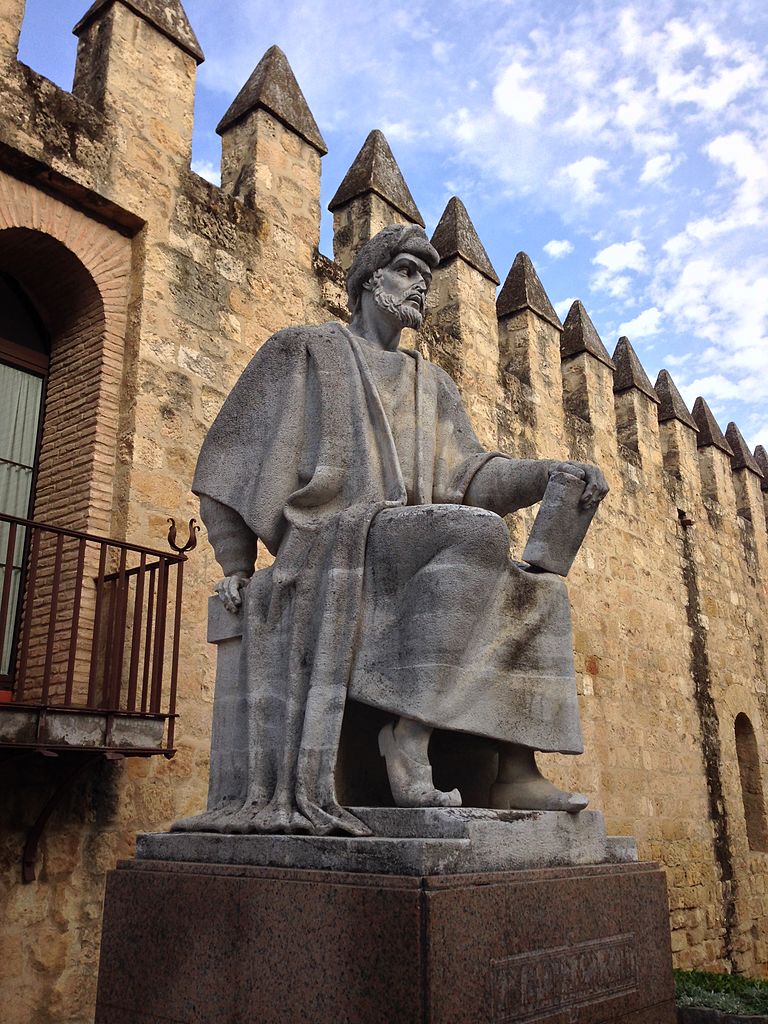
Averroës statue in Cordoba, Spain

Abu Al-Walid Muhammad Ibn Ahmad Ibn Rushd, Ibn Rushd for short, or Averroës, as he is known to the West, was born in Córdoba (Qurtuba), Spain, in 1126 to a family of distinguished Andalusian scholar-jurists. Ibn Rushd was to become a famous philosopher, theologian, physician, and royal consultant. He was a scholar of the natural sciences, namely biology, astronomy, medicine, physics, and the Qur’anic sciences.

His grandfather, after whom he was named, was a renowned chief justice (qadi) in Córdoba and an authority on Malikite jurisprudence, having written two famous books on the subject. At the same time, he was the imam of the Great Mosque of Córdoba. Ibn Rushd’s father was also a judge. Having grown up in a family of scholars, Ibn Rushd received an excellent education in Córdoba in linguistics, Islamic jurisprudence, and theology.

He became very knowledgeable in these subjects, evident through his many writings. He was especially competent in the subject of khilaf, which dealt with controversies in legal sciences. Ibn Rushd had profound knowledge of Aristotelian philosophy, possibly introduced to the subject by one of his teachers or one of the leading scholars in Córdoba.


He was educated in medicine and accomplished a major work known as the Al-Kulliyat fi‘l tibb translated as General Medicine in 1169. Ibn Rushd’s writings were so widely celebrated at one time that it was claimed that medieval Islamic philosophy was an earlier version of the European Enlightenment.

In 1153 Ibn Rushd moved to Marrakech, where he met the Almohad ruler Abu Ya’qub Yusuf, who was very impressed with the young Ibn Rushd’s intellect and deep knowledge of philosophy. It is interesting to note that Ibn Rushd was initially reluctant to reveal the extent of his knowledge to the prince because at the time strict Muslim leaders frowned on philosophy, which was considered anti-Islamic.

Ibn Rushd had to fight against this prevalent belief by asserting that philosophy could be compatible with religion, if both were properly understood. He had nothing to fear with regards to the Almohad prince, who admired his wide knowledge.


In fact, the ruler consulted Ibn Rushd on philosophical matters from then on and became his patron. It was also because of Abu Ya’qub’s prompting that Ibn Rushd summarized the works of Aristotle in a clear manner. During this time he also provided detailed commentaries of his Aristotelian philosophy, such that he is popularly known as the Commentator of Aristotle.

In Marrakech, Ibn Rushd remained active in other areas beside writing and philosophy. He also made astronomical observations. In 1182 he was appointed chief physician in Marrakech. He then became the chief justice in Córdoba. In 1195 Ibn Rushd fell out of favor with the new Almohad prince during the latter years of his reign. His works were considered contrary to religion, and the Caliph passed edicts forbidding their study. He was banished to Lucena near Córdoba but later returned to Marrakech. He died soon after in December 1198.

Al-Azhar

Al-Azhar
Al-Azhar

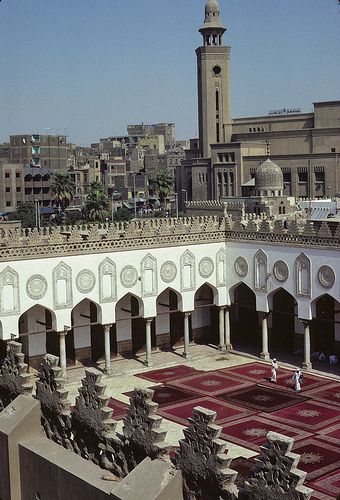
The Fatimids established al-Azhar, one of the oldest universities in the world, in Cairo in 970. Built around a large mosque with an open courtyard surrounded by columned walkways where classes were taught, al-Azhar quickly became one of the premier educational centers in the entire Islamic world, attracting students from Asia, Africa, and, in subsequent centuries, the Western Hemisphere.

Originally, the university focused on the tenets of the Isma’ili sect of Islam followed by the Fatimid rulers, but over the following centuries the university became a center for orthodox Sunni belief. By the 1600s the Shaykh al-Azhar, leader of al-Azhar, was chosen from among the shaykhs of the university.

A peek inside Al-Azhar Mosque and University
A peek inside Al-Azhar Mosque
and University nowdays
Generations of legal scholars and judges were educated in theology and Islamic law at al-Azhar. In the 15th century c.e., the Mamluk sultan Qaitbey financed the construction of an inner gate and elaborate minaret overlooking the courtyard.

Following sultans added further buildings and ornamentation to the sprawling complex, including living quarters for students, libraries, and the mosque. After the 1952 c.e. revolution in Egypt, Gamal Nasser modernized and instituted major reforms including the creation of a College of Islamic Women and the addition of colleges in medicine and engineering.

Bayezid I

Bayezid I
Bayezid I

Bayezid I was declared sultan following the death of Sultan Murad on the battlefield at Kosovo in 1389. To ensure his uncontested succession to the sultanate, Bayezid had his brother Yakub assassinated; subsequently the practice of fratricide became commonplace among heirs to the Ottoman throne.

To cement Ottoman control over Serbia, Bayezid married a Serbian royal princess. Bayezid immediately embarked on a series of successful military conquests, personally leading his troops throughout Thrace. Under Bayezid’s rule, only the heavily fortified cities on the coast, including Athens and Constantinople, remained outside Ottoman control.

Recognizing the importance of sea power in any attempt to seize Constantinople, the Ottomans began to build up their navy. Fearful of the mounting Ottoman threat, the Hungarian king and later Holy Roman Emperor Sigismund rallied Christian forces in Europe to attack the Ottomans at Nicopolis in 1396.


The Europeans were resoundingly defeated by the Ottoman troops, who were personally led on the battlefield by Bayezid who then conquered virtually all of the Balkans, the Turkoman areas of Karaman, Anatolia, and the eastern Mediterranean. Because of his military prowess, Ottoman troops called Bayezid the “thunderbolt” (yildirim).

However, Bayezid’s love of luxury and increasing arrogance alienated many of his subjects and offended many traditional Muslims. Some amirs (local governors) fled to the court of Timurlane, whose mounting power posed a serious threat to Bayezid’s conquests. In 1402 Ottoman and Mongol forces met on the battlefield at Ankara, where Bayezid was captured.

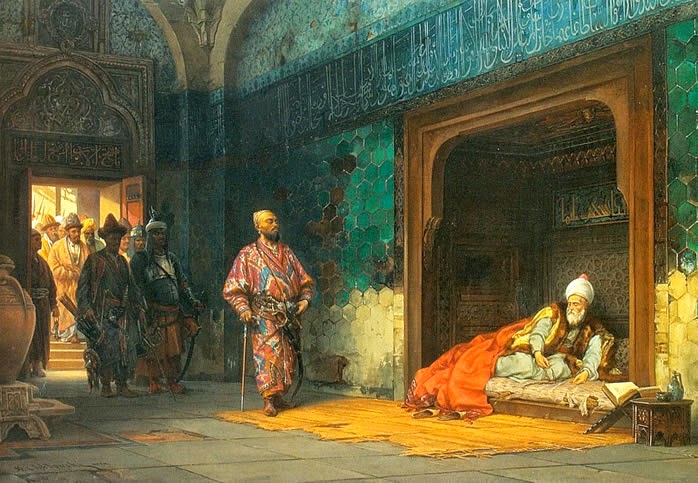
Brought before Timurlane, Bayezid was initially treated with respect, but after a failed attempt to escape, he was placed in an iron cage; he died several months later. Timurlane went on to conquer the rest of Anatolia but divided his newly gained territories among four of Bayezid’s sons. Although they pledged loyalty to Timurlane, upon his death three years later, they promptly resumed the Ottoman quest for empire.

Bayezid held by Timurlane

First Four Caliphs

First four caliphs at greatest extent

After the prophet Muhammad’s death in 632, the elder statesman Abu Bakr (r. 632–34) was selected as the new caliph or representative of the Muslim community. The first four caliphs were known as the Rashidun or rightly guided ones. Abu Bakr irritated Muhammad’s daughter, Fatima, and her husband, Ali, by declaring that the Prophet’s estate belonged to the Muslim community and not to the family. Although Ali’s supporters reluctantly accepted Abu Bakr as the caliph they would ultimately split from the majority Muslim community.

In what were known as the Ridda wars (wars against apostasy), Abu Bakr’s first major challenge was to put down a number of rebellions by tribal nomads who opposed the central control of the Islamic state. Within two years, the Muslim forces had secured the entire Arabian Peninsula and ruled from the capital of Medina. With Abu Bakr’s death Omar was selected as the second caliph in 634. For his achievements as a ruler and administrator, Omar has been called the second founder of Islam.

Under Omar (r. 634–44), the Arab forces, embarked on a series of dynamic and swift wars against the neighboring Byzantine and Sassanid Empires. The plunder from these conquests was divided with one-fifth going to the state and the rest apportioned among the warriors. Ownership of conquered lands reverted back to previous owners with payment of a tax or went to the state. As a result the new Islamic/Arab empire became increasingly wealthy.


At the Battle of Yarmuk the Arab Muslim forces decisively defeated the Byzantine emperor Heraclius and Damascus was taken in 636. The city’s grand Byzantine church was turned into a mosque and subsequently expanded. The Muslim forces swiftly moved on to Palestine, taking Jerusalem in 637.

Omar visited the city and proclaimed that Christians, the majority population at the time, and Jews, as people of the book, had protected status as Dhimmis under Qur’anic injunctions; they therefore were to be treated with tolerance and no forced conversions were to be undertaken.

Although over time many willingly converted to Islam, the population of the area remained predominantly Christian until the Crusades. Although the Byzantine Empire survived with its capital at Constantinople, the new Muslim/Arab empire now controlled the eastern Mediterranean coast and plains.

After initial reluctance Omar agreed that the commander Amr ibn al-‘As could move on to the conquest of Egypt. Amr took Alexandria with relative ease in 642 and established Fustat, outside modern Cairo, as the new Muslim administrative center. His forces also pushed into Libya, taking the port of Tripoli.

Muslim forces were equally successful in their battles against the weakened Sassanid Empire in the east. They won a decisive battle at Qadisiyyah in 637 and moved on to the Sassanid capital of Ctesiphon, where the warriors collected enormous quantities of plunder in gold, silver, and jewels.

Ali and Aisha in Battle of Camel
Ali and A'isha in Battle of Camel

In keeping with tradition regarding the apportioning of booty, the fabulous jeweled carpet from the palace was cut into pieces and given to the conquering soldiers. By 638 the Arabs controlled all of the Tigris and Euphrates and by 644 had effectively taken Persia (present-day Iran). Within a decade Persia had become a predominantly Muslim nation. The Muslim state absorbed many of the administrative and economic practices of both the older Byzantine and Sassanid Empires.

Following Omar’s murder by a slave, the Muslim community again gathered to choose a successor. After some acrimonious debate, Uthman (r. 644–656), a member of the powerful Umayyad family, was selected as the new caliph. In his 70s Uthman was not as capable or popular a leader as his predecessors.

After he appointed Muaw’iya, a member of his own family, as governor of Syria, Uthman was accused of nepotism. Opposition to Uthman grew and in 656 rebellious troops returning from Egypt assassinated him and declared Ali (r. 656–661) the new caliph.


Muaw’iya and the Umayyad family criticized Ali for his reluctance to prosecute the assassins; A’isha, the Prophet’s widow, also opposed Ali and mounted troops to fight against him. However Ali and his supporters defeated A’isha at the Battle of the Camel in 656, but in face of the open hostility in Medina, Ali moved his capital to Kufa.

As opposition from Syria continued to mount, Ali prepared to fight Muaw’iya’s opposing claims to the caliphate. The two sides met at the Battle of Siffin in 657. The fighting continued for several months and at one point Muaw’iya’s forces raised parts of the Qur’an to demand negotiations in accordance with Muslim tradition.

Mediators, including Amr ibn al-‘As, declared that Ali would continue to rule from Kufa and Muaw’iya would rule from Damascus; this essentially meant that the Muslim community now had two caliphs. Some seceders (Kharijites) blamed Ali for his willingness to negotiate and in 661 a Kharijite assassinated Ali in Kufa. However the division between the Muslim believers over who was the legitimate ruler proved to be a lasting one.

Crusades

Crusades
Crusades

In 1095 Pope Urban II incited the Crusades with a speech urging Christian armies to free the holy sites, especially Jerusalem, from Muslim control. The Crusades sparked a fire of religious fervor among thousands of young knights and other Christian believers. Other crusaders were adventurers, fortune seekers, and the poor and destitute.

In part the Roman Catholic Church sought the return of the Holy Land to Christian rule because the Seljuk Turks could not ensure the safety of Christian pilgrims. The Seljuk dynasty also extracted high taxes from and sometimes persecuted Christian pilgrims. The success of the early Crusades also reflected the disarray and weakness of the Arab-Muslim world in the 11th century.

The First Crusade (1096–99) was preceded by the Peasant Crusade, a crusade of hungry peasants; most died on the way to the Holy Land. Some 30,000 soldiers, mostly Franks and Germans, participated in the First Crusade. The crusaders crossed the Anatolia Peninsula and took Antioch in 1097.


They then moved on to take Jerusalem in 1099 where they massacred thousands of civilians, mostly Eastern Orthodox Christians, considered as heretics by the Catholics, and Jews. First hand accounts describe the city running with blood knee-deep for several days.

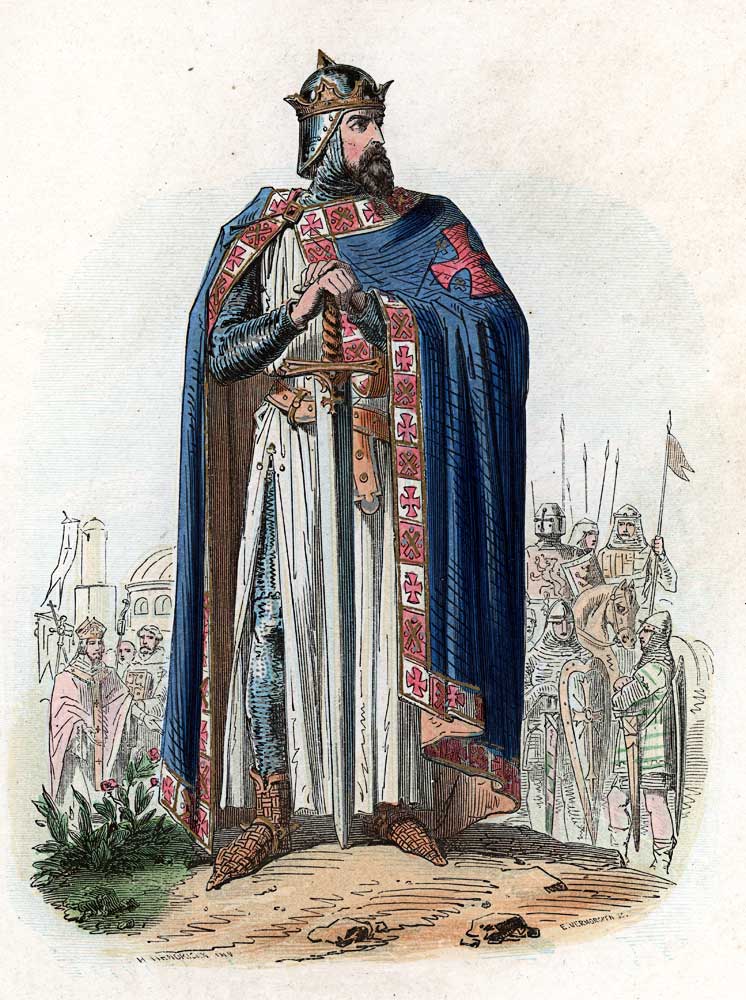
After taking the city, the crusading knights gathered in the Church of the Holy Sepulcher and proclaimed Godfrey of Bouillon as king. Godfrey continued the war and extended crusader territory. Some knights settled more or less permanently in the new Crusader States, that at its greatest extent included the Syrian coast and Palestine.

The Crusader States replicated the feudal system prevalent in Europe. Fiefs were given to favored knights who were tied together for common defense. The crusaders built huge castles, often enlarging older Arab fortresses on high ground in strategic locations. Some of these castles, such as Beaufort Castle in Lebanon and the Krak des Chevaliers (Quala’at al-Husn) in Syria, still stand.

Godfrey of Bouillon king of crusader states

Indigenous Arab villagers were little affected by the crusader rule as they were accustomed to giving tribute to local lords and fulfilling obligations of service during wartime. Likewise the Crusader States had little or no impact on the vast interior regions of the Arab-Muslim world. Under the crusaders, agriculture remained the mainstay of the economy. However the Crusader States were strategically and economically vulnerable.

Church and military orders were exempt from taxation and the Italians enjoyed special extraterritorial rights. Indeed the Italian city-states who provided transportation at high costs for many crusaders and financial backing, at high interest rates, for expeditions were among the chief beneficiaries of the Crusades. The Crusader States were also dependent on Italian city-states for supplies from Europe.

The Second Crusade (1146–48) led by King Louis VII of France and Emperor Conrad III followed the same geographic route as the First Crusade, but attempts to take Damascus failed. Conrad returned to Germany because of sickness, but Louis remained to make pilgrimages to the holy sites.


At the time of the First Crusade Syria had been close to political collapse as rival powers struggled for ascendancy throughout the eastern Mediterranean after the collapse of the Abbasids. However Muslims challenged the crusaders and launched a series of counterattacks to regain control of Jerusalem and Syria.

Saladin proved the most formidable Muslim opponent. He united the Muslims and at the Battle of Horns of Hattin in the summer of 1187 stopped crusader expansion into the heartland of the Arab world. He then attacked crusader strongholds and took Jerusalem in 1187.

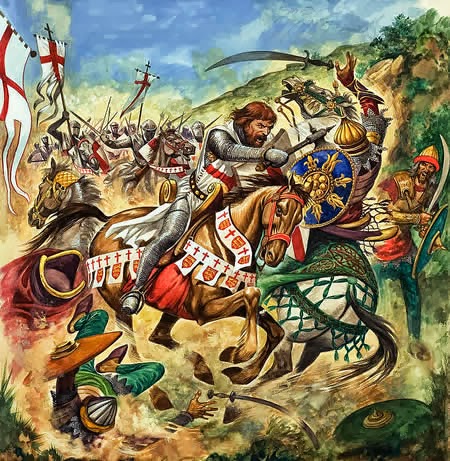
The fall of Jerusalem provoked the Third Crusade led by King Richard I of England, the Holy Roman Emperor Frederick I Barbarossa, and Philip II of France. Frederick drowned in Asia Minor in 1190 and after Philip and Richard quarreled, Philip returned to France. Without taking Jerusalem, Richard negotiated a truce with Saladin that ensured safe passage of Christian pilgrims into the city.

Krak des Chevaliers
Krak des Chevaliers

Although Pope Innocent III called for new attacks on Jerusalem, the crusading zeal was beginning to wane. When the Venetians demanded a high price to take crusading troops to Egypt, the Muslim military stronghold, the crusaders moved against Constantinople, the famed capital of the Byzantine Empire.

In the Fourth Crusade, the crusaders looted Constantinople and established a short-lived (1204–1261) Latin Empire there. The attack on Constantinople undermined the papacy and crippled the Byzantine Empire, which became more vulnerable to subsequent attacks by the Ottoman Turks. It also exacerbated animosities between Eastern Orthodox believers and the Roman Catholic Church. That schism persisted into the 21st century.

After Saladin’s death, divisions within the Muslim world enabled the crusaders to retain tenuous control of their territory, but Mamluk rulers resumed attacks from Egypt in the mid-13th century. Sultan Baybars (r. 1260–1277) launched annual attacks against the Frankish kingdoms, taking most of the Palestinian coastal cities.

He also defeated the Mongols, thereby preventing them from taking the coast. His military exploits were often favorably compared to those of Saladin. The Mamluks captured the city of Tripoli in 1289.

The Mamluk Sultan al-Ashraf Khalil took Acre, the last crusader outpost, in 1291. Signifying the end of the crusader presence, the city was looted and razed. Sultan Khalil was feted as a conquering hero on his return to Cairo. However as with many Mamluk rulers, rivals to the throne assassinated Khalil within a year of his victory.

The Crusades marked almost 200 years of intermittent warfare and sporadic coexistence between Christian Europe and the Muslim East. The exchanges fostered many negative cultural and religious stereotypes. Positive results included the introduction of many new goods, including brocades, perfumes, soaps, and foodstuffs, especially spices, to the West. Damascus retained its importance as a center for industry and commerce while Jerusalem was a religious center.

Some crusaders remained, intermarried, and assimilated into Muslim society. The Italian city-states established long-lasting commercial ties that continued even during times of open warfare. The wealth from this trade helped to finance the cultural flowering of the Renaissance. In the long term, the Crusades worsened Christian-Muslim relations and intensified religious animosities.

In spite of having been under Muslim rule for over 400 years, most of the population in the eastern Mediterranean was still Christian when the crusaders arrived. However the massacres of Eastern Orthodox Christians by the crusaders and their rude treatment of the local population ironically contributed to a massive conversion of Christians to Islam after the fall of the Crusader States.

Divine Caliphate and the Ummah

Devine Caliphate at its greatest extend

In June 632 the prophet Muhammad, the founder and last prophet of Islam, died of natural causes. He left behind a nascent Islamic state within the Arabian Peninsula. Although some Muslim sources state that there had been a premonition of his death, the confusion and divisions within the Muslim community or Ummah suggest that Muhammad’s death was unexpected.

In the wake of the Prophet’s death the general consensus was that, since Muhammad did not leave explicit instructions on how to choose a successor, such a leader should be elected. Despite this consensus not all factions agreed.

One group, which later came to be known as the Partisans of Ali or Shiat Ali, claimed that Ali ibn Abu Talib, Muhammad’s cousin and son-in-law, was designated as the prophet’s successor at a place called Ghadir Khumm during his last hajj pilgrimage.


The four successors to Muhammad as leaders of the Ummah—Abu Bakr al-Siddiq, Umar ibn al-Khattab, Uthman ibn alAffan, and Ali ibn Abu Talib—formed what is now known as the al-Rashidun or “Rightly Divinely Guided” Caliphate.

Originally many believed that the caliph was the political, but not the religious, successor to Muhammad. However other scholars have argued that the caliph, at least initially during the al-Rashidun period and Umayyad dynasty, held both political and religious authority, though they did not claim prophetic powers, since Muhammad was considered the “seal” of the prophetic line that began with Adam, the first man in the Islamic tradition.

Abu Bakr al-Siddiq

Abu Bakr al-Siddiq
Abu Bakr al-Siddiq
Umar ibn al-Khattab, Abu Ubayda ibn al-Jarrah, and Abu Bakr al-Siddiq, three of Muhammad’s closest companions and allies, decided that Abu Bakr should take over as head of the Ummah. As a member of the influential tribe of Quraysh, of which Muhammad was also a member, Abu Bakr was an early convert to Islam and father of A’isha, one of the prophet’s wives.

In 622 when Muhammad was compelled to leave his native city of Mecca for the oasis city of Yathrib (later renamed Medina) to the north, because of the death of his uncle and protector Abu Talib ibn Abd al-Muttalib and threats from the city’s polytheistic leaders, Abu Bakr was his trusted lieutenant and traveling companion.

As word of Muhammad’s death spread throughout Arabia, several Arab tribes that had pledged allegiance to Muhammad refused to obey the new caliph, Abu Bakr, who ruled from Medina. Although some of these tribes openly rejected Islam, despite having converted during Muhammad’s lifetime, other rebellious tribes objected to the continuation of political subjugation to the caliphate in Medina.

Abu Bakr moved swiftly against the rebels, stopping the rebellion with military force in what came to be known as the Ridda Wars, or the Wars of Apostasy. The struggle against the Hanifa clan, led by their leader Musaylimah, who claimed to be Muhammad’s prophetic successor, was the bloodiest, finally ending in 633 with the defeat of the Hanifa and the death of Musaylimah at the Battle of Aqraba.

Abu Bakr infographic

The larger result of the triumph of the al-Rashidun Caliphate over its challengers was the first major expansion of the Islamic state since the death of Muhammad, as the Muslims were in firm control over the vast majority of the Arabian Peninsula. After his victory in the Ridda Wars, Abu Bakr turned his attention to the north and east, directing Muslim armies to begin moving against the Byzantine Empire and its Arab allies in Palestine and Syria and the Persian Sassanid Empire’s landholdings in Mesopotamia.

The first Muslim military expeditions into Byzantine and Sassanid lands occurred during Abu Bakr’s reign. Before he was able to continue the caliphate’s expansion, Abu Bakr died of old age in August 634, after nominating Umar as his successor.

Umar ibn al-Khattab

Umar ibn al-Khattab
Umar ibn al-Khattab
Umar ibn al-Khattab, one of Muhammad’s greatest critics and persecutors before converting to Islam, oversaw the caliphate’s first great expansion. It was during his reign as caliph that Islam’s political and religious authority spread by leaps and bounds outside its Arabian homeland.

In fairly short succession, the Byzantine Empire was driven out of Syria, Palestine, Egypt, and parts of southern Asia Minor while the Sassanid Empire was pushed out of Mesopotamia by Muslim armies. After entering Iran and forcing the Sassanid government to flee farther east, the Muslims established new settlements at Kufah and Basra in present-day Iraq, which would act as garrisons to safeguard the caliphate’s new conquests.

Under Umar, the administration of the caliphate began to develop, with its soldiers paid varying rates according to the length and nature of their service, and local subjugated non-Muslim populations required to pay taxes, while Muslims were required to pay religious taxes. In 644 Umar was mortally wounded by Abu Lululah, a Persian slave, while leading communal prayers in Medina, for personal and not political reasons.

Utsman bin al-Affan

Utsman bin al-Affan
Utsman bin al-Affan
Before he died Umar appointed a six-member council of Muhammad’s Companions, all members of the tribe of Quraysh, to elect the next caliph. Ali was offered the position if he would agree to follow the edicts of his two predecessors. After Ali declined, the council elected Utsman ibn al-Affan, an early convert to Islam and a member of the powerful Umayyad clan, as the new caliph.

During his reign the authority of the central government in Medina was enhanced and a conference of scholars was called to codify an official version of the Qur’an, placing the chapters in the order in which they appear today. During Utsman’s reign the caliphate continued to expand, with Muslim armies moving farther east into Sassanid Iran.

Through treaties and military conquest, the Muslims established their control over the region’s urban centers, though in the mountains and rural areas, traditional societies continued to exist and non-Muslim peoples, such as the Turks of Central Asia, were prone to occasional revolt. The Sassanid empire, which had been in power since 224, was unable to maintain centralized control and by 651 it had collapsed.

Three regions in particular opposed Utsman’s reign: Medina, where non-Umayyad members of the Quraysh were dismayed at the caliph’s favoritism; and Kufah and Egypt, where the caliph had attempted to revoke longstanding privileges and increased taxation. In 656 opposition to the caliph came to a head when several hundred Muslim soldiers stationed in Egypt returned to Medina to protest Utsman’s policies.

He talked them into returning to Egypt but sent an order to that region’s governor instructing him to punish the soldiers. The caliph’s message was intercepted and the soldiers returned, enraged, and assassinated Utsman as he sat reading the Qur’an. Uthman’s nepotism led to his downfall and further divisions in the Muslim Ummah.

Ali Ibn Abi Talib

Ali Ibn Abi Talib
Ali Ibn Abi Talib
After Utsman’s assassination, Ali became the fourth al-Rashidun caliph. Although he had not faced open opposition to his ascension to the seat of caliph, opposition to his rule soon coalesced around the Prophet’s widow A’isha, and two of Muhammad’s Companions, al-Zubayr ibn al-Awwam and Talha ibn Ubayd Allah, who objected to Ali’s close alliance with prominent factions of Muslim converts.

Fearing that the influence of the Quraysh would be eclipsed, A’isha, al-Zubayr, and Talha led a rebellion against Ali. In December 656 at the Battle of the Camel outside Basra in Iraq, Ali’s forces defeated the rebellion, killing al-Zubayr and Talha. A’isha was sent back to Medina, where she was placed under house arrest.

The main bases of Ali’s support were in Iraq; however in Syria, Ali was faced with open opposition from that province’s governor, Muawiya, an Umayyad relative of Uthman, who criticized the caliph for refusing to punish Uthman’s assassins. Muawiya was in command of a powerful military force and in 657 the armies of Muawiya and Ali met at Siffin.

A full-scale fight eventually ensued, but was soon ended when Muawiya’s soldiers held up pages from the Qu’ran and called out for a peaceful settlement. Ali, to the dismay of some of his more zealous followers, agreed to have his dispute with Muawiya arbitrated.

In the end Muawiya remained governor of Syria and Ali was left unchallenged as the caliph, though his position had been severely weakened. A group of zealots, the Kharijites, previously staunch supporters of Ali, claimed that by agreeing to arbitration, Ali had circumvented the will of God. Although he later defeated the bulk of the Kharijites’s military forces, Ali failed to stamp out their rebellion.

Kharijite assassination attempts against Muawiya and other senior Umayyad leaders failed, but in 661 Ali was mortally wounded by the Kharijite Abdur-Rahman ibn Muljam while leading the predawn prayers at the central mosque in Kufah. With his assassination, the al-Rashidun Caliphate came to an end and Muawiya and the Umayyad dynasty of Syria rose in its place. The Umayyads would continue expanding the Islamic state until the Abbasid dynasty overthrew them in a violent revolution in 750.