Pope Sylvester II

Pope Sylvester II
Pope Sylvester II
As a young man, Gerbert of Aurellac became a monk in Gaul and later studied in Spain at Barcelona, and under Islamic teachers at Seville and Córdoba. He was particularly skilled in the natural sciences and arithmetic.

After completing his education under Bishop Hatto of Vichy, he traveled with the bishop to Rome and won the support of Pope John XIII. Upon a recommendation of the pope, Emperor Otto I sent Gerbert to Reims, where he was given a position as an instructor in the cathedral school under Archdeacon Gerannus.

He was highly skilled in oratory and debated Ortricus of Magdeburg before Emperor Otto II on many theological matters. He was bestowed the abbey of Bobbio by the emperor but returned instead to Reims. He was partially responsible for the rise of Hugh Capet.

Gerbert was elected archbishop of Reims in 991 by a synod of bishops. This elevation to the See of Reims was later declared invalid. Gerbert argued against the primacy of the pope in settling disputes of ecclesiastical office.


Not being able to counteract this decision Gerbert chose another path and went to the court of Otto II, where he became the emperor’s teacher. Gerbert accompanied Otto to Italy and in 998 Pope Gregory V appointed him archbishop of Ravenna.

Shortly thereafter, the pope died and Gerbert was elected to the Chair of Peter on February 18, 999, and took the name of Sylvester, becoming the first pope from France. He reigned until his death in 1003.

Sylvester II statue
Sylvester II statue

Sylvester’s greatest accomplishment as pope was to fight the abuses of the bishops in regard to simony and concubinage. He argued vehemently that all men who rose to the episcopate should be innocent of sin.

He became friends with Emperor Otto III and was exiled with the emperor after a Roman revolt against the politics of the emperor. He remained in exile for years.

Abandoning his previous beliefs that the pope could not settle ecclesiastical disputes, Sylvester declared his former opponent for the See at Reims, Arnulph, as the rightful archbishop. His reputation suffered some criticism from historians for this change in policy.


After the death of Emperor Otto III, Sylvester returned to Rome, though he gained no temporal power from the competing factions of the city. He established metropolitanates in Poland and Hungary and declared the ruler of Hungary to be a king and papal representative.

Sylvester wrote many works on mathematics and the physical sciences. The people of Rome held him in high esteem as an exorcisor of the devil and a miracle worker. Some historians claim he introduced Arabic numbers into the West and was the inventor of the pendulum clock.

Taizong (T’ang-tsung) - Chinese Emperor

Taizong (T’ang-tsung) - Chinese Emperor

Tang Taizong (T’ang T’ai-tsung), meaning “Grand Ancestor of the Tang,” is the title of the second ruler and real founder of the Tang (T’ang) dynasty in China (618–909). Born Li Shimin (Li Shih-min), he was the second son of Li Yuan, the duke of Tang, who was an important governor under the Sui dynasty.

Taizong’s achievements and the policies that he laid down would make the dynasty the most powerful, successful, and prosperous since the Han dynasty. The Li family was descended from Li Guangli (Li Kuang-li), a famous general under Emperor Wu of the Han dynasty.

As most aristocratic families in northern China, it had intermarried with nomads who had settled in the region; Taizong’s mother, the empress Dou (Tou), came from a powerful Turkic clan.


In 617 the Sui dynasty was collapsing and revolts were widespread. Eighteen-year-old Li Shimin maneuvered his father to revolt and played a leading part in defeating numerous other contenders to establish him on the throne of the new Tang dynasty in 618.

Li Yuan is known in history as Tang Gaozu (T’ang Kao-tsu), meaning “High Ancestor of the Tang.” As second son, Shimin was the object of jealousy of his older brother, the crown prince, who planned to murder him.

In a final showdown in 624 the crown prince was killed, Shimin became crown prince and de facto ruler, and two years later Gaozu retired and Shimin ascended the throne.

Brilliant and precocious, he had by his late teens mastered the Confucian Classics and literature, had gained experience in administration and martial skills, and had led men into battle.

A dashing and fearless leader who placed himself at the forefront of cavalry charges and who excelled in hand-to-hand combat, he boasted that he had personally killed over 1,000 enemies before taking the throne. Taizong was immediately confronted with a crisis along the northern frontier.

Taking advantage of China’s internal chaos the Eastern Turks had launched massive annual expeditions along the borders beginning in 623, to plunder and also to instigate revolts against the new dynasty.

The one in 626 reached within a few miles of the capital Chang’an (Ch’ang-an). Only three weeks on the throne Taizong, who was a man of imperial and intimidating bearing, led his men to confront the enemy and secured their retreat with a combination of bravado and bribes.

His long-term response was to train and bolster his army, which allowed him to launch a massive six-pronged offensive with 720 miles separating the easternmost and westernmost columns in 629.

A combination of superior Tang tactics and internal disaffection among the Turkic tribes resulted in a one-sided Tang victory at the battle at Iron Mountain in which some 10,000 nomads were killed and more than 100,000 surrendered.

This campaign ended the Eastern Turkish Khanate and established Chinese dominion over the Mongolian steppes. Taizong was acknowledged “Heavenly Khan” by the Turks, the first Chinese ruler to hold that title.

The surrendered Turks were treated with kindness; many were settled along the Ordos region of the Yellow River and other borderland areas. Thousands of others settled in Chang’an and served the dynasty. Peace would reign in the northern borders for 100 years.

Other campaigns broke the power of the Western Turks; established Chinese power throughout Chinese Turkistan, across the Pamirs into Afghanistan to the border of Persia; and also brought Tibet under Chinese suzerainty. The marriage of a Tang princess to the Tibetan ruler, the first of several throughout the dynasty, would bring Chinese culture to that land.

In 648 a Chinese force, with Tibetan assistance, crossed into India and brought an Indian rebel who had assassinated King Harsha Vardhana of India (Taizong and Harsha had diplomatic exchanges thanks to the Chinese Buddhist monk Xuanzang’s [Hsuan-tsang’s] journey to India) to Chang’an for punishment.

Taizong also sent two expeditions to Korea in the 640s but failed to bring the king of Koguryo to heel. Taizong rode six horses to battle. Relief carvings of all six, with accompanying inscriptions detailing their names and deeds, decorate the entrance to his mausoleum.

Taizong was a rationalist and believed that men, not heaven, determined the course of history. He was conscientious and hardworking, was concerned with the welfare of the people, and respected the opinion and sought the criticism of his advisers.

He surrounded himself with able ministers. Wei Cheng was the most fearless of his critics, yet never suffered from his blunt rebukes of the emperor.

Taizong called Wei his mirror for showing up all his blemishes and mourned Wei’s death as a great loss to good government. Because the basic institutions of the Tang were already in place when he ascended the throne, Taizong’s task was to consolidate, rationalize, and improve where necessary.

He halted the growth of the bureaucracy, redrew the empire’s administrative units, and continued the codification of the laws but lightened many punishments. His economic policies led to recovery and prosperity after the wars that marked the end of the Sui dynasty and led to surpluses that financed his military expansion.

He established a network of granaries that provided against natural disasters and stabilized the prices. He also extended and improved the militia system begun by his father.

Taizong’s last years were marred by poor health; the death of his wife, the Empress Zhangsun (Chang-sun), who had been his wise and able adviser; the demotion of his heir for plotting against him; and rivalry among his other sons for the succession. He finally settled on a younger son by the empress, who would be known as Emperor Gaozong (Kao-tsung).

But in death his reputation would grow and he would be acknowledged one of the greatest rulers of all Chinese history. His reign came to represent exemplary civil government, unrivaled military might, and unmatched cultural brilliance.

Taizu (T’ai-Tsu) - Chinese Emperor

Taizu (T’ai-Tsu) - Chinese Emperor

Ming Taizu means “Grand Progenitor of the Ming”; this was the posthumous title for Zhu Yuanzhang (Chu Yuan-chang), who founded the Ming dynasty (1368–1644) in China. He was the second commoner to found a Chinese dynasty, the first being Liu Bang (Liu Pang), founder of the Han dynasty (220 b.c.e.–220 c.e.).

The Ming founder drove out the Mongols who had ruled China oppressively for a century and restored Chinese self-confidence, economic prosperity, and international prestige that equaled that of the previous great Han dynasty and Tang (T’ang) dynasty (618–909).

Zhu Yuanzhang was the son of poor tenant farmers from Anhui province in southern China. Mongol misrule and natural disasters reduced the area to penury and a plague killed most of his family.


Left an orphan he joined a Buddhist monastery, and when the monastery ran out of food, he went out begging, then joined a rebel movement called the Red Turbans, one of many that emerged in southern China as Mongol power disintegrated. His ability led to quick promotions and marriage to the leader’s daughter (née Ma). She became his key adviser and mother to his successors.

While other rebels looted, Zhu captured Nanjing (Nanking), a key city south of the Yangzi (Yangtze) River in 1356; set up a rudimentary government; and then subdued the entire Yangzi valley by 1367.

Marching north he captured the Yuan capital Dadu (T’a-tu) in 1368, ending the Yuan dynasty (1279–1368). Zhu assumed the reign name of Emperor Hongwu (Hung-wu), which means “bounteous martial emperor” (r. 1368–98).

By 1388 Ming forces had conquered all southern and southwestern China, Inner Mongolia, Manchuria, and Xinjiang (Sinkiang). Remnant Mongols were driven beyond Karakorum to the shores of Lake Baikal. Korea, many oasis states in Central Asia, and some Southeast Asian states submitted as vassals.

Taizu built up a new centralized government on the Tang model, reestablished the examination system to recruit officials, and encouraged and subsidized local education to nurture talented young men for government service. He also proscribed eunuchs’ gaining political influence.

He earned popular gratitude by freeing millions of Chinese enslaved by Mongols, confiscating large estates belonging to Mongols and their collaborators, and granting land to the landless. The people were also given free tools and seeds and tax remission to rebuild a neglected rural economy, especially in devastated northern China.

Taizu was also suspicious and insecure, and after Empress Ma’s death in 1382, increasingly paranoid and cruel. He ruthlessly persecuted and purged many officials who had helped him gain power.

Taizu was predeceased by his eldest son and crown prince, and according to Chinese practice, passed the throne to a youth, the son of the crown prince. This action would trigger a war of succession.

Battle of Talas River

Battle of Talas River

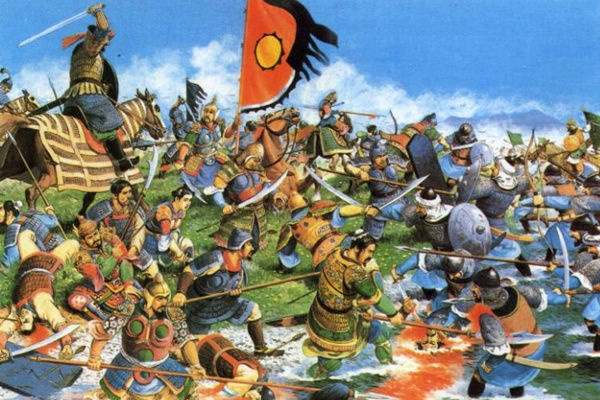
In 751 a Tang (T’ang) dynasty army commanded by Gao Xianzhi (Kao Hsien-chih), military governor of Anxi (An-hsi) in the Western Regions, met an Arab army in battle at Talas River near Samarkand. The Chinese were defeated. Although this was not a major military confrontation, it had great consequences.

Tang power and prestige stood at their zenith up to 750. Tang military forces had scored major successes and secured the frontiers from Tibet to Central Asia; the northern steppes were under a friendly semisedentary people called Uighurs, while the Khitans in the northeast and the Xixia (Hsi Hsia) in the southwest were contained.

International trade flourished by land along the Silk Road, and by sea routes. However soon all would change. The aging Emperor Xuanzong (Hsuan-tsung), infatuated with a young concubine, the Lady Yang (Yang Guifei), had been neglecting his duties while her corrupt family and favorites dominated the government.


The military system that had made the empire strong during the previous 100 years was deteriorating. Many of the frontier garrisons were manned by nomadic mercenaries and commanded by non-Chinese generals. Meanwhile Muslim Arab power had been expanding eastward.

The conflict began as one between two local states, Ferghana, a Chinese client state, and Tashkent. It led to battle between Ziyad bin Salih, governor of Samarkand under the Ummayyad Caliphate, assisting Tashkent, and General Gao Xianzhi and his Chinese forces. Gao was badly defeated when his ally the Western Turks defected to the Arabs and retreated across the Pamir Mountains.

The fierce battle of Talas river

The battle was not significant in the short term, because the Arabs did not press eastward to threaten China, but because of what followed in the long term. In the same year, nearer to home, the aborigines in Yunnan in southwestern China revolted and declared independence, creating a state called Nanzhao (Nan-chao).

Finally in 755 the Turkic general and once imperial favorite An Lushan (An Lu-Shan) began a rebellion that captured both Tang capital cities and threatened the throne.

The immediate result of events in 755 was the recall of Chinese forces from Central Asia, creating a political vacuum. That left the Arabs in a strong position. Likewise the power vacuum enabled the Tibetans and the Xixia people to expand their power at China’s expense.


Even as an ally the Uighurs expanded their power at the Tang’s expense. Without Chinese military protection the Buddhist states in Central Asia would fall to the rising power of Islam. Chinese power would not return to the region for another 600 years.

Tamil Culture


Tamil is a Dravidian language group that originated in southern India and is not linked to the northern Aryan language group. Tamil speakers are found in Tamilnadu, the region surrounded by Kerela, Karnataka, and Pradesh and parts of present-day Sri Lanka. Historically, the two largest and most influential Tamil cities were Madras and Madura.

Intense trade and military expansion resulted in Tamil cultural expansion from the second century to the 10th century. At the core of Tamil cultural identity is the Tamil language. As early as the end of the third century, Tamil script and Tamil as a distinct Dravidian language are documented.

Thus literature and poetry are at the core of culture in this period. However religion, another important aspect of Tamil culture, informed art in the form of painting, sculpture, and architecture.


The fourth century began after the end of the classical period in Tamil literature and was also the beginning of the rule of Pallavas, which would dominate until the 10th century. While this dynasty is not of Tamil origin, the integration of this dynasty into Tamil society transformed the cultural identity.

Pallavas encouraged the worship of Shiva and Vishnu and built lavish temples to honor them. They modeled their society after the great Aryan northern dynasties, the Mauras and Guptas. The Pallava kingdom marked the beginning of the Bakthi poetry movement.

The greatest collection of religious poetry that is indicative of this movement is the Thirumurai, which includes hymns of Appar, Sampanthar, Suntharar, and Manikkavasagar’s mystical poem Thiruvacagam.

The Chola kingdom (c.985–1300) began with ascension of Raja Raja I (985–1014) and the installation of his son Rajendra I. Their power and the crystallization of Tamil cultural identity provided a rich environment to facilitate cultural output. The Cholas were able to conquer vast amounts of territory as far as Malaysia.

As they conquered these lands they erected glorious temples and statues including bronzes of the dancing Lord Natarajan. By the 10th century the Cholas had a well-established trade relationship with China, which aided in enriching cultural connections.

Tamil statue
Tamil statue

Under the Cholas, epic poetry was written by three great poets: Kampan, Ottakkootar, and Pukalenthi. The masterpiece of Tamil literature from this period was poetry created from stories written by Kamban.

Ramayanam (epics) were told in temples and were a part of worship. These were episodic public works performed in the temple, and in many ways were a reaction to the Bakthi movement.

Avvaiyar was a popular Tamil female poet, whose canon of expansive work spanned many topics, including spirituality and wisdom, which was largely popular among the people.


By the 13th century the Pandyas grew in political importance and displaced the Cholas as the dominant power. The Pandyas were highly proficient in trade and education. They controlled the pearl fisheries between the southeastern India coast and Sri Lanka, which produced the finest quality of pearls.

The Pandyas kings were known as far as Syria. The Nayaka period (c. 1336) was the instillation of the Nayaks of the Vijayanagara empire after the gradual spread of Muslim political authority in South Asia beginning in 711 with the Arabs and later, Turko-Afghans and Persians.

The decline of Tamil literature ends with the Nayaka Viceroy period under the hegemony of Sanskrit and Tugulu languages. However there was resurgence in Tamil literature in the 16th and 17th centuries.

Tamil culture from the seventh century until the mid-15th century was influenced heavily by religious devotion in the form of art, architecture, and sculpture. It was also in this period that Tamil literature underwent many transformations. This period provided the foundation for later articulations of Tamil identity.

Taiho Code

map of provinces
map of provinces
The Taiho Code went into effect in 702. It symbolized the advances Japan had made since the sixth century in the establishing of a state in the Chinese style.

Prince Shotoku Taishi had begun the practice of sending Japanese students to China in the early seventh century, a practice that continued long after his death.

The returned students understood that laws, especially administrative laws, were a crucial component of the strength of the Chinese empire, because they defined the forms and function of the bureaucracy, the collection of taxes, and performance of services and justified the secular and ritual role of the emperor. Emperor Tenchi (Tenji) (r. 661–672) had ordered the compilation of an administrative code, reputedly 22 volumes long, but it has not survived.

His brother and successor Temmu had ordered a reform of the laws promulgated under Tenchi, which supposedly was based on the Tang (T’ang) code of 651. Temmu’s code also no longer exists.


Then came the Taiho (meaning “great precious”) penal and administrative code of 702. Fragments of this code survive and more can be extrapolated from commentaries and the Yoro Code derived from it that followed in 718.

It consists of several important component parts. First, it provided for a system of household registration used for assessing taxes for land and labor services from the people.

A complex system of land allocation based on Tang China’s equal field system was put into effect. Second, it stipulated the collection of taxes, based on individuals and not households. Third, it defined the administration of local areas: Japan was divided into 60 provinces, each containing districts and villages.

They had been administered under local chieftains, which were switched to Crown appointees. Fourth, it covered the administration of the central government, which the code put under councils and ministries in the Chinese model. Fifth, it involved administration of military affairs.

Another entire section stipulated state control of Buddhist monks and nuns, their training, ordination, residence, activities, and responsibilities under canon and civil law. This too was taken from the Chinese model under the Tang (T’ang) dynasty.

The promulgation of the Taiho Code was shortly followed by the building of a permanent capital called Nara on a reduced scale of the great Tang capital Chang’an (Ch’ang-an). Until now there had been no permanent capital in Japan. Each reigning emperor or empress had used his/her residence as the administrative center of the state, which changed as each reign came to an end.

This impermanence was due to the simple structure of early Japanese government and the belief of ritual pollution associated with a place where the sovereign had died under indigenous Shinto belief. The change to permanent capitals was predicated on new ideals from China and the increasing complexity of Japan’s government.

The Taiho Code was an ambitious attempt by Japanese leaders to implement a complex legal system on the Chinese model where the state had much greater resources and history of administration.

It was well enforced during the first half of the eighth century. But it became less effective as changing social and economic conditions weakened the imperial court’s control over the land and people.