Zimbabwe

Great Zimbabwe ruin
Great Zimbabwe ruin

As with much of southern Africa, the earliest inhabitants of what is now the country of Zimbabwe were the nomadic San peoples, who led a life in search of game and edible vegetation about 20,000 years ago.

Later the Khoi-Khoi people, pastoralists with herds, entered the region. The two cultures fused into the Khoisan people, who have shown an amazing degree of adaptation to one of the world’s most forbidding climates: the Kalahari Desert.

By approximately 500 the Bantu arrived as the Gokomere people, climaxing the long Bantu migration from the central Sahara, which was most likely caused by the country’s turning into desert and driving out the livestock-herding Bantus. Whether this was the cause of overgrazing or an early example of global climate change is unclear.


The settlements at Mapungubwe in the Limpopo River valley date from the 10th century, although archaeologists have found evidence from as remote as the third century. By 1175 Mapungubwe had become the center of a small kingdom whose population was devoted to raising livestock.

Gold, however, is what drew Arab traders originally to the region. The region became involved in trade throughout the world, as John Reader notes in Africa: A Biography of the Continent, “glass beads made in India and Egypt testify to the community’s involvement in long-distance trade.”

Sketch of Great Zimbabwe

Sometime during this era of Bantu migration to the region, the great stone, cyclopean structures of Zimbabwe, Khami, and Dhlo-Dhlo were built, the Stonehenges of southern Africa. It was buildings like these, and the legends that grew up around them, that led Victorian author H. Rider Haggard to write his classic adventure novels She, King Solomon’s Mines, and Allan Quartermain.

John Reader writes, “At the time of its pre-eminence in the fifteenth century, at least 11,000 and as many as 18,000 people are said to have lived at Great Zimbabwe.” Reader notes that Zimbabwe was built between 1275 and 1550.

By the 14th century the Bantus had created the Mutapa empire, which would reach to the East African coast at Mozambique. Even before this, Arab merchants were in large numbers in the coastal cities, creating an oceanic trade with what are now Saudi Arabia, Yemen, and east to India in their sailing ships, or dhows. Their voyages would be expertly timed with the monsoon seasons, which still dominate the region today.


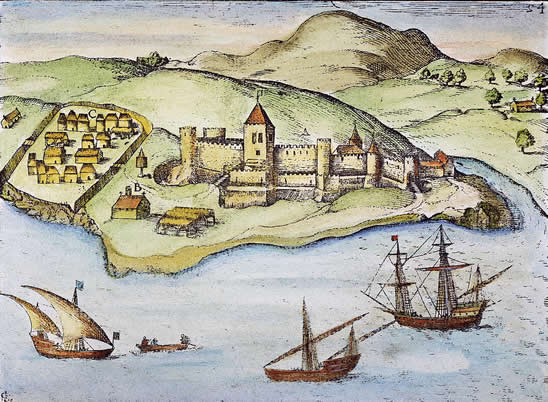
By the 16th century the Portuguese, with their far more heavily armed caravels, dominated the trade on both coasts of Africa, building castles to protect their trading interests from the African chiefs and Arabs with whom they were in competition. In 1498 Vasco da Gama reached India, thus making Portugal the first of the European maritime trading empires.

On his voyage down the West African coast, he had seen Arab dhows picking up the vast amount of gold that the Mutapa empire and the Shonas sent to the coast, a product of the rich gold mining that was the greatest heritage of old Zimbabwe.

Abahai Khan - Manchu Military

Abahai Khan - Manchu Military

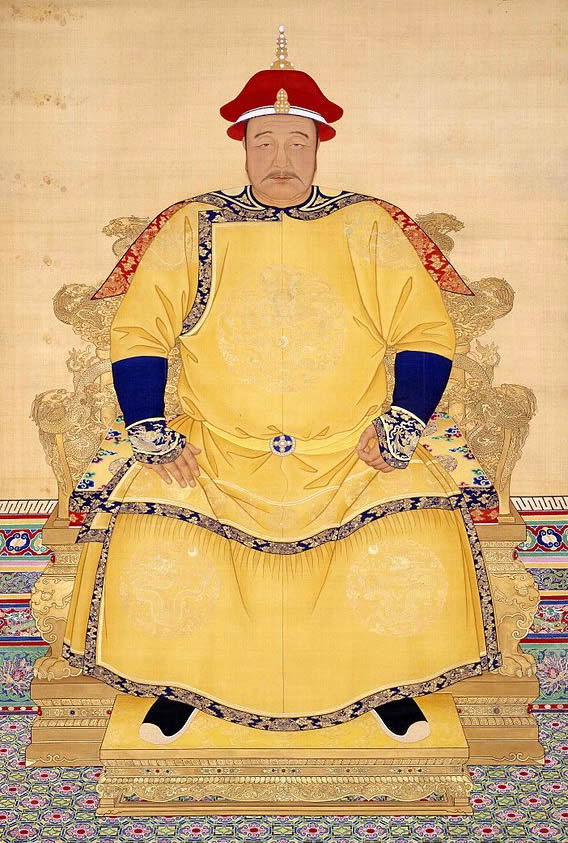
Abahai (also named Hung Taiji) was the eighth son of Nurhaci, a Jurchen tribal chieftain who founded the Manchu state in what is today northeastern China. Elected by the Hosoi Beile, or council of clan princes and nobles, in 1623 to be his father’s successor, Abahai built upon his father’s foundations for a Manchu state during the last years of China’s Ming dynasty. In 1644, his son was proclaimed emperor of the Qing (Ch’ing) dynasty, assuming leadership of China as the Ming dynasty collapsed.

The Jurchen tribal people who lived in Manchuria, a frontier region of the Chinese Ming Empire, did not recognize the right of firstborn sons to succeed their fathers. Because of this, all the ruler’s sons were eligible to succeed him in an election by their fellow tribal leaders.

Abahai was elected and continued his father’s unfinished work. He expanded the powerful Banner Army that consisted of Manchu, Mongol, and Han Chinese units and used it to consolidate control of the Liaoyang area in southern Manchuria.


Next he used his military forces to subjugate Korea, forcing its government to transfer its vassal relationship from the Ming dynasty to him. Abahai then conquered the Amur region of northern Manchuria and the Mongols of eastern Mongolia. His next move was to set up a civil administration in the capital city of Shenyang in 1631.

The six ministries and other institutions he implemented were copied from the Ming government, and he staffed them with many Han Chinese administrators. In 1635, he gave his people a new name, Manchu (from Jurchen), and changed his dynastic name from Hou Jin (Hou Chin, adopted by Nurhaci, which means “Later Jin,” after the Jin dynasty that ruled northern China 1115–1234).

By this act, he disssociated his dynasty with the Jin, who had conquered northern China after much bloodshed. Instead he adopted the dynastic name Qing (or Ch’ing, which means “pure”), and he assumed the title emperor rather than khan, which had been his father’s title, because of its nomadic associations.

In 1640, Abahai attacked Jinzhou (Chinchow) at the southern tip of Manchuria, defeating a Ming force. This victory brought the Manchus to the key eastern pass of the Great Wall, Shanhaiguan (Shanhaikuan, or Mountain and Sea Pass). However, this formidable fortress was defended by a strong Ming army, and Abahai was not ready to challenge it. He died in 1643 before he could do so.

Abahai continued his father, Nurhaci’s, work of building up Manchu power, and he transformed the Manchus from a frontier tribal vassal of the Ming Empire to become its rival. Under his rule, a collaborative relationship developed among the Manchus, the Mongols, and the Han, or ethnic, Chinese.

The adoption of the Chinese model of a bureaucratic administration and its inclusion of Han Chinese would characterize the Qing Dynasty and account for its success in conquering and ruling China.

Abbas the Great of Persia

Abbas the Great of Persia

Shah Abbas the Great reigned from 1588 to 1629 during the zenith of Safavid glory and power. He effectively unified all of historic Persia and centralized the state and its bureaucracy.

Using loyal slave soldiers (ghulam) recruited among Caucasians, Abbas successfully destroyed the influence of the Qazilbash princes and extended Crown-owned land taken from defeated local rulers. With English advisers, he moved to reform the army into a successful fighting force.

In the Ottoman-Safavid Wars, Abbas was generally successful. He conquered northwest Persian and in 1623 took Baghdad and then Basra in southern present-day Iraq from the Ottomans. His forces seized Hormuz in the Persian Gulf in 1622, thereby extending Safavid power along this important seafaring trade route.


By the time Abbas came to power, the majority of the people in Safavid Persia, who had previously been Sunni Muslims, had become Shi’i. Qom and Mashad, sites holy in Shi’i tradition, were enlarged into centers for pilgrimages, and the veneration of Shi’i imams became widespread.

The martyrdom of Husayn, Ali’s son, was annually commemorated in massive passion plays and ceremonies; pilgrimages to Kerbala, in present-day Iraq, where Husayn had been killed, became a major event for devout Shi’i.

However, unlike many of his predecessors, Abbas encouraged religious tolerance. He encouraged foreign traders, especially Christian Armenians, who were known as skilled silk producers, to move to Iran. Although the sale of silk became a royal monopoly, Abbas provided Armenians financial inducements, including interest-free loans for building houses and businesses, to move to the outskirts of Isfahan.

In 1592, Abbas made Isfahan his new capital and turned it into a center for Safavid arts, culture, and commerce. Under Abbas, Isfahan’s population grew to more than one-half million people and became a major trading center.

He sent envoys to Venice, the Iberian Peninsula, and eastern Europe to encourage trade in luxury textiles and other goods; he also provided tax incentives to foreign traders. By 1617, the East India Trade Company had established trading posts along Persian Gulf, and Bandar Abbas became a major port. Along northern routes, the Safavids also enjoyed a lively trade with Russia.

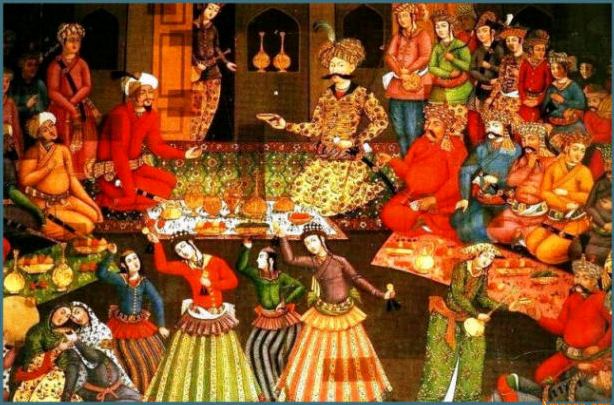
As befitted 16th- and 17th-century monarchs, Abbas presided over a lavish court. He was the patron to numerous court poets and painters, even allowing portraits of himself and members of his court to be painted.

Like Suleiman I the Magnificent of the rival Ottoman Empire, Abbas, who had killed or blinded several of his sons, left no able successor. After his death, the Safavid empire entered into a century-long period of decline. It is a tribute to Abbas’s abilities as an administrator and leader that the empire survived as long as it did.

European Absolutism

European Absolutism

Royal absolutism is a controversial concept among historians. There has been considerable debate about both the proper definition of the term and its applicability to the actual workings of European states in the early modern period.

Scholars have suggested that elements of absolutism appeared at one time or another in France, Russia, Spain, Austria, the German states, and other smaller entities, and that even England (after 1707, Britain) displayed some traits common to absolute monarchy.

At a most basic level, the term royal absolutism suggests a system of state administration centered on and dominated by a monarch as opposed to some other level of society or some other office or institution, and usually without legal or constitutional restraints.


It can be differentiated from the older medieval form of monarchy by its increasing independence from, or suppression of, the feudal apparatus that linked each person in a hierarchy of mutual obligation between higher and lower. An absolute monarch controlled the state directly, rather than being forced to rely on the cooperation of the nobility through a lord-vassal relationship.

Medieval monarchs usually had to contend with multiple challenges to their authority. These challenges included rival claimants to the throne, powerful nobles who could raise armies and funds independent of the sovereign, councils or parliaments that insisted on being heard, merchants and financiers who were more interested in profit than in paying taxes or serving political interests, towns that claimed immunity from certain controls, and frequent peasant uprisings.

Religious institutions, which were often wealthy and had great influence over the population, could also be tenacious in defending their independence from temporal authority.

In essence, the idea of an absolute ruler was developed as one solution to these problems. Rather than living in constant fear of their antagonists, or being forced to share power with them, an absolute monarch could create and maintain a powerful kingdom and rule it effectively.

James II

James II

One of the problems with the study of royal absolutism in history is that too often the term absolute was used in a pejorative sense by those who opposed a particular ruler. This was true of both internal and external conflicts.

In the 1680s, for example, the groups in England who opposed the policies of James II accused him of attempting to establish an absolute monarchy that would disregard Parliament, reimpose Catholicism, and generally strip his subjects of their rights and liberties.

The English would also apply this label to Louis XIV in the late 17th and early 18th centuries, when England fought two wars against France. Even the term absolutism to describe a particular style of government was not coined until after the French Revolution, with the explicit purpose of discrediting the ancien régime.


The concept of a powerful ruler in a centralized state was not always viewed in a negative light, especially among some intellectuals of the 16th through 18th centuries. Three thinkers closely associated with the development of absolutism as a political theory are Jean Bodin (1530–96), Thomas Hobbes (1588–1679), and Jacques-Bénigne Bossuet (1627–1704).

Each was deeply influenced by the political circumstances of his time. Bodin and Hobbes were examining the nature of authority when it had clearly broken down; Bossuet was justifying a system developed in reaction to such crises, but which itself was subject to challenge.

Although their ideas were not necessarily representative of the opinions of their contemporaries, or of the realities of statecraft in early modern Europe, each work was widely known and read in its time and afterward.

Bodin’s Six Books of the Commonwealth first appeared in 1576, in the midst of the French Wars of Religion. Bodin undertook a sweeping study of various forms of government, taking care to distinguish between what he called royal monarchy, despotic monarchy, and tyranny. Despots generally violated the property rights of their subjects; tyrants were arbitrary and purely selfish.

Royal monarchy meant that a ruler, although entirely sovereign, would always seek to rule in the best interests of his subjects. There were no formal constitutional checks on power, but a paternal sense of duty to the welfare of the kingdom would guide the ruler’s actions.

Parliaments

The other limit on royal power evident in Bodin’s own time was the legislative or consultative body, such as the Estates General and parlements of France. All such legislative bodies claimed some rights and privileges from the sovereign.

The political history of France and England after Bodin’s time demonstrated that although rulers of those countries could circumvent Parliament and the Estates for extended periods of time, this eventually led to resistance and revolution.

Hobbes also lived in a turbulent age. Many of Hobbes’s most important political works, including De Cive, Leviathan (both published in 1651), and Behemoth (1681), were heavily influenced by the events surrounding the English Civil War, which ended with the execution of King Charles I.

In Leviathan, his best known work, Hobbes drew a lengthy analogy between a commonwealth and the human anatomy, in which the king is represented as the head and the rest of society as the body. He proceeded to set out his view of human nature unconstrained by government or communal moral standards.

In such a situation, he argued, there could be no guarantee of life or possessions except by violence. Human beings needed government to remove them from this state of nature, and the best government was the one that reduced violence and uncertainty the most.

This required people to surrender a portion of their individual liberty (either by making a covenant between themselves or by being conquered) to a single authority, which would be charged with the protection of their lives, property, and other retained rights. This authority could take one of three forms: monarchy, aristocracy, or democracy.

He argued that of these, monarchy was theoretically preferred, since it was least likely to degenerate into factional struggles and civil war. This monarchy, he continued, should not be elective (as in the Holy Roman Empire) or limited (as claimed in England), or else it was not a true monarchy, since the ultimate source of sovereignty lay with others.

Enlightened Self-Interest

Like Bodin, Hobbes argued that a true monarch would be restrained from acting in an arbitrary and wicked manner through reason and enlightened self-interest. Because the monarch was the embodiment of sovereignty, his or her private interest would be aligned with the public good. A wise ruler would seek counsel from those best equipped to provide it, but would always reserve the personal right to choose and implement the best policy.

Anticipating critics who would point to historical examples of rulers who did not concern themselves with the common good or the most reasonable policies, Hobbes repeatedly stated that whatever problems could be caused by the corruption of a single sovereign would simply be multiplied in an oligarchy or a democracy.

Bossuet’s Politics Derived from the Very Words of Holy Scripture (1709) was an exploration of the nature of kingly power as demonstrated in the Bible and in history. For a number of years Bossuet had served as the tutor to the Dauphin, the son and heir of Louis XIV, and he was thus highly interested in and knowledgeable about the workings of the French monarchy.

He proposed that the power of the king is “paternal,” “absolute,” and “subject to reason,” but he also added a “sacred” quality. The principle that temporal authority originates with God is found in many parts of the Bible, and most medieval European sovereigns were considered to be God’s anointed.

The doctrine of divine right kingship was invoked by 16th and 17th century rulers such as James VI and I of Scotland and England to justify their actions and to condemn resistance or questioning of their authority.

In France, the sacred quality of kingship had an added dimension: since the king was placed on the throne by God, resistance to his power was illegitimate and sinful; those who opposed the political or religious policies of the king, such as the Huguenots, should not be tolerated at all.

The Russian czar Ivan IV (reigned 1533–84) provides an early example of an attempt to centralize authority in the person of the ruler and circumvent existing institutions and controls. Ivan began his reign as the grand duke of Muscovy, but by 1547 he assumed the title of czar (emperor) of Russia.

In 1565, frustrated with the problems still facing his fragmented domains, Ivan created a separate administration under his personal control, the Oprichnina. Originally this was confined geographically to certain towns and parts of the countryside, but over time it grew in both size and scope.

Ivan IV’s reign illustrates two different concepts often associated with absolutism. The first is reform of the state, which included the creation of a standing army and a centralized bureaucracy responsible directly to the ruler, as well as a systematic overhaul of laws and institutions dating from feudal times. The second, despotic and arbitrary rule, was one of the primary reasons that many philosophers and statesmen feared and opposed anything resembling royal absolutism.

The one ruler who is most often associated with absolutism is Louis XIV of France (reigned 1643–1715). While it is true that the Sun King had a more powerful state apparatus at his disposal than his predecessors, and showed more vigor in running France than his immediate successors, he was not primarily responsible for creating the system he led.

France had been divided by internal political and religious wars in the 16th century, although the appearance of a strong ruler, Henry IV, began the process of healing the rifts and stabilizing the government—at least until Henry was assassinated in 1610. His successor, Louis XIII, was not as assertive, and by the 1620s he had effectively delegated much of his authority to Cardinal Richelieu.

Louis XIV may have consciously portrayed himself as an absolute ruler, but the daily reality of managing his kingdom was something quite different. He did not rid himself of all obstacles to his authority, but through a combination of compromise and assertiveness he was able to reduce the resistance of such bodies as the nobility, the parlements, and the church.

Louis XIV was only partially successful in establishing himself as the unquestioned master of his kingdom, and even less so in his attempt to act as the “arbiter of Europe.” In fact, scholars such as Nicholas Henshall argue that the lingering image of Louis XIV as an absolute monarch owes more to the perpetuation of a myth by English polemicists than to his actual behavior.

After the Glorious Revolution in 1688, Henshall says, absolutism came to be defined by the English as everything that their constitutional monarchy was not: French, Catholic, and despotic. This was a simplistic definition that ignored the continuing importance of the monarch in British politics and the real constraints on the power of the French king.

Even with all of the centralization and modernization associated with absolutism in this period, most states still remained a patchwork of different jurisdictions under the nominal control of a single crown. Spain, France, the Austrian empire, and Russia all had ancient internal divisions that no monarch could simply erase, no matter how much he or she might want to.

Portuguese in Africa

Portuguese port in Africa

The Portuguese were the first to make significant inroads into Africa during the age of discovery, yet they were the last to decolonize their African possessions. This was to a large extent true of Portuguese socioeconomic and political activities in the various communities of Africa in which they operated. The Portuguese empire in Africa was the earliest and longest lived of the colonial empires, lasting from 1415 until 1974, with serious activity beginning in 1450.

The first attempt made by the Portuguese to establish a presence in Africa was when some Portuguese soldiers captured Ceuta on the North African coast in 1415. Three years later, a group of Moors attempted to retake it. A better armed Portuguese army defeated the Moors, although this did not result in effective political control.

In 1419, two captains in the employ of Prince Henry (Henrique) the Navigator, João Gonzalez Zarco and Tristão Vaz Teixeira, were driven by a storm to Madeira. A Portuguese expedition to Tangier in 1436, which was undertaken by King Edward (Duarte) for establishing Portuguese political control over the area, followed.


However Edward’s army was defeated, and Prince Ferdinand, the king’s youngest brother, was surrendered as a hostage. Tangier was later captured by the Portuguese in 1471.

The coast of West Africa also attracted the attention of the Portuguese. The Senegal was reached in 1445, and Cape Verde was passed in the same year. In 1446, Álvaro Fernandes was close to Sierra Leone. By 1450, the Portuguese had made tremendous progress in the exploration of the Gulf of Guinea.

Specifically under João II, exploration had reached the fortress of São Jorge da Mina (Elmina), which was established for the protection of the trade of the Guinea. The Portuguese reached the ancient kingdom of Benin and the coastal part of present-day Niger Delta region of Nigeria before 1480. Oba (King) Esigie, who reigned in the last quarter of the 15th century, is said to have interacted and traded with the Portuguese.

The famous Portuguese explorer Diogo Cão sighted the Congo in 1482 and reached Cape Cross in 1486. The Portuguese thus found themselves in contact with one of the largest states in Africa.

The leading kingdom in the area was the Kongo Kingdom built by the Bakongo, a Bantu people whose king, the Mani-Kongo, had his capital at Mbanza-Kongo, modern San Salvador in northern Angola. Other leading states in the area included Ngoyo and Loango on the Atlantic coast.

When the Portuguese arrived on the east coast of Africa at the end of the 15th century, the region was already witnessing some remarkable prosperity occasioned by a combined effort of Africans and Arab traders who established urbanized Islamic communities in the area.

These included the coast of Mozambique, Kilwa, Brava, and Mombassa. From East Africa the Portuguese explorer Pêro da Covilhã reached Ethiopia in 1490. The big island of Madagascar was discovered in 1500 by a Portuguese fleet under the command of Diogo Dias.

The island was called Iiha de São Lourenço by the Portuguese. Other Portuguese might have visited previously, as was evidenced in the stone tower, containing symbols of Portuguese coats of arms and a Holy Cross. Mauritius was discovered in 1507.

By 1550, Portuguese dominance in both the Indian and Atlantic Oceans had been confirmed. Their position was further strengthened by the Treaty of Tordesillas of July 7, 1494, with Spain, leading to the emergence of a large empire. Some African communities were part of this sprawling Portuguese empire.

Commercial Aims

The needs to establish Christianity and Portuguese civilization were not strong motivators; the aims of the Portuguese were essentially commercial. In the East African region, the Portuguese wanted to supplant the preexisting network of Arab seaborne trade.

Consequently, Portuguese bases at Sofala, Kilwa, and other areas such as the offshore islands of Mozambique, Zanzibar, Pemba, Mombassa, and the island of Lamu were established. In this direction, Vasco da Gama took the first step on his second voyage to India in 1502. He called at Kilwa and forced the sultan to pay a yearly tribute to the king of Portugal.

This was typical of Portugal’s dealings with the coast, and unless tribute was paid, the town was destroyed. If it was paid, the local ruler was usually left in peace, provided he carried out the wishes of the Portuguese.

Map of Portuguese in Africa

After Kilwa, Zanzibar was the next place to suffer from the Portuguese. In 1503, a Portuguese commander, Ruy Lourenço Ravasco showed the power of guns by killing about 4,000 men aboard canoes. The men were carrying commodities that were of interest to Ravasco. Available evidence shows that the local men in no way provoked the Portuguese official.

Sofala was another center of attraction to the Portuguese. The town was important because it gave the Portuguese control of the gold supply of the interior of East Africa. The town offered minor resistance to Portuguese incursion. Consequently, a fort was built there to protect the Portuguese colony that now replaced the old Arab settlement in the area.

Kilwa shared the fate that befell Sofala. As in the case of Sofala, the Portuguese met little resistance there. A Portuguese fleet commanded by D’Almeidas captured the town. From there the Portuguese official then sailed away to Mombassa, where they met strong resistance.

Indeed the city was like a thorn in the flesh of the Portuguese. The island was consequently named “the island of war.” However the resistance of the people of Mombassa collapsed and the city was set on fire.

Outside the coast the Portuguese were interested in the gold region of the Zambezi. The Portuguese embarked upon such a massive exploitation of the mineral that within a few years of their activities and occupation, the region had withered to an unattractive settlement.

This development sometimes created a crisis and revolt from the local people. The first serious revolt to succeed was in 1631 when Mombassa rebelled.

It should be noted that it was in an effort to contain uprising from the local people that the Portuguese in 1593 established and garrisoned the great and famous Fort Jesus at Mombassa. Still, the safety and security of the Portuguese merchants were never guaranteed relative to Arab threats.

Already a part of the Indian Ocean community was slipping out of the grip of the Portuguese. In 1622, they were ejected from the Persian Gulf and by mid-17th century, the seafarers of the maritime state of Oman were regularly making incursions and conducting raids as far south as Zanzibar.

By the middle of the 18th century, the maritime trade of the East African coast was more or less out of the control of the Portuguese and the region had gradually resumed its pre-Portuguese commercial activities that made the area an attraction for many traders. The appearance of the British and the Dutch East India Companies was another threat to Portuguese commercial interests in East Africa.

Elsewhere in Africa the Portuguese experimented with the plantation system in São Tomé from where they introduced it to Brazil. Following this development a new era of Portuguese exploitation of Africa started. This was in the area of the slave trade, which lasted for more than two centuries.

During the 16th century, the Portuguese concentrated their slave trading attention on the Kongo Kingdom. During the reign (1507–43) of the Christian king Afonso (Nzinga Mbemba), the Portuguese had already started to export young Kongolese across the atlantic in large numbers.

Although King Afonso disliked the slave trade, he paid in slaves for European goods and services, which he regarded as essential to his kingdom. Such services included those provided by missionaries, masons, carpenters, and other artisans. King Afonso died frustrated with his desires to see the Portuguese technologically transform his kingdom unfulfilled. Instead the slave trade continued unabated.

A turning point in Portuguese exploitation of West Central Africa came in 1575 when Paulo Dia de Novais was sent as a conquistador to Africa. From his base at Loanda, south of the Kongo frontier, several wars were waged against the so-called recalcitrant king of Ndongo, the Ngola. Sometimes the Portuguese made an alliance with the predatory Jaga group encouraging them to wage wars against Ndongo and some parts of Kongo Kingdom.

The situation was so chaotic that early 17th century Mani-Kongos had to send petitions to the Holy See through the missionaries urging them to intervene in the matter, but nothing substantial came out of it. Not even the Portuguese Crown could help the situation.

This was the development when in 1660 the Bakongo turned to war with the Portuguese. The Portuguese defeated them. Further raids weakened the kingdom. In fact many of the provinces began to break away. By 1750 the once powerful Kongo state had become a shadow of its former self.

The high demand of slaves in the Portuguese colony of Brazil put pressure on Ndongo, known as Angola by the Portuguese. The state was the largest supplier of slaves to the colony of Brazil in the whole of Africa south of the equator. The demand was so great that the Portuguese often incited the local communities to wage war on one another in the interest of obtaining slave labor for Brazil.

The Portuguese also tried their hands in commodities other than slaves, such as pepper from the Benin kingdom (in present-day Nigeria) and gold from the Gold Coast. However by 1642, the Dutch had permanently ousted the Portuguese from the Gold Coast.

This development encouraged both the English and French to join in the competition against the Portuguese. By the 18th century, it was the traders of these countries who became very active in the trade of the Gulf of Guinea, while the Portuguese continued with their slave-trading activities.

Meanwhile, before the other European powers joined in international trade, the Portuguese experimented with all sorts of goods. In the 1470s, for example, the Portuguese were able to procure cotton cloth, beads, and other items from the Benin kingdom, which they exchanged for gold on the Gold Coast. The Portuguese also participated in the trade in cowries in the Kongo and its offshore islands. They were also very active in the trade in salt along the Angolan coast.

The Portuguese dominated trade in this era because they were better organized compared to the Africans and they were technologically superior. This showed in the way the Portuguese dislodged the Arab traders along the East African coast who had been established in the area long before the advent of the Portuguese in Africa.

Akan States of West Africa

Akan States of West Africa

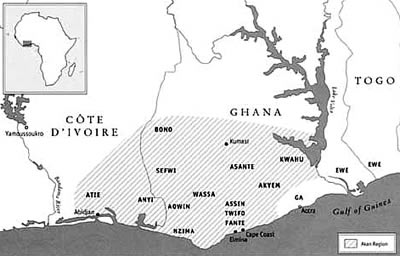
The Akan people of West Africa are descandants of the residents of the early Akan states and continue to live in the area east of the Mende people that makes up present-day Ghana and the Ivory Coast. It is believed that the Akan people have been present in West Africa since the first century.

However, it was not until the 15th century that the world outside Africa became aware of the Akan states. Most of the early information on the Akan came from the Portuguese who developed the West African gold trade.

When the Portuguese first appeared in West Africa, the area controlled by the Akan states stretched from the equatorial forest southward to the Ofin and Pra Rivers. This area roughly compares to what later became the states of Ashanti and Adansi.


While locals called the early Akan settlements Akyerekyere, Europeans identified the people as belonging to two separate groups, the Akany and Twifu (or Twifo). While a number of scholars suggest that members of Akan states were of Dyula ancestry, others disagree. It is true that a number of Dyula settlements existed in Akan states, but the most prevalent view is that Akan states grew in strength to rival Dyula rather than evolving from it.

Further arguments that support the belief that the Akan states were separate from Dyula center on cultural differences. Two customs that were distinctly Akan in nature and that had no counterpart in Dyulan culture were the annual yam festivals and the tradition of matrilineal inheritance.

Subsequent studies of the Akan people have led scholars to believe that the southern branch of the Akan, the Fante, traveled in earlier times from the Volta Gap to the coastlands of Accura, where they intermarried with existing inhabitants.

As the area expanded, several powerful Akan states emerged. The oldest of these is thought to be Bono, which was also called Brong. Asante, which later came to be known as Ashanti, proved to be the most powerful Akan state. Others included Akwamu, Denkyira, Akyem, and Fante.

Europe and the Akan States

When the Portuguese established their presence in West Africa in 1471, they discovered that the Akan people were not living in towns, as was typical in Africa during this period. Instead, the Akan were occupying small kingdoms ruled by kings and queens in the savanna north of the existing gold belt.

Within each kingdom, families that were descended from seven or eight particular clans, identified by matrilineal lineage, lived in villages where they were ruled by their own chieftains. In addition to the chieftains, each family and clan had its own leader. All of the families, clans, and villages worshipped gods that they had individually deified. The various lineages also had their own symbols, which were used to identify matrilineal ancestry.

Once it became clear that the gold trade would develop into a significant economic undertaking, the Akan states realized that it was in their best interest to control the route to and from the Gold Coast.

As a result, the Akan states took on a prominent role in developing West Africa. Early on, the Akan depended on three significant areas to establish their presence in the gold trade. The first of these was Bona, which was located close to the Lobi gold mine.

The others were Banda, which controlled passage to the main gold trading route through the Volta Gap, and Bono, where Bono-Mansa, the capital of the early Akan states, was located. Over the following decades, the gold trade with Portugal exploded, reaching its peak in 1560 with West African gold providing one-fourth of all revenue for Portugal.

From the earliest days, the Akan had been heavily involved in agriculture, developing a farming belt along the outer environs of the equatorial forest where they grew yams and oil-producing palms.

Other agricultural activities included the production of plantain, bananas, and rice, as well as collecting kola nuts, raising livestock, hunting, fishing, and making salt. The density of the soil in and around the forest limited the type of produce that could be grown, and increasing populations soon exhausted the soil.

As a result, the Akan people entered the equatorial forests, where they cleared enough land to support the needs of the people. In the 17th century, agricultural production and the growth of the trade along the Gold Coast led to permanent settlements in the equatorial forest.

Rates of urbanization and increasing sophistication among the Akan states subsequently led to the emergence of more complex political and social structures. Strong leadership among the people of the Akan states allowed them to retain their own cultures in the midst of the expanding European presence, while winning the respect of the Europeans in the process.

Slavery in The Akan States

In the past, attempts by some Akan leaders to dominate the entire region had resulted in tribal wars. As a result, victorious tribes had begun selling members of conquered tribes at local European slave markets.

The more vulnerable tribes, such as the Ewe who lived in the lower Volta area, were continually subjected to being enslaved. Additionally, certain Africans were born into lineage slavery and were forced from their earliest years to serve the dominant African groups. The Akan states also bought slaves from the Portuguese.

Most of these came from Benin, where the government regularly sold off its captives. After 1516, when the government of Benin reduced its military activity, most of the slaves that the Akan states purchased from Portugal came from the Niger Delta and the Igbo region.

The Akan states retained some slaves for local use, while others were placed on slave ships bound for markets along the Atlantic slave-trading route. Domestically, the Akan states used slaves in royal households and in transporting goods to market. Additionally, large numbers of slaves were put to work in construction, in mines, and on farms.

A smaller number of slaves were employed as artisans in various crafts. The Akan states also designated some slaves to be trained to use flintlock muskets as part of citizen armies employed in the Akan quest to crush neighboring states and expand the existing Akan empire.

Along with slaves, the Akan states also commandeered the services of immigrants and migrants to be employed in various tasks. In general, both slaves and forced labor were allowed limited freedom because their numbers prevented total control over the population.

Rivalry Among Akan States

As individual states became more powerful, competition arose among the Akan states, with Denkyira and Akwamu emerging as the most powerful. By the middle of the 17th century, Denkyira had won the right to control most of the western gold-bearing area and had begun forging an empire leading northward to the established European trading routes that led to Banda and Bono.

During the 1670s, Denkyira seized control of the entire area around the western Gold Coast and beyond. On the eastern coast, Akwamu had begun to do the same. From 1677 to 1781, Akwamu worked on its campaign to win control of Accara, which had been under Denkyira control since 1629. Ultimately, Akwamu annexed Accara, in addition to the surrounding areas of the eastern territory.

This expansion provided them with direct control of the trading forts operated by the English, Dutch, and Danish along the eastern Gold Coast. Thus, by 1702, Akwamu had also gained control of the east coast slave-exporting businesses. Despite their enormous strength, greed ultimately destroyed both Denkyira and Akwamu.

Asante, which had originally been a dependency of Denkyira’s, emerged as a major contender in the ongoing power struggle of the late 17th and early 18th centuries, giving birth to the powerful Ashanti state. Ashanti was formed from the various Akan states that had gathered together in the north-central section of the equatorial forest.

The combined strength of these states enabled them to dominate the trading route from western and central Sudan. Within the state of Ashanti, the various kings agreed to accept the supremacy of one king to be based in the capital city of Kumasi. The first Ashanti king was Osei Tutu (c. 1680–1717).

In 1698, Osei Tutu declared war on Denkyira, using arms from Akwamu. In 1701, Ashanti finally succeeded in overwhelming Denkyira, thereby gaining essential territory for its southward expansion.

Three decades later, Akyem, an important Ashanti ally, defeated Akwamu. After the downfall of Denkyira and Akwamu, Ashanti became the most powerful influence in the area now known as Ghana, continuing to rule until the end of the 19th century when the British conquered the area.

Ashanti Development and Expansion

Over the course of the 18th century, Ashanti strengthened its hold on the central forest region and began reaching outward to expand its territory. Each captive area was forced to pay tribute to Ashanti. Areas such as Dagoomba in the northeastern area of the equatorial forest paid their tribute in slaves, which had in turn been taken captive from more remote areas of Africa.

Ashanti then traded those slaves for firearms, smelted iron, and copper. Between the 15th and 19th centuries, some 4 million slaves had been taken for this purpose from south of the equator in an area that extended from Cameroon to Kunene.

Until the pope banned the sale and trade of European firearms to Ashanti out of fear that radical Muslims would lay hold of the guns and use them against Christian traders, the Portuguese regularly traded weapons to Ashanti in exchange for slaves.

By 1820, the Ashanti Empire controlled some 250,000 square kilometers that had been organized into three distinct regions. The first was composed of the six metropolitan chiefdoms that had furnished the military power for King Osei Tutu.

The bulk of the people of Akan descent lived in the second region. The third was composed of dependencies, such as Gonja and Dagomba, which were required to pay tribute of 1,000 slaves each year.

Since the strength of the Ashanti state was always dependent on the force of its military rather than on a sense of nationalism, it became impossible to maintain a hold on those tributary states that made up two-thirds of the Ashanti Empire. This weakness made Ashanti more vulnerable when the British declared war on the state in the 19th century.

Today, the remaining Akan people belong to either eastern or western Akan groups. The five groups of eastern Akan, which all speak Twi, include Asanta, Auapem, Akyem, Denkyria, and Gomua. Sehwi-speaking Western Akan is made up of Anya, Ahanta, Baule, Sanwi (Afema), Nzima, and Aowin.

Despite the fact that each subgroup has its own dialect, groups are able to communicate with one another. While the Akan people continue to practice the tradition of matrilineal descent, some changes have been instituted to make inheritance laws more equitable.

Akbar - Emperor of India

Akbar - Emperor of India

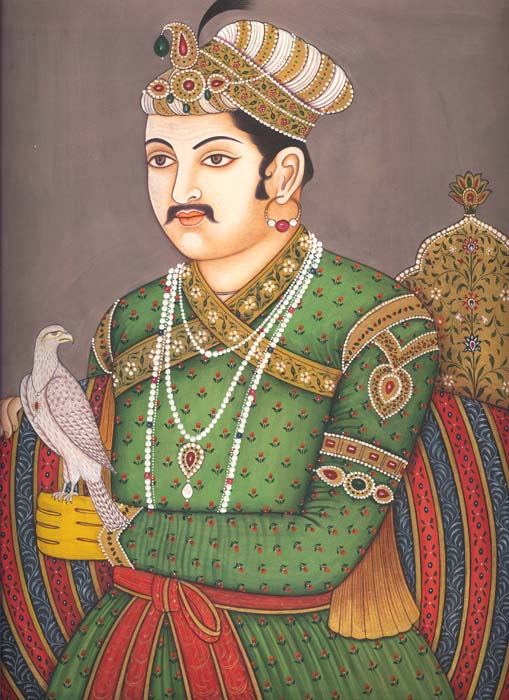
Jalal ud-din Akbar was born in 1542 to Humayun, in India, while the latter was a fugitive ruler. Akbar succeeded to a very shaky throne at age 13 but went on to enjoy a long and successful reign, becoming the greatest ruler of the Mughal (Moghul) Empire founded by his grandfather Babur and his followers, who were Muslims from Central Asia.

Akbar spent much of his difficult childhood on the run. Consequently, he never learned to read or write. However, he was a brilliant man with an inquisitive mind and phenomenal memory who had others read to him throughout his life.

Akbar’s leadership highlighted his diverse achievements. He was a good general who expanded his empire after personally leading troops to defeat the powerful Hindu Rajput warriors. Then he married a Rajput princess, daughter of the ruler of Amber; she would become the mother of his heir.


His lenient treatment of the defeated Rajputs, whom he kept as his vassals, foreshadowed his policy toward other Hindu subjects. In 1572, he conquered Gujrat, thereby gaining access to the sea. When he encountered the Portuguese, he grew to admire their ships, arms, and European merchandise.

In 1573, he signed a treaty with the Portuguese viceroy ensuring safe passage for Indian Muslims crossing the Indian Ocean on pilgrimages to Mecca. Later he added Bengal, Baluchistan, Afghanistan, Kashmir, and part of the Deccan region to his empire.

Like his grandfather Babur, Akbar was a builder. In Delhi, the tomb he built for his father was constructed of red sandstone and adorned with white marble, the precursor of the mature Indo-Islamic style of the taj mahal. He also built a fort at Agra from red sandstone.

Above all, he was noted for building a new palace city at Fatehpur Sikri near Agra, close to the retreat of a Muslim holy man and his mentor. Built of white marble, it became his head-quarters until 1585, when he moved away and the palaces were never occupied again.

Young Akbar leads a Mughal Army of 10,000 during the Second Battle of Panipat

Akbar’s national policies aimed at uniting his subjects. The centerpiece was religious tolerance, partly the result of his disillusionment with Sunni Islam’s rigidity and intolerance and partly to conciliate his Hindu subjects. Thus he abolished the poll tax on non-Muslims and the special tax on Hindu pilgrims.

He hosted religious debates of Hindu, Muslim, Parsi (Zoroastrian), and Christian (Jesuit) scholars at Fatehpur Sikri and concluded that no religion held the exclusive truth. Attracted by mysticism he also took up Sufi Islam and Hindu yogi practices. Akbar eventually established a new religion called Din-I ilahi, or Divine Faith, in 1582.

With Akbar himself as spiritual guide, Din-I ilahi was drawn mainly from Hinduism, Jainism, and Zoroastrianism. Orthodox Muslims were offended and accused him of heresy. He ruled as an autocrat served by ranked officials who were given salaries.


However, 70 percent of his officials were foreigners, mostly Afghans and Persians, and Persian was the official language of his empire. The rest were Indians, both Muslim and Hindu. The employment of some Hindus in government service was an improvement in the status of Hindus from previous Muslim dynasties.

He abolished tolls, made roads safe, and kept dues low to encourage commerce. Akbar was a patron of the arts, and culture flourished during his reign, enormously impressing the Europeans who visited India at the time.

His last years were saddened by the death of two sons from drinking and drugs, and by the revolt of his eldest son and heir, Selim (Salim). Similar troubles also plagued his successors, who faced revolts by their sons and civil wars among them.