Africa and the Slave Trade

enslaved africans
enslaved africans

The discovery of the Americas created new economic opportunities with agriculture the foundation of these opportunities. In 1493, only a year after his first voyage, Christopher Columbus introduced sugarcane into the Caribbean, the crop on which Europeans built the first plantations in the New World.

Sugarcane demanded a large labor force, particularly at harvest. Europeans sought to meet the demand for labor by using criminals, orphans, indentured servants, and Native Americans.

But there was still a need for laborers. Native Americans succumbed to Old World diseases, and the supply of European laborers met only a fraction of the demand. In the mid-15th century, the Portuguese addressed the problem of labor by enslaving Africans to grow sugarcane on the Madeira Islands in the Atlantic Ocean.


The Spanish used slavery in their New World colony Hispaniola (now the island of Haiti and the Dominican Republic), importing the first slaves in 1502. The institutionalization of slavery in the New World spurred trade in slaves. The fact that demand for slaves outpaced the growth in supply by natural increase nearly everywhere in the Americas perpetuated the slave trade over four centuries.

Portugal Leads Slave Trade

Portugal monopolized the trade at the outset. The Treaty of Tordesillas in 1494 granted Portugal access to Africa and with it, slaves. After 1528, Portuguese shipping companies supplied Spain with slaves through a series of asientos, or contracts.

An asiento specified the delivery of slaves in piezas de India, which quantified labor rather than slaves. Men tallied more piezas than women because of the expectation that men would yield more labor than women. For the same reason, the young were worth more than the old.
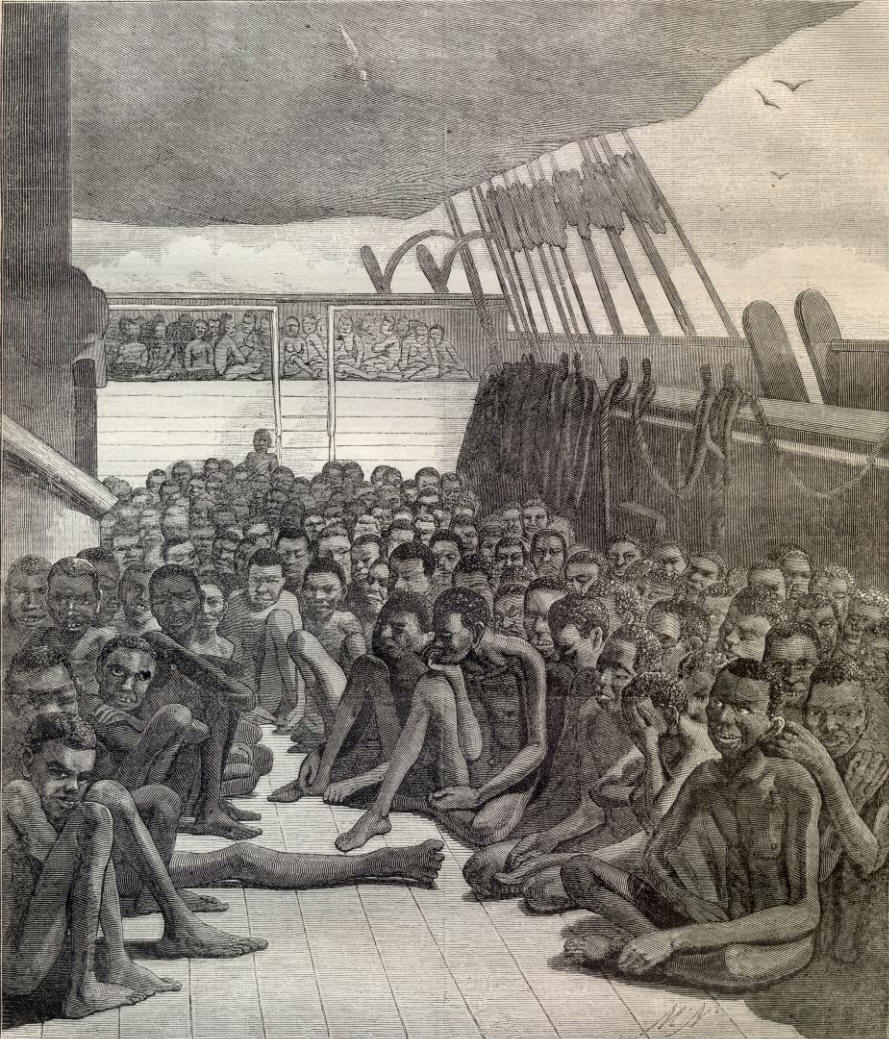
Shipping slaves
Shipping slaves

A cargo of 100 piezas constituted the smallest number of slaves if all were young males and the largest if all were elderly females. Of course slave traders rarely got the “ideal” of all young men fit for the rigors of the plantation.

Market conditions yielded a mix, with a majority being young men with some women also included, particularly those of childbearing age in hopes of perpetuating the slave population by reproduction. A cargo might also contain the prepubescent and elderly because of their low prices. Their purchase, however, entailed risk because they were susceptible to disease and early death.

The value of labor and therefore of slaves fluctuated over time. In 1693, the records of the Portuguese Cacheau Company reveal that one pieza was worth 1.6 slaves. In 1715, however, records of the South Sea Company of Great Britain reveal that the value of one pieza had declined to 1.04 slaves. These figures imply an increase in the demand for slaves over time. Supply rose to meet demand.


Between 1521 and 1550, Spain imported into its colonies 15,000 slaves, 500 per year on average, and between 1551 and 1595, they brought in 36,300 slaves, amounting to 810 per year on average. The largest importer of slaves, Brazil, imported more than 200,000 during these years.

In total Portugal had shipped 264,000 slaves to the New World by 1600. Portugal so dominated trade that by 1600, its maritime rival Britain had shipped only 2,000 slaves to the Americas. No other nation participated in the trade until after 1600.

Portugal’s trade in slaves benefited from political instability in Africa. War engulfed the empire of Jolof, spanning modern Senegal and Gambia, in the middle of the 16th century. Warlords enslaved prisoners, trading them with Portugal for guns.

At the same time, the deterioration of the central government of Kongo, modern Angola, Cabinda, and the Republic of the Congo permitted the Portuguese access to the interior of the kingdom and to a larger number of slaves than had been possible when Kongo confined Portugal to the coast.
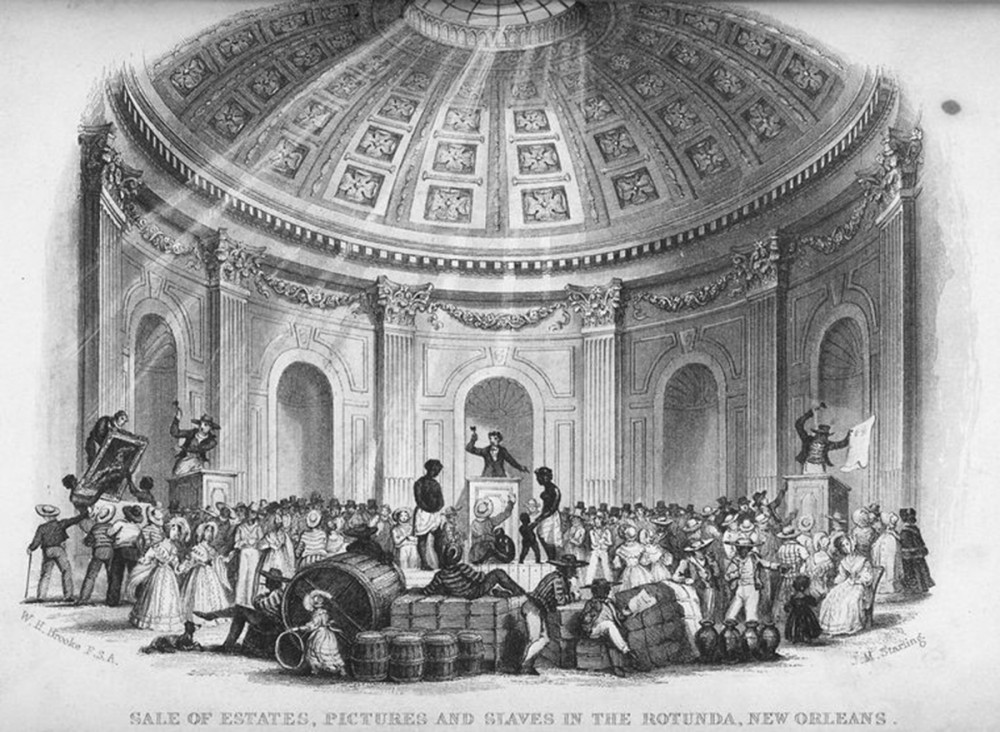
Slaves sale
Slaves sale

In 1614, Portugal allied with the Jaga, a group hostile to the Ndongo rulers of Angola. The resulting war won Portugal captives it sold as slaves. New alliances after 1640 gave Portugal access to slaves in Luanda, the modern capital of Angola.

Political instability gave Europeans more slaves than they might otherwise have expected, for Africa was impenetrable to Europeans into the 19th century. Tropical diseases made it hazardous for Europeans to roam the interior of the continent in search of slaves. Where African tribes remained united, they kept Europeans at arm’s length.

Instead, Europeans established fortresses along the western coast of Africa, the first at Elmina, a town in Ghana, in 1482, and awaited the delivery of slaves from African merchants and chieftains. Once at the coast, slaves waited in dungeons, pens, or stockades until the arrival of a ship. Both Africans and Europeans, intermingling for the first time, were at risk of disease. Confinement in tight quarters on the coast and aboard ship exacerbated the danger to Africans of an epidemic.

Slave Ship Conditions

Once onboard the ships, slaves endured lengthy waits until the captain had enough slaves and the right force and direction of wind to sail. Seldom less than a month, the wait on the coast sometimes stretched to half a year. All the while slaves, packed 100–1,000 per ship, depending on its size, occupied little more than six square feet of space with two or three feet of headroom. Slavers separated men from women, shackling the men in pairs to reduce the danger of rebellion.

Long chains tethered groups of slaves, kept below deck most of the time, for movement to the deck for fresh air and meals. The duration of the wait on the coast and the voyage to the Americas tempted the all-male crews to rape female slaves.

Once a ship set sail, slaves were vulnerable to the vicissitudes of weather and wind. Rain prevented them from getting fresh air on deck and increased the incidence and spread of diseases. Storms imperiled even the most promising crossing.

In 1738, a storm assailed the Dutch ship Leusdan only days from its destination. When it began to leak, the crew, fearing a fight over the lifeboats, locked some 660 slaves below deck, leaving them to drown. Only the crew and 14 slaves on deck survived. The absence of wind brought ships to a standstill and strained the food supply. Ship captains rarely had more than three months of food at the start of a voyage and reduced slave rations on long trips.

The crossing from the Guinea Coast was especially perilous because ships had to traverse the doldrums twice and thereby risk a lengthy calm. One study estimated the mortality rate for ocean crossings of fewer than 20 days at 8 percent, though the death rate increased to nearly one-quarter for voyages longer than two months. Malaria, yellow fever, and intestinal ailments accounted for two-thirds of deaths, and smallpox, scurvy, and suicide the remaining third.

Once a ship reached its destination, an inspector boarded to check slaves for disease, quarantining all slaves if he found one with a communicable disease and prolonging their stay aboard ship until contagion had passed. On land, slaves at last had fresh food and water.

Traders amassed slaves for sale once ashore, selling the young and old first and holding men and women of childbearing age for sale until last in the expectation that prices would rise with the eagerness of buyers to close the deal.

The fact that ovulating women fetched a higher price than pre- and postmenopausal women contradicts the assertion of slave traders that they did not sell slaves for the purpose of breeding. Traders sold most slaves by auction, though an alternative was to fix the price for a group of slaves of similar age and physical condition and allow buyers to choose from among this group.

Other Nations Enter the Slave Trade

Portugal’s hold on the slave trade began to weaken in the 17th century, as the Netherlands entered the fray. After 1630, the Dutch imported into northern Brazil slaves they wrested from Portugal. Taking Curaçao in 1634, the Dutch used it to funnel slaves to their colonies and to those of Portugal, Spain, Britain, and France.

In 1637, the Netherlands captured the Portuguese fortress at Elmina, making it the point of origin of the Dutch slave trade. After 1667, the Netherlands imported slaves into Suriname. In total the Netherlands brought 39,900 slaves to the New World between 1601 and 1650 with the number rising to 76,400 between 1726 and 1770. Thereafter the Netherlands’s share of the slave trade decreased rapidly.

Britain also contested Portuguese dominance. The spread of tobacco in Virginia after 1617 opened British North America to the slave trade. In 1619, the Dutch landed 20 slaves, the first shipment of its kind, in Jamestown. During much of the 17th century, the slave trade in the thirteen colonies was more trickle than deluge.

In 1640, Virginia had only 150 slaves and in 1670, fewer than 1,000. In contrast to Latin America and the Caribbean, slaves in the thirteen colonies increased their numbers through reproduction, diminishing the need to import slaves.

The slave trade in British North America was strongest after the decline of indentured servitude around 1670 and the rise of rice plantations along the Carolina coast about 1700. The thirteen colonies, according to one estimate, imported between 1619 and 1750, roughly 201,500 slaves, an average of 1,550 per year. By comparison the French imported 1,690 slaves per year on average into the island of Martinique between 1664 and 1735 and the Spanish 3,880 per year on average into its colonies between 1640 and 1750.

Following the pattern of British North America, the colonization of the Caribbean opened it to the slave trade. Settling Barbados in 1624, Britain imported the first slaves in 1627. Thereafter the slave trade grew with the spread of sugar cultivation as the trade had in the thirteen colonies with the tobacco boom.

Barbadian imports increased from 6,500 slaves between 1640 and 1644 (an average of 1,300 per year) to 36,400 between 1698 and 1707 (an average of 3,640 per year). In Jamaica sugar and the slave trade took hold in the middle of the 17th century.

Between 1651 and 1675, planters imported 8,000 slaves, an average of roughly 330 per year, roughly one-sixth the number imported into Barbados. By the turn of the century, however, Jamaica had eclipsed Barbados, importing between 1676 and 1700 77,100 slaves, an average of roughly 3,210 per year.

Extrapolating the number of imports from the Royal African Company, a slave trading firm granted a monopoly by King Charles II, to all traders throughout Jamaica, planters imported into the island roughly 7,800 slaves between 1708 and 1711, an average of 2,600 per year.

Between 1655 and 1674, Barbados supplied Jamaica with one-third of its slaves though the proportion fell by the turn of the 18th century to 5 percent. By then most imports came from Africa though the voyage to Jamaica was 1,000 miles farther west than Barbados. The Leeward Islands were the last of Britain’s Caribbean holdings to enter the slave trade. By 1670, island planters had imported only 7,000 slaves.

The numbers grew to 44,800 between 1672 and 1706, an average of 1,280 per year, with another 43,100 between 1707 and 1733, an average of 1,600 per year. In total the British imported 250,000 slaves into the Caribbean by 1700, and throughout the Americas, traders of all nations bought and sold 266,100 slaves between 1519 and 1600.

This represents an average of 3,300 per year, with the number rising to roughly 1.3 million between 1726 and 1750, an astonishing average of 52,000 per year. In all the New World absorbed more than 1.5 million slaves between 1519 and 1750.

Songhai Empire

Jenne mosque

The Songhai Empire was the largest empire in the history of western Sudan. It grew from the small state of Gao, which was founded between 500 and 700 a.d. However the empire did not become a major force in the history of empire building and territorial expansion until 1464 when Sunni Ali, also known as Ali Beer, became the king.

In 1469 and 1470, his military campaigns led to the incorporation of Timbuktu and Azawad, located northward and northeast, respectively. In 1473, he attacked Jenne, a great Islamic center located southward, and in 1483, he was able to drive the Mossi out of Walata-Baghana.

Within 28 years of his ascendancy, Sunni Ali had converted the little state of Gao into a magnificent empire stretching from the Niger in the east to Jenne in the west, and from the Timbuktu in the north to Hombori in the south. He was said to be a ruthless ruler who maltreated all those who opposed his administration and did all that was possible to keep vassal states under firm administrative control by appointing governors who administered his orders.


Payment of tributes, which were in form of goods and contribution of workforce for further territorial expansion, placed the empire on a powerful economic and political footing.

The death of Sunni Ali in 1492 was followed by a 40-month reign by his son Sunni Baru, who was deposed in 1493 by Askia Muhammad Touré. Askia Muhammad Touré, popularly known in history as Muhammad the Great, completed the process of nation building and conquest initiated by Sunni Ali by extending territories of Songhai Empire to Baghana and Taghaza, a significant caravan route and salt producing area.

Songhai people

While Sunni Ali’s reign was characterized by ruthlessness and dislocation of commerce, that of Askia Muhammad the Great was known for the pacification of the subjugated people and the promotion of commerce, Islamic scholarship, and general tranquility.

His 1496 pilgrimage to the holy city of Mecca had far-reaching consequences for the promotion of Islam as it attracted Muslim clerics and commerce to the empire. Islamic religion flourished in the great Islamic centers such as Timbuktu and Sankore. The University of Sankore produced the likes of Mahmoud Kati and Abdulrahman As Sadi, whose books are valued sources for the reconstruction of the history of Songhai and western Sudan in general.


Askia Muhammad the Great relied on the advice of Muslim clerics in governing the empire and made Islamic law the instrument of political and administrative machinery in western parts. In the eastern territories of Gao and Kikiya he allowed traditional religion to exist by granting non-Muslims of the region the freedom they needed to practice their religion.

As had his predecessor, Askia Muhammad divided the entire kingdom into provinces administered by governors, or kio. The central administration consisted of a council of ministers predominantly from his immediate and extended families. While Jenne controlled internal commerce, Gao and Timbuktu served as link to other economic centers in the east and northeast and west and northwest, respectively.

Songhai map

Short-lived Prosperity

The prosperity of the empire was however short-lived. Starting in the middle of the 16th century, internal problems hindered the government and provided an enabling condition for its invasion and destruction by the Moroccans in 1651. At the top of the list of the internal factors that led to the fall of Songhai Empire was the succession dispute among the sons of Askia Muhammad the Great.

Aside from allowing hitherto subjugated states to assert their independence, this development inhibited economic prosperity and further territorial expansion. The Civil War of 1588 had its origin in poor internal control exemplified in the succession dispute between Ishaq and Sadiq, two sons of Askia Daud, and the crises between the western parts, which was under strong Islamic influence, and the east, under the firm control of the non-Muslims.

The last straw was the Moroccan invasion of 1591. The defeat by the Moroccans can only be appreciated against the backdrop of the fact that the empire on the eve of the invasion was in the throes of an internal convulsion. Al-Mansur, the sultan of Morocco, who had failed in two early expeditions, wasted no time to invade the empire during its most turbulent period.

View of Timbuktu
View of Timbuktu

In 1591, he attacked Songhai with 4,000 professional soldiers and another 2,000 armed with arquebus, a gun with three legs. Askia Ishaq II raised an army of 18,000 cavalry and 9,700 infantry to resist the invasion of the Moroccan army.

The overwhelming numbers of the Songhai army could not defeat their Moroccan counterparts in the battle, known to history as the Battle of Tondibi; the Moroccan army was more professional, disciplined, and equipped with sophisticated weaponry.

The Moroccan invasion led to the demise of the Songhai, the largest empire to have emerged in western Sudan. The guerrilla warfare initiated after 1591 was not formidable enough for the reassertion of political freedom.

The invasion led to loss of lives and property and the extension of Moroccan political hegemony over Songhai. Islamic scholars and clerics fled to other parts of the western Sudan and the great Islamic centers of Timbuktu and Sankore lost their hitherto prime position.

Spanish Armada

Spanish Armada
Spanish Armada

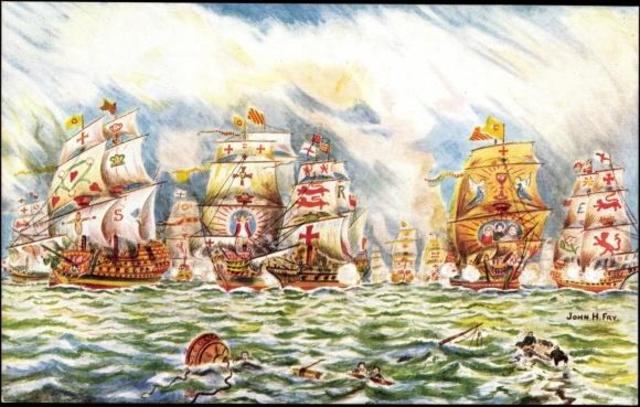
The growing frictions between England and Spain in the mid-16th century gradually led to the armed conflict between the Spanish “invincible” fleet, Armada, and the English Royal Navy in the English Channel and around the British coast in 1588, resulting in the devastating defeat of Spain and a glorious triumph of Queen Elizabeth I of England.

When Queen Elizabeth (r. 1558–1603) ascended the English throne in 1558, King Philip II of Spain (r. 1556–98), who had been the husband of the English Queen Mary I (r. 1553–58), showed interest in proposing marriage to Elizabeth in order to form an alliance with England to balance the French power on the Continent.

When Elizabeth chose to procrastinate, Philip gradually lost patience. In the mid-1580s, the situation changed dramatically, when Philip II, a fervent defender of the Roman papacy, joined his old French Catholic rivals in their wars against the French Huguenots and the Dutch Calvinists.


Meanwhile, Elizabeth became the archheretic of the Catholic world, after Pope Pius V excommunicated the queen in 1570 for declaring herself the “Supreme Governor” of the Church of England and introducing Calvinist rituals into public worship for her people.

King Philip’s hostility toward Queen Elizabeth was linked closely to his own personal trouble with his Calvinist Dutch subjects. In 1578, the king appointed the duke of Parma to suppress the Calvinists in the northern provinces of the Netherlands, who had been rebelling against Habsburg Dynasty control for decades. While the duke gained some ground in the south, the ten northern provinces declared the independence of the United Provinces, or Dutch Republic, in 1581.

Facing escalating pressure from the duke of Parma, the Dutch sought military assistance from Queen Elizabeth. She sent an army of 6,000 soldiers led by the earl of Leicester to the Netherlands, and the joint Dutch and English forces began to hold a front to check Parma’s northern advance for two years (1585-87).

To Philip II, the military involvement of the English queen in his personal dynastic affairs rendered her, just as the German Lutherans, the Dutch Calvinists, and the French Huguenots, an enemy of God.

Philip II, moreover, felt humiliated by English piracy on the high seas, which challenged the century-long imperial dominance and commercial monopoly of Spain over the Atlantic Ocean.

In the 1560s, Sir John Hawkins made three risky trips, transporting West African slaves to the Americas for sale, and thus helped England gain a share in the highly profitable slave trade. In the 1570s, Sir Francis Drake carried out a series of raids on Spanish treasure ships on the high seas. Queen Elizabeth enjoyed her share of profits from both adventures.

In 1587, while the duke of Parma made progress in upsetting the Anglo-Dutch alliance in the Netherlands, the Anglo-Spanish relationship deteriorated because of two incidents. In February, Elizabeth issued the order for the execution of Mary, Queen of Scots, who had been a proxy in Philip’s conspiracy against the heretic English queen for about two decades.

In April, Sir Francis Drake led a fleet of 23 English ships, attacking the Spanish homeland, burning about 30 ships in the harbor of Cádiz, and looting treasures from the Spanish merchants worth more than 100,000 pounds in the Azores, of which Elizabeth gained 40,000 pounds.

Philip became convinced that the time had come to crush the middle-aged queen, whom the Catholic world despised and the Habsburgs had to destroy in order to save the Netherlands.

In the late summer, the strategy of the Armada invasion was designed by the king himself. The Armada would sail to the English Channel at the same time as Parma was crossing the channel with his own vessels, carrying 30,000 soldiers from Flanders.

The joint forces would then invade England by disembarking near the mouth of the Thames. The strategic plan was no longer a secret at the end of the year, and Queen Elizabeth decided to take the challenge.

English Naval Forces

By common estimation, the Spanish Armada comprised 138 ships from Spain and different Habsburg dominions, weighing a total of 58,000 tons, carrying 30,000 men and 2,400 cannons. The number of soldiers would be doubled once the forces of the duke of Parma joined in.

The English naval forces comprised 34 royal warships and 170 privately owned ships carefully chosen from East Anglia and Kent. Spain had dominated the high seas for about a century, but its navy was not superior to its English counterparts. The Armada had 21 galleons, which were massive in size, but slow in speed.

The commander of the Armada, the duke of Medina-Sidonia, was an expert of fleet logistics, but not a professional military leader. The soldiers of the Armada were pious Catholics, but inexperienced in sea battles, especially in navigating the Channel, where winds and waves were often unpredictable.

battles of Gravelines

In comparison, the major English warships were also huge, but faster, more maneuverable, and equipped with better guns. The commanders of the English Royal Navy, Lord Howard of Effington, Sir Francis Drake, and Sir John Hawkins, were career seamen, each having unique experiences in sailing and battling on the sea.

The English soldiers, including many veterans from the Dutch War, knew the Channel better and were well prepared for sea battles there. Of course, both sides were determined to win, but neither side calculated correctly how the war would eventually proceed.

On July 29, 1588, after three months of voyage from Lisbon, the Armada reached the Lizard Point, the southern tip of England. It spread into a crescent formation and sailed along the English coast northeastward up to Calais.


The duke of Medina-Sidonia led the main battleships in the center with the vanguard on the left and the rearguard on the right of about 20 capital ships each. On July 31, the English naval ships sailed out from Plymouth with an equally impressive force and kept chasing the Spanish fleet.

For next few days, the two fleets faced off tensely in the Channel, but neither side attempted a major military engagement. The Armada was approaching Calais on August 6, hoping to join the forces with the duke of Parma as planned by Philip II himself.

However, the duke had been outmaneuvered by the Dutch forces on land and sea in Flanders, did not dare risk being lacerated while convoying his army in his own small barges from Flanders across the Channel to England.

While the Spanish were considering how to get Parma’s soldiers embarked, eight English blazing fireships, on the night of August 7, penetrated the colossus of the Armada, breaking the crescent formation, setting fires on Spanish ships, and causing the whole fleet to flee in panic. On the following day, the Spanish fleet suffered from an all-day gale blowing from the south-southwest to the north-northwest, and lost many lives in the battles of Gravelines.

Afterward, the continuously deteriorating weather dispersed the Armada into the North Sea, and thus buried any hope for the duke of Parma to join the Armada for invading England. On its way back to Spain, the Armada was forced to sail around the Scottish and Irish coasts and continued to lose ships and lives under the fierce chase of the English naval force.

In mid-October, the surviving Spanish ships miraculously navigated back home. The final tally of the Armada’s loss was appalling. Only 60 of 130 ships could be accounted for, and 11,000 lives might have been lost.

In 1588, Spain undoubtedly lost the battle, Philip II was certainly humiliated, and the English victory saved England from a very probable disaster anticipated by its enemy. However, the defeat of the Spanish Armada did not alter the policies and behavior of the Spanish, English, or other major European monarchs.

The religious wars continued to spiral all over Europe. Neither did it immediately change the geopolitical balance in Europe. Spain recovered quickly and continued its interventionist role in transnational affairs of Europe, and England did not transform itself into a superpower overnight. However, Queen Elizabeth emerged from her victory a heroine to her subjects in England and Protestants all over Europe.

War of the Spanish Succession

War of the Spanish Succession

The War of the Spanish Succession (1701–14) was a great European conflict fought over which claimant would assume the vacant throne of Spain.

Throughout the 16th century, Spain had been ruled by the Habsburg dynasty, which also controlled Austria and other parts of Europe. Charles II (1661–1700), the last Habsburg king of Spain, had no legitimate heir. He named Philip, duc d’Anjou (1683–1746), as his successor.

The Bourbon dynasty, which ruled France, had been long-standing rivals of the Habsburgs; the closest claimant to the Spanish throne was Louis XIV’s eldest son with Maria-Theresa. However, the princess had been barred from her rights to the Spanish throne as part of her marriage contract.


This condition was contingent upon receipt of the bride’s dowry, which was never paid. Since the promotion of Louis XIV’s son to the Spanish throne would unite the thrones of both France and Spain and certainly prompt a reaction from the European powers, Louis XIV advocated that his younger grandson, duc d’Anjou, rule Spain.

Leopold I (1640–1705), Holy Roman Emperor, king of Austria, and member of the Habsburg family, attempted to preserve his family’s control of Spain by forwarding himself as the rightful successor to Charles II. Such a situation would unite the thrones of Austria and Spain, a situation unacceptable to the European powers, and Leopold I advocated his son, Archduke Charles (1685–1740), as king of Spain.

Expanding French Influence

Milan regiment (Spanish) in war of the spanish succession
Milan regiment (Spanish)
Louis XIV’s attempts to expand French influence on the European continent prompted England and the Netherlands to side with the Holy Roman Empire against France in order to preserve the balance of power.

The son of Leopold I’s daughter, Prince Joseph Ferdinand of Bavaria (1692–99), was the preferred candidate as king of Spain by the European powers, who feared either family’s gaining too much dominance. Prince Joseph Ferdinand was agreed upon as heir in 1698, but he died of smallpox in 1699. England then ratified the Treaty of London (1700) recognizing Archduke Charles as heir to the Spanish throne.

Charles II died in 1700. He declared the duc d’Anjou his successor and Louis XIV quickly declared his grandson Philip V king of the Spanish empire. England could not afford war with France and recognized Philip V as king of Spain in 1701.

Louis XIV attempted to solidify his newfound influence by severing both England and the Netherlands from Spanish trade. The blow to both countries’ commercial interests forced them into an alliance with Austria against France and Spain.

The Treaty of the Hague (1701) of the Netherlands, England, and Austria recognized Philip V as king of Spain but transferred sections of Italy and the Netherlands under Spanish rule to Austria. It also confirmed England’s and the Netherlands’s commercial rights in Spain.

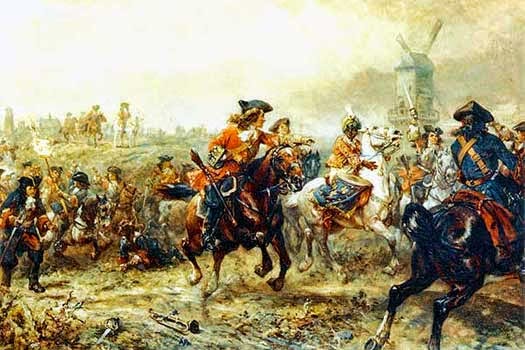
The war began in 1702, when Austrian forces invaded Spanish territories in Italy, forcing French intervention. England, the Netherlands, and several German states sided with Austria while Bavaria, Portugal, and Savoy supported France and Spain. Other opportunist states joined sides in the conflict, expanding fighting throughout Europe and North America, where the conflict became known as Queen Anne’s War.

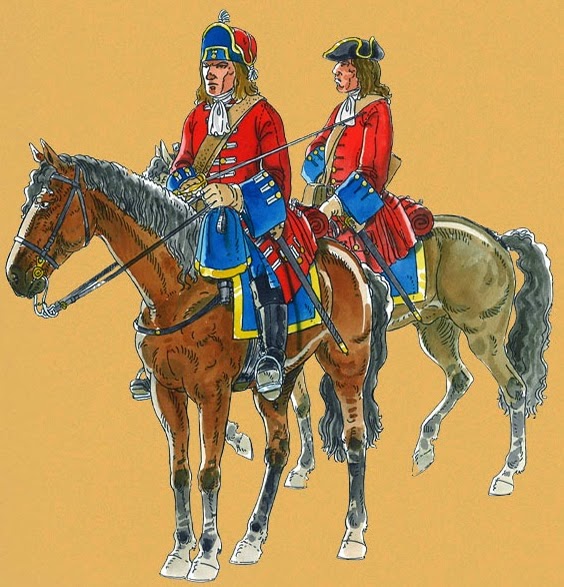
The Royal Regiment of Dragoons circa (spanish) in The War of The Spanish Succession.
The Royal Regiment of Dragoons circa (spanish)

The duke of Marlborough captured territories in the Netherlands in 1702–03 while Prince Eugene held French forces in Italy. The French, under the duc de Villars, scored a victory at Friedlingen in 1702. Success in Alsace, located between France and the Holy Roman Empire, presented the opportunity for an invasion of Austria in 1703, but dissention among French commanders ruined this opportunity.

Marlborough moved his troops from the Netherlands to Bavaria, linking with Prince Eugene’s forces to defeat the French at the Battle of Blenheim (1704). Meanwhile, Portugal and Savoy switched sides, joining the coalition headed by England, Austria, and the Netherlands. In 1704, England captured the strategic island of Gibraltar.

The French, under the duc de Villars, scored a victory at Friedlingen in 1702

French Invade Italy

In 1706, French forces evacuated Italy following Prince Eugene’s victory at Turin and the Netherlands following Marlborough’s victory at Ramillies. In 1708, following Prince Eugene’s disastrous expedition into Provence the previous year, Marlborough and Eugene won at Oudenarde and captured Lille.

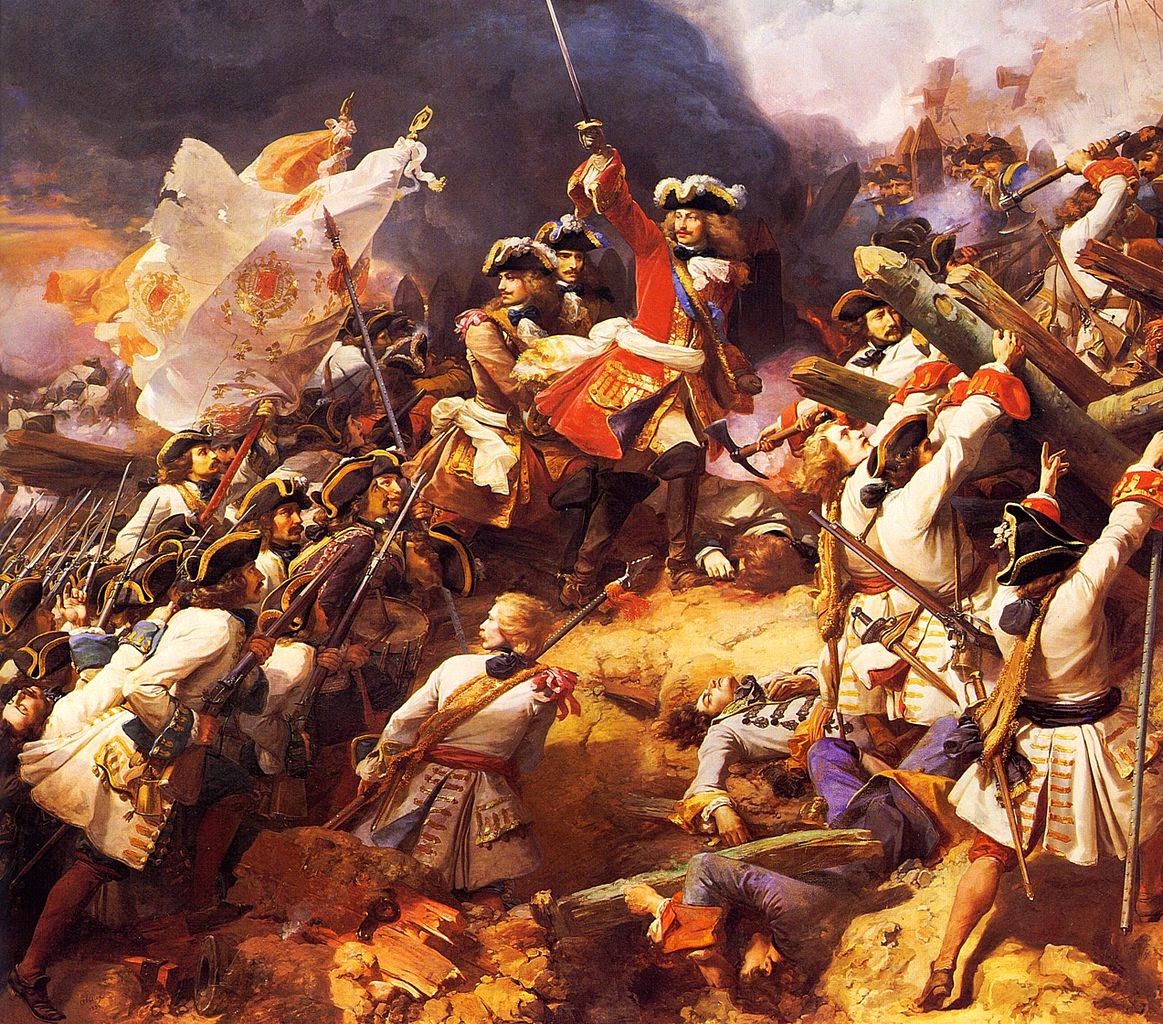
French forces retreated, losing an additional battle at Malplaquet (1709). Allied campaigns in Spain (1708–10) garnered little success in weakening Philip V’s position. Louis XIV opened peace negotiations, but his refusal to join against his grandson brought negotiations to a halt.

In 1711, the death of Holy Roman Emperor Joseph I (1678–1711) resulted in the ascension of Archduke Charles (Charles VI) to the thrones of Austria and the Holy Roman Empire. The English opened negotiations to end the war.


The Treaty of Utrecht (1713) ended hostilities among France, Spain, England, and the Netherlands. Charles VI continued the war, finally ending hostilities by signing the Treaties of Rastatt and Baden (1714), which complemented the general settlement of the Treaty of Utrecht.

Philip V retained the Spanish throne under the condition that he and his descendants were barred from the throne of France. Austria gained territory in Italy and the Netherlands previously belonging to Spain while England gained Gibraltar, Minorca, and exclusive rights to slave trading in Spanish America for 30 years.

France recognized Anne as queen of England and surrendered some of its American territories. France’s dominance over the European continent was checked and the notion of the preservation of the balance of power emerged as the cornerstone of European politics for centuries to come.

The Battle of Malplaquet. This Pyrrhic victory began to revive French fortunes in the war.