Taj Mahal

Taj Mahal
Taj Mahal

There are very few buildings in the world more famous than the Taj Mahal, a queen’s mausoleum in Agra, India. The sense of romance that the Taj Mahal invokes was developed as a result of British fascination with this structure during the late 18th century and has continued into the 21st century.

This monument was built by the Mughal emperor Shah Jahan after his favorite wife, Mumtaz Mahal, died while giving birth in 1631. Shah Jahan was deeply affected by her passing, and her body was carried from Burhanpur to Agra to be entombed until the completion of the Taj Mahal.


In 1631, Shah Jahan began the construction of the Taj Mahal. Despite the fact that a massive labor force was involved in its construction, it took approximately 17 years to complete the main structure. A small village of artisans was created near the site in order to accommodate their immediate needs. In fact, many of the materials used for the construction of the Taj Mahal originated from China, Egypt, and Tibet, and a large number of people were involved, including Europeans.

The layout of the Taj Mahal has symbolic meaning; its main gate symbolizes a barrier between the outside world and the purity and serenity of the inside world. It is constructed of white marble, the color of purity. The use of water in the garden also symbolizes purity, emphasizing the belief that the Taj Mahal is a holy site. As one enters the heart of the mausoleum, Islamic prayers can be read above the doorway, which are recited before a person of the Islamic faith dies.

Shah Jahan and Mumtaz Mahal

It has been rumored that Shah Jahan wanted to construct a black marble mausoleum for himself beside his wife’s. But his son and successor, Aurangzeb, did not fulfill his wishes, and he was buried in a separate crypt beside his wife. The architecture and decorating of the Taj Mahal epitomized the highest achievement of the Indo-Islamic artistic style.

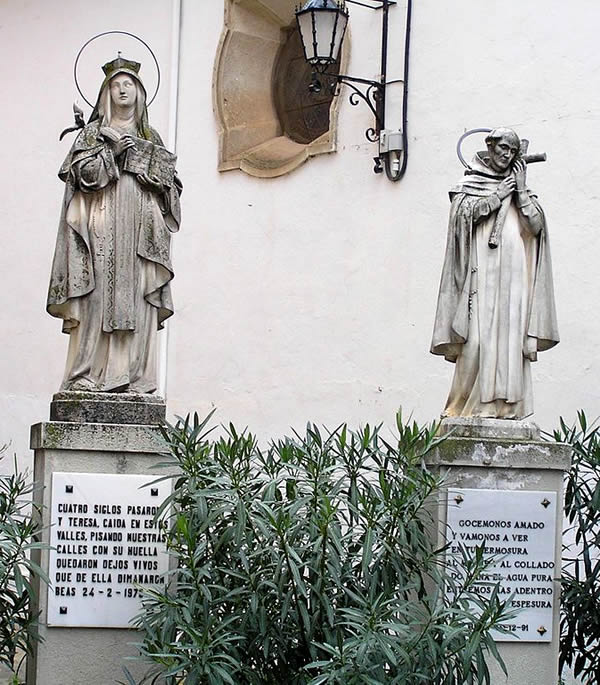
Teresa of Ávila and John of the Cross

Teresa of Ávila and John of the Cross

Juan de Yepes y Álvarez, later known as John of the Cross, was born in 1542 in Fontiveros, a small town north of Ávila, Spain. John’s father died when he was three and his mother was left to provide for her three sons, one of whom died in childhood.

From the age of nine to 22, John lived in Medina del Campo, where he was fortunate to have the help of Don Alonso de Toledo, who provided him with a job as an orderly in a hospital and who paid for his studies at the Jesuit school.

In 1563, John entered the Carmelite monastery of Santa Ana in Medina del Campo; from there he was sent to study for the priesthood at the University of Salamanca.

He was an excellent student, yet he always found time to dedicate to prayer and to helping the poor. John was ordained a priest in 1566. A year later, he met Teresa of Ávila and, at her urging, he joined in her efforts to reform the Carmelite order in Spain.


The story of the life of John of the Cross is intertwined with the story of the life of Teresa of Ávila. Teresa was born into a well-to-do family in Ávila, Spain, in 1515. Hers was a generation when the Reconquista Christians threw out Muslim overlords of Spain. It was a time of knights, chivalry, and fierce religious devotion reflected in her own writing and ideals.

She entered the Carmelite Convent of the Incarnation in 1535. After 20 years in the convent, at the age of 39, Teresa experienced a deeper conversion and a desire to return to the primitive Carmelite rule of Mount Carmel. The Carmelite order in Spain had lapsed in the observance of the rule of poverty, prayer, and seclusion lived out by the first hermits. Teresa felt called by God to bring about a reform in the practices of her religious order. She established her first house for nuns in 1562.

She was looking for someone to help her with the reform of the friars when she heard about John. She arranged to meet John in 1567 and convinced him to join her cause. He inaugurated the first house of Discalced (barefoot) friars in Durelo, Spain, in 1568.

The friars adopted the more ascetic and contemplative observance of the primitive rule that involved a very simple lifestyle and many hours of prayer. They made some changes to the rule that allowed them to leave the monastery to preach and to hear the confessions of the nuns. John traveled extensively in his work to reform the order.

The efforts made by Teresa and John to bring about reform were met with mixed response. While many supported their efforts, some were threatened by the changes they were making. John was arrested several times by his own religious brothers. He spent nine months as a prisoner in a six-by-10 room at the monastery of the Carmelite friars in Toledo.

During his imprisonment, John composed some of the poetry for which he would later be famous. After his escape from prison, John was elected superior of the Monastery of Calvario. For the next eight years, he served as superior of various houses of the Discalced friars in Andalusia, traveling extensively in his efforts to support the reform.

In 1589, he left Granada and went to Segovia, where he lived until he became ill in 1591. As a result of the painful medical practices of his day and the scandalous neglect of the prior who held an old grudge against him, John’s condition worsened. He died at the age of 49 in the year 1591. His body was moved in 1603 to Segovia, where it still resides.

Sainthood Declared

John was declared a saint by the Catholic Church in 1726, and he was made a doctor of the church in 1926. He is best known for his poetry and prose reflecting his spiritual wisdom and his profound, very personal relationship with God. His major works are four books that consist of prose commentary on four of his most famous poems: The Ascent of Mount Carmel, The Dark Night, The Spiritual Canticle, and The Living Flame of Love.

The remaining of John’s correspondence with others gives a taste of the personal, affectionate relationship that he had with those he counseled. John was an artist, a mystic, and, above all else, he was a lover of Christ, who lived a life of charity and service to others.

Teresa is most known for her instruction on spirituality and prayer. Her most important works include Interior Castles, The Way of Perfection, Foundations, and her own account of her life. All of the correspondence between John of the Cross and Teresa of Ávila has been lost or destroyed.

Thirty Years’ War

Thirty Years’ War
Thirty Years’ War

The Thirty Years’ War was a series of wars, escalating from armed clashes of German princes to military confrontations involving all major European monarchs from 1618 to 1648. It was a crucial stage in the ongoing European wars of religion between Catholicism and Protestantism.

It was also the first civil war in continental Europe that mixed religious conflict with traditional princely territorial ambitions and emerging sentiments of national unity and transnational geopolitical balance of power.

In 1617, Ferdinand of Styria (1578–1637), the Habsburg heir apparent to the imperial throne of the Holy Roman Empire, was elected to be king of Bohemia. The Calvinists, the majority in Bohemia, revolted against their new Catholic king.


In May 1618, a group of Calvinist noblemen threw the two most hated Habsburg councilors from the Hradschin Castle’s window into a ditch, severely injuring both. This incident, termed the “defenestration of Prague,” put the Calvinists in temporary control over Bohemia and spread the religious conflict into surrounding principalities.

In 1619, Ferdinand succeeded to the throne of the Holy Roman Empire as Emperor Ferdinand II. In Bohemia, the Calvinists openly rejected Ferdinand as their king and offered the Crown to Frederick V of the Palatinate. In response, Ferdinand II secured support from the papacy and the Catholic kings of Spain and Poland and formed an alliance with Maximilian I, duke of Bavaria (1573–1651) and leader of the German Catholic League.

In November 1620, Catholic forces invaded Bohemia and defeated Frederick’s Union at the Battle of White Mountain. The Bohemian phase of the Thirty Years’ War ended with Catholic victory in 1623. Emperor Ferdinand recovered his Bohemian throne, and Maximilian acquired Palatinate after Frederick was deposed and his Union dissolved.

Spanish Cavalry officer

In 1625, as the triumphs of the Catholic forces enabled Ferdinand to restore centralized monarchical power over Austria and Bohemia, Christian IV (r. 1588–1648), Lutheran king of Denmark and duke of Holstein, intervened to rescue the German Protestants.

However, his army was no match for the Catholic League. Ferdinand secured assistance not only from Tilly, but also from Albrecht von Wallenstein, a Bohemian nobleman, who was a Lutheran by birth, then a converted Catholic, and now an ambitious mercenary with an eye on the Bohemian Crown lands.

After a series of military victories, Tilly and Wallenstein scattered the renegade German princes and compelled Christian IV to make peace in 1628. The Danish phase of the war ended again with Catholic victory. In 1629, Emperor Ferdinand issued the Edict of Restitution. The edict outlawed Calvinism, restored the former ecclesiastic territories to the Catholic Church, and restricted the right of legal appeal to the imperial diet by the Protestant princes.

Gustavus Adolphus of Sweden

The edict alienated the German Protestant princes. Meanwhile, the alliance between Spain and the Empire alarmed Lutheran king Gustavus Adolphus of Sweden (r. 1611–32) and King Louis XIII of France (r. 1610–43) and his chief minister, Armand-Jean du Plessis, duc and cardinal de Richelieu.

In the summer of 1630, the Swedish king, encouraged by the French Cardinal Richelieu and supported by the German Protestant princes, invaded Germany. After winning a few noteworthy battles in the early stage, he crushed Tilly’s Catholic League army in the battlefield at Breitenfeld in September of 1631.

Facing this defeat, Ferdinand was forced to turn to Wallenstein, who had been disgraced by the German Catholic powerhouses for his greedy and fast expansion of personal power. In November 1632, Wallenstein led his newly formed army, engaged the Swedish force at the Battle of Lutzen, and killed King Gustavus Adolphus on the battlefield. He then entered into a secret negotiation with the Swedes.


Because of his treachery, Ferdinand deprived him of his command and ordered his assassination in February 1634. The Swedish phase of the war ended with the Treaty of Prague of 1635, under which the Edict of Restitution was suspended and the Empire’s constitutional order was restored to pre-1618 conditions.

Louis XIII and his cardinal became increasingly disturbed by any possible settlement that would give the Habsburgs in Europe opportunities to mount attacks against France—from Spain in the south, the Netherlands in the north, and from a number of Habsburg territories in the east. A few days before the Treaty of Prague was finalized, France declared war on Spain. In retaliation, Spain invaded France and defeated Sweden, the French ally, at the Battle of Wittstock in 1636.
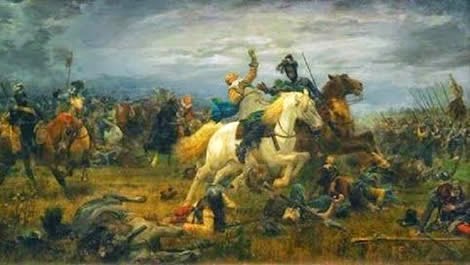
6 November 1632 - the Leu von Mitternacht, Gustavus Adolphus of Sweden, fell in the Battle of Lützen, 20 miles southwest of Leipzig
6 November 1632 - the Leu von Mitternacht, Gustavus Adolphus of Sweden,
fell in the Battle of Lützen, 20 miles southwest of Leipzig

Meanwhile, the German Imperial armies, now combining the Catholics and the Protestants allied with a new sense of national unity, marched into France, forcing the French back in Alsace and Lorraine, ravaging Burgundy and Champagne, and threatening Paris. The French, supported by Dutch Protestants, carried out a few successful counterattacks but could not gain a clear advantage over the enemy.

However, the deaths of Emperor Ferdinand (1637), Cardinal Richelieu (1642), and Louis XIII (1643) gradually slowed down the momentum of the war, and both the new emperor Ferdinand III and the new cardinal Mazarin under the child king Louis XIV began to work toward a peace settlement in 1643.

The German people, after suffering from three decades of havoc of war, political treacheries, religious bloodshed, and economic devastation, had to live miserably for another fives years to see peace.

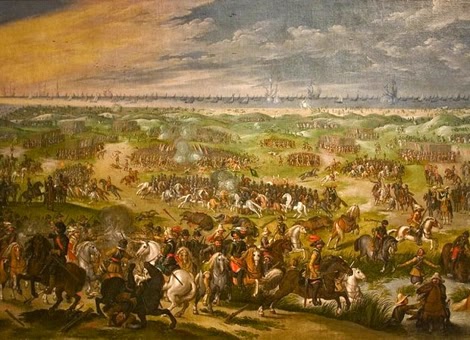
Battle of Rocroi 1643
Battle of Rocroi (1643)

The Peace of Westphalia was finally reached in October 1648, composed of a set of treaties among the enemies in the Thirty Years’ War. It reorganized Germany into a very loose confederation with a unified diet and unified army.

The emperor remained in place symbolically as feudal overlord for the purpose of recognizing and protecting “German Liberties.” The peace legalized Calvinism, gave it equal status as Catholicism and Lutheranism, and recognized the rights of religious minorities in the electorates and principalities.

In short, the peace treaties announced little new but redrew a constitutional framework, which would guarantee a decentralized Germany for another two centuries. However, the territorial changes defined in the treaties did help the rise of Prussia to challenge the traditional authority of Habsburg Austria in the Holy Roman Empire.

In Europe, the peace marked the rapid decline of support for prolonging the ongoing wars of religion, and fresh sentiments of national unity, national interest, and national defense would gradually reshape European peoples and states. It also helped promote transnational cooperation and alliance.

The immediate consequences of the Thirty Years’ War in European geopolitics were the isolation and decline of Spain and the rise of France as the dominant power till the French Revolution at the end of the 18th century.

Tobacco in Colonial British America

Tobacco in Colonial British America

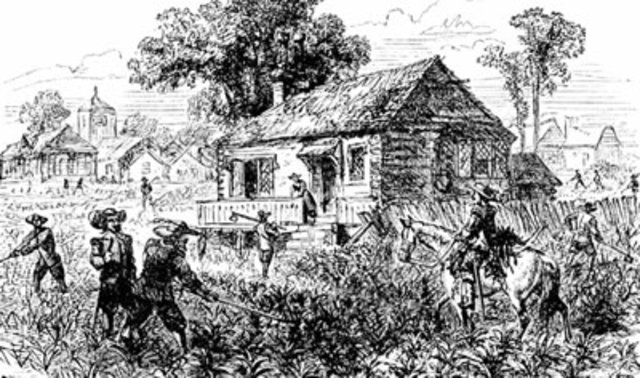
Tobacco is an herb native to the Americas. It is believed to have originated in South America. In 1535, Jacques Cartier found natives on the Canadian island of Montreal using tobacco. The root of the word tobacco comes from the native word for pipe or instrument used to consume tobacco among some native people.

Sir John Hawkins took tobacco to England about 1564 although some Englishmen may have been smoking tobacco before this. In less than two centuries, tobacco was the most important export of the English colonies in North America. It remained a main export of the United States until the addictive and destructive effects of tobacco use became widely understood in the 20th century.

Among natives of the Americas, tobacco use generally had a ceremonial aspect. There is disagreement whether tobacco was always ceremonial or was used in everyday life among indigenous Americans. Because Native Americans believed tobacco was a gift from the spiritual world, they used it as a healing herb.


Tobacco was used for toothaches and earaches and as a painkiller and antiseptic. Tobacco was an important gift item to seal commitments and social arrangements among Native Americans. In North America, a pipe was generally used in tobacco ceremonies.

Growth of Colonies

The future of the colonies in British North America, especially Virginia, grew because of the production of tobacco. Tobacco production affected the economic, social, and geographical development of much of the southern United States.

John Rolfe of Jamestown colony in Virginia in 1612 was the first to find a means of curing tobacco so it could withstand the trip across the Atlantic to Europe. Sailors spread the habit of pipe smoking to northern Europe. When tobacco was introduced into European society, it became popular as a medicinal herb.

Sir Walter Raleigh persuaded Queen Elizabeth I to smoke tobacco in 1600. Although tobacco growing soon began in many parts of the world, including Europe, the British North American colonies soon became the primary source of tobacco for much of the world.

The English obtained tobacco by growing it in their colonies. King James I of England was one of the first to label smoking a filthy, unhealthful habit of lazy people. However, his dislike of tobacco did not prevent him from collecting taxes on the importation of tobacco into England. The Spanish Inquisition banned two other Native American drugs, coca and peyote but, as had King James I, respected the revenue tobacco brought to Spain and did not ban it.

When the Dutch discovered tobacco, they saw it as a bond with the other major Protestant country of Europe, England. Unlike the English, the Dutch sought to gain tobacco by trading for it. The Dutch focus in the New World became setting up trading posts to buy tobacco rather than establishing colonies to grow it.

The production of tobacco was highly labor intensive. At first, indentured servants from Europe labored to produce tobacco but by 1675, African slaves replaced them. Besides labor, the production of tobacco required large amounts of land.

The coastal areas of Virginia and Maryland had lost nine-tenths of their Native American population in a smallpox epidemic in 1617–19. This left land open for the cultivation of tobacco. As indentured servants won their freedom, they too became tobacco growers.

Soon the North American colonists needed more land to grow tobacco. Tobacco quickly removes the nutrients from the soil in which it is grown. Colonists traded with Native Americans for their land and forced the native population farther from the Atlantic coast.

While the tidewater colonies of Virginia and Maryland were engaged in growing tobacco, some northern colonies were forbidding the use of tobacco. In 1632, the Massachusetts Court of Assistants and General Court levied fines on persons caught “taking” tobacco.

Later the colonies of New Netherland (now New York) banned smoking. Connecticut banned the public smoking of tobacco in 1647. Some bans on smoking were more concerned with the danger of fire caused by smoking materials. The Articles of Piracy had rules controlling the smoking of an open pipe on board a pirate ship.

The Navigation Act in 1651 allowed only English ships to import tobacco into England. This angered the Dutch, the Scottish merchants, and the colonies. The Second Navigation Act of 1660 required colonists to sell tobacco only to the English.

Fully 90 percent of all tobacco imported to Europe came through England. These acts were the beginning of what the colonists in British North America would see as tyrannical treatment by the British government.

Used as Currency

The value of tobacco was so high and reliable that it was used as currency in the colonies. When inferior-quality tobacco appeared in North American exports, Virginia enacted the Inspection Act of 1730.

This regulation of export of tobacco required the product to pass through government-controlled warehouses, where it was inspected and approved for export from Virginia. The size of hogsheads, the barrels in which tobacco was packed, was also regulated. Soon Maryland enacted its own inspection acts.

Since the planting of tobacco quickly exhausted the land, land was not the measure of wealth; rather wealth resided in the number of slave laborers a family owned. Most people who owned land owned slaves. Unlike slave holders in the Caribbean, North American colonists encouraged their slaves to have children. Slaves were not viewed as an expendable commodity.

Tobacco was one reason why the culture of the southern colonies was different from that of the northern colonies. Villages were less important in tobacco-growing areas because people had to live farther apart. Landowning families often controlled the local government, unlike in the more democratic communities in New England.

Japan Tokugawa Bakuhan System

Tokugawa Bakuhan System

The Tokugawa shoguns were the de facto rulers of Japan from 1603 to 1867, when emperors, symbolic rulers of the country, bestowed the title of shogun on the Tokugawa clan. After the Battle of Sekigahara in 1600, the first shogun, Ieyasu, instituted a form of government that established the dominance of the Tokugawa family completed under his grandson Iemitsu.

They enacted laws to control Japan’s polity, society, and economy under the Tokugawas’ centralized authority. The center of the Tokugawa power was the Kanto Plain around Edo (Tokyo). The bakufu that they instituted unified Japan after the Warring States Era, brought peace to the land for 250 years, and created a vibrant domestic economy that flourished in a strict hierarchical society.

Social Order

Ieyasu’s policy to establish Tokugawa hegemony began with freezing the social order. Adapting China’s Confucian system, Japanese society was organized into four classes, in descending order, scholar-officials (samurai), peasants, artisans, and merchants. The samurai and their families composed about 6 percent of the population. Since peace prevailed, the samurai became educated to perform bureaucratic tasks of administration and tax collection.


They were the only men allowed to carry a sword, which became a symbol of their social superiority. They were paid a stipend according to their rank by the lord, or daimyo, in whose domain they lived. Samurai were supposed to cultivate and follow a strict ethical code of behavior called Bushido, of duty to the shogun, disciplined lifestyle, and frugal living.

Peasants were to live and work on the land and could not marry with samurai. Peasants were not allowed to sell their land. Artisans worked their crafts orgainized in guilds, and merchants belonged at the lowest levels of society, despised for an unproductive life.

There was some mobility between artisans and merchants. Tokugawa Ieyasu created their strictly hierarchical society to preempt social chaos and rebellion. Their stability may have been welcomed by the Japanese themselves as it created stability after a protracted period of warfare.

Social live in tokugawa period

Government Structure

The basis of Tokugawa power was control of the land. Under the shogun were daimyo or feudal lords, who governed land given to them by the shogun, called han. Since powerful daimyo could pose challenges to the Tokugawa, Ieyasu immediately set about shuffling the domains of various daimyo; these numbered 295 but after the reallocation of lands there were reduced to 267.

About a quarter of the han lands were put under direct Tokugawa family control. Ieyasu redistributed the remainder among the daimyo on the basis of their allegiance to him. Ieyasu, Hidetada, and Iemitsu then created a structure by which Tokugawa hegemony was ensured.

Daimyo were classified into three categories:
  1. Shimpan were members of the Tokugawa family,
  2. Fudai (hereditary nobles) were those daimyo who had been allied with the Tokugawa before the Battle of Sekigahara, and
  3. The tozama (outside nobles) were those who had surrendered to Tokugawa dominance after the battle. Since tozama were least reliable, their han were strategically placed the farthest from Edo or between two fudai domains; the intent was to watch for any signs of rebellion.

The Buke Sho-Hatto, or Ordinances for the Military Houses, was first passed by Ieyasu in 1615 and then firmly reiterated by Iemitsu in 1635. These ordinances were a code of conduct for the daimyo. They included the sankin kotai system, which required that every daimyo live in Edo every other year for a full year; if he could not do so then he had to send his family to Edo.

Also, a daimyo’s chief wife and heir had to be left in Edo at all times as permanent hostages. The requirement was expensive for the daimyo because they had to travel back and forth with large retinues and also had to maintain two residences, one in their own domains, another in Edo.

Marriages between daimyo families could not take place without the shogun’s permission. The impressive castle-towns in which the daimyo resided, called the jokamachi, were put under shogunal surveillance and repairs or improvements to the castles needed permission from the shogun. Notably, the tozama daimyos were excluded from playing any active role in the bakufu.

The daimyo were required to model their government on that of the bakufu. A collective form of government developed. The shogun was assisted by councilors in administration. Usually four or five roju were selected from among the fudai daimyo who controlled the finances, made policy decisions, and dealt with officialdom.

Theoretically, the daimyo were free to manage their local affairs and retain their own vassals, who received stipends in kind from them. Initially, the bakufu closely supervised the daimyo. In the first 50 years of Tokugawa rule, there were 281 cases of daimyo moved from one han to another, and 213 of domain confiscation because of misrule or lack of an heir. Later, the daimyo replicated the shogunal system of government in their han. The bakufu’s interference in the hans was reduced.

The main task of the civil officials in both bakuhan was to collect taxes. Rice was the primary form of taxation; the unit of rice, called koku, was equal to 4.97 bushels. The bakufu’s landholdings yielded 7 million koku out of the total 30 million koku produced nationwide; hence it enjoyed the most revenue.

The common people lived on five koku of rice per capita per annum. The bakufu reserved the right to control all matters related to foreign affairs, minting and distribution of gold and silver coins, and interhan transportation.

The machinery for collecting taxes was small and efficient. The bakuhan levied taxes on an entire village; it was decided within the village what each household paid as taxes. Junior-ranking samurai oversaw the collection of taxes. Nearly all the taxes were deposited to the bakufu and han treasuries.

The bakufu is military force. It consisted of samurai recruited from Tokugawa lands. These were divided into two categories: 5,000 standard-bearers who enjoyed high rank, and 18,000 middling rank and foot-soldiers. In addition, the daimyo were required to provide armies and ammunition whenever the shogun needed them, which was infrequent.

Samurai were used more for policing than as active warriors throughout the era. Fudai and Shimpan daimyo, and their samurai, kept watch over the tozama domains for a possible challenge to Tokugawa authority.

The bakuhan system remained largely unchanged from the 1600s into the 1860s, an era of stability, economic growth, and peace internally and externally. There were only local rebellions, easily suppressed. However, the shogunate was never able to tame the tozama daimyo and it was the han of Choshu, Satsuma, and Tosa who eventually challenged the Tokugawa in the 1860s, bringing the Edo era to an end.

Tokugawa Hidetada - Japanese Ruler


The second shogun of the Tokugawa family, Hidetada lived in his powerful father’s shadow until the latter’s death in 1616. He was Tokugawa Ieyasu’s third son; his two older brothers had died, making him Ieyasu’s successor.

Hidetada nominally assumed the title of shogun in 1605 when his father voluntarily retired, but as long as Ieyasu lived, Hidetada’s role was to learn from and implement the policies of his father. He was a careful student, who watched his father build his realm for the family and the bakuhan system.

Among Hidetada’s achievements were the continued organizing of the Bakufu and development of domestic commerce. Both of these ensured the Tokugawa family’s political and economic dominance in Japan.


In 1614–15, Hidetada helped his father in leading a victorious campaign against Osaka castle that ended the residual power of the Toyotomi family. From 1616 onward, he boldly tamed the domains of vassals who might challenge his authority.

Domestic commerce grew with the expanded control of Hidetada’s government. However, he was highly suspicious of foreign traders, missionaries, and those Japanese who had converted to Christianity.

Tokugawa Hidetada reinforced Ieyasu’s ban on Christianity. In 1617, he had four missionaries executed. He later ordered the execution of 120 missionaries and Japanese Christians and banned any import of books related to the Christian religion.

Hidetada’s severe reservations about all things foreign extended to their trading ships as well. In order further to regulate foreign presence, he ordered all foreign ships, other than Chinese, to dock only in the ports of Nagasaki and Hirado.

The British had already pulled out of Japan because of nonprofitable trade relations. Hidetada severed all relationships with the Spanish, of whom he was highly suspicious because of their Christian influence. Hidetada effectively isolated Japan, a stance his son terminated when he became shogun.

Hidetada had established a relationship with the imperial family through the marriage of his daughter to a member of the royal family. This relationship further solidified the base of the Tokugawa family. In 1623, Hidetada abdicated in favor of his son Iemitsu but continued to influence policy of the bakufu as retired shogun until his death.

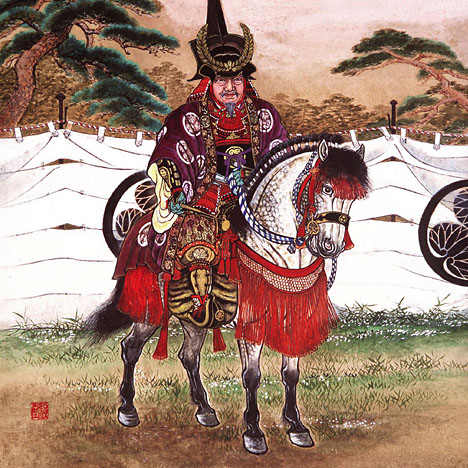
Tokugawa Ieyasu - Japanese Ruler

Tokugawa Ieyasu

Tokugawa Ieyasu was granted by the Japanese emperor, the title of shogun in 1603; his family was to rule Japan until 1867. In 1605, his son, Tokugawa Hidetada, officially took the office of the shogun, but Ieyasu remained the ruler from behind the scenes until his death.

Reared in an atmosphere of unrelenting civil war among different clans of Japan during the Warring States Era, Ieyasu was a remarkable unifier of competing interests among warring vassals, and a leader who brought relative peace to a land torn by centuries of civil war.

Ieyasu is remembered for his brilliant stratagems, his compassion for those enemies who accepted his authority, his skill in managing the rivalries of his generals, his commitment to keep Japan united, and his patience. He laid the foundations of a political, economic, and social system that was to lead to a century of dynamic growth in Japan.


Ieyasu started his political career as a vassal of Toyotomi Hideyoshi, from whom he learned about governance, military planning, and management of state affairs. After Hideyoshi’s death, Ieyasu led a coalition of vassals against a rival group in the bloody Battle of Sekigahara, where he was victorious in 1600. He later got rid of Hideyoshi’s young heir. He already was the master of vast tracts of military holdings in eastern Japan.

Entirely ignoring the authority of the imperial court, he established his central headquarters in edo (Tokyo); thus, the Tokugawa period is also known as the Edo era in Japanese history. He built a massive fortified castle with huge concentric moats in Edo; it is the Imperial Palace today. From here, Ieyasu used his military strength to reorganize Japan and to establish a government system called the bakufu.

Centralized Rule

The system of rule that Ieyasu established was begun by his two predecessors in the 16th century. Because it was based on centralized control over daimyo (vassal) domains, it is called a feudal structure, though uniquely Japanese.

Ieyasu sought stability for Japan and dominance for himself among the landed aristocracy. He demonstrated administrative skill that matched his military abilities. First, he redistributed the lands of the vassals. His enemies’ lands were confiscated and distributed to his allies as rewards in an organized way.

Tokugawa Ieyasu as supreme command at the battle of Sekigahara

He kept about a quarter of the confiscated domains under his family, the remainder distributed depending on the seniority and allegiance to other clans. The reallocation of about 265 domains ensured allegiance to the Tokugawa clan and stability.

Moreover, he placed his most trusted vassals to keep a close eye on others whose allegiance was undependable. Ieyasu issued a code of behavior called Buke Sho-Hatto, or Ordinances for the Military Houses, which limited the power of the feudatories in personal, civil, and economic spheres. It required them to seek permission from the shogun or his representative for all important activities.

Shogun Ieyasu amassed a huge fortune for the Tokugawa clan. This included property rights over commercial cities and trading ports such as Nara, Nagasaki, Osaka, Kyoto, Edo, and Yamada. He also owned profitable gold and silver mines and controlled the circulation of all the gold and silver coinage in the country.


In a surprising turn of events between 1611 and 1614, Ieyasu issued ordinances prohibiting all teaching and practice of Christianity in Japan, deeply affecting political and economic relations of the Japanese, Portuguese, and Dutch, and moved toward seclusion. However, this seclusion did not hurt Japan’s economy, as domestic commerce was robust and vigorous.

Tokugawa Ieyasu was a wealthy but frugal man. His sense of discipline directed his efforts in ensuring calm and peace for Japan after the civil war. By the time he died at 74, he had established his family’s de facto rule, which was to last for over two centuries. In so doing, he completed the process of reestablishing national unity by a combination of military and civilian talent that amounted to genius.