Showing posts with label french. Show all posts

Peter Abelard and Heloise

Peter Abelard and Heloise

Peter Abelard (1079–1142) was an abbot in the monastery of Saint-Gildas in the province of Brittany, France. He was born in Nantes, moved to Paris at the age of 15, and attended the University of Paris. He became a prolific writer, composing philosophical essays, letters, an autobiography, hymns, and poetry. He is best known for his intellectual work in the area of nominalism, the antithesis of realism and basis of modern empiricism.

His book Sic et Non posed a number of theological and philosophical questions to its readers. In Ethics, he began two works: “Dialogue between a Philosopher, a Jew and a Christian” and “Know Yourself.” Neither work was completed. His rebellious nature frequently angered people, particularly those in positions of authority.

Often his independent thinking gave rise to conflicts, especially when he demonstrated mastery of a subject being taught by a mentor. On one occasion he challenged his former teacher, William of Champeaux, regarding realism and logically proved that nominalism, also known as conceptualism, explained what realism could not prove.


At a time when education was not yet public, professors had no permanent place to teach. They would post an announcement that advertised where and when they would teach a particular subject and wait for students to arrive. In this way they established a following. Abelard was quite brilliant at age 25 and set up his own school despite limited teaching experience.

He founded his school uncomfortably close to his former teachers’, provoking their anger. He lived a life of extremes, gaining the admiration, respect, and awe of those who studied under him, but often receiving the wrath of those whom he defied. He was accused of heresy on many occasions and at one point was forced to leave his monastery because he aggravated his peers so intensely. On two occasions he was excommunicated from the church.

Heloise (1101–64) was the highly intelligent, beautiful, and charming niece of Fulbert, a prominent canon of Notre-Dame. Fulbert doted on her and demanded that she have only the best education, which took her to Paris near the monastery. Abelard heard of Heloise and requested that he be allowed to tutor her in her home. Permission was granted, and he moved in.

There he found an eager pupil, 22 years his junior, and they soon became involved in a physical as well as scholarly relationship. When Heloise became pregnant, they rejoiced in their child (whom they later named Astrolabe) and made plans to marry. Heloise was fiercely independent and would not be forced into a marriage where she had no rights.

But in her collected letters she mentions that she did not want to bring shame on Abelard by being a burden to him. In order to hide their relationship, and Heloise’s imminent delivery, Abelard took her to his sister’s house, where she stayed until she gave birth to their son. They secretly married in Paris, with only Heloise’s uncle and a few of their friends in attendance. Right after the marriage, Heloise took refuge in the Argenteuil convent to allay any gossip regarding her relationship with Abelard.

Unaware that both Heloise and Abelard had planned this provisional measure, Fulbert thought that Abelard had abandoned Heloise and forced her into a nunnery. He planned to ambush and restrain him and cut off Abelard’s genitalia. In a series of maneuvers he arranged to pay one person to put a sleeping powder in Abelard’s evening meal and his servant to allow a gate to remain open.

Fulbert sent word that he was looking for a Jewish physician to perform the sordid mutilation. After he had assembled his kinsmen and associates, they sought out Abelard and performed the horrible act. After the surgical alteration, Abelard took vows to become a monk at the monastery of Saint-Denis and persuaded Heloise to take vows to become a nun in a convent in Argenteuil.

Although their physical relationship could not continue, they remained in contact throughout their lives. Ironically, Abelard, who had previously considered himself a ravening wolf to whom a tender lamb had been entrusted, wrote that the alteration had been a positive rather than a harmful event.

He wrote, “... divine grace cleansed me rather than deprived me ...” and that it circumcised him in mind as in body to make him more fit to approach the holy altar and that “no contagion of carnal pollutions might ever again call me thence.”

Abelard and Heloise have been resurrected in a variety of artistic genres since their plight was first told in the 12th century. Although never completed, in 1606 William Shakespeare wrote the play Abélard and Elois, a Tragedie. Josephine Bonaparte, upon hearing the tragic story, made arrangements for the two to be buried together in Père LaChaise Cemetery in Paris.

Their modest sepulcher can be found on the map at the entrance to the cemetery. In 1819 Jean Vignaud (1775– 1826) painted Abélard and Heloïse Surprised by the Abbot Fulbert (Les Amours d’Héloïse et d’Abeilard), which is now at the Joslyn Art Museum in Omaha, Nebraska. The extent to which artists have chosen Abelard and Heloise to create operas, plays, and movies is testament to the universality and poignancy of their story.

Hundred Years’ War

Hundred Years’ War
Hundred Years’ War

In battles fought from 1337 to 1453 primarily by England and France for control of France and the French Crown, England initially had the upper hand, but in 1429 the French, inspired by Joan of Arc, regained all areas of France that they had lost except for Calais. England and France had been at war several times before the Hundred Years’ War because of the landholdings of the English Crown in France.

Through several wars, the French had slowly been regaining control of these lands. With the beginning of the Hundred Years’ War the French found themselves losing ground against the English. Militarily the English longbow proved especially devastating to the French and led to the English victories at Crécy and Agincourt.

The English believed that they were secure in their victory but found the tables turned on them in 1429 by Joan of Arc. The French were able to retake much of the land the English had captured up to that point in the war. The Burgundians switched sides, joining the French, and the English found themselves pushed back even more.


The English would continue to send armies to France and were, at times, able to retake lost territory; the war had definitely turned against them. The final years of the war saw the English lose all their territory in France except Calais. With France’s control over all the previously controlled English lands in France, the war ended in 1453.

Early English Lands in France

The English and the French had been at odds over the relationship of their kings to each other because of the English Crown’s control over lands in France. In England the English king was sovereign, yet in France he was a vassal of the French king and accountable to the French king.

This accountability was used, usually on trumped up charges, by the French kings to try to take land away from the English. The French did this in 1202 and when the English king did not show up at the French court to answer charges brought against him, the French king declared his lands to be confiscated and war followed.

During the war (which lasted until 1204), the French conquered Normandy, Maine, and Anjou from the English. With the signing of the Treaty of Paris in 1259 the English had been reduced to control of just Aquitaine. The English king also reconfirmed his status as a vassal of the French king with respect to his lands in France.

English army in hundred years' war

The French trumped up charges again in 1294 against Edward I and again declared his lands confiscated and launched an invasion of those lands. The war lasted until 1298. This war also saw the Scots allied with the French against the English in 1295. A new peace treaty, the Treaty of Paris, was signed, returning the lands lost by the English during the war to them.

Isabella, the daughter of the French king Philip IV, was married to the English heir, Edward II. At the time this seemed to be a way to create lasting peace between the two kingdoms but ended up causing more problems by later giving the English king a claim to the French throne during the Hundred Years’ War.

In 1324 the French again provoked the English and summoned the English king to the French court. When the king did not show up, the French again declared the province of Aquitaine confiscated from the English and the two countries went to war again.


The war did not last long and in 1325 Edward II’s son, Edward III, and his mother went to France so Edward III could pay homage to the French king, Charles IV. Returning to England in 1327, Queen Isabella had Edward II deposed and Edward III, only 14 years old, crowned king.

With such a young king, the English ended up agreeing to a peace treaty that favored the French, allowing them to keep the land they had conquered. In 1328 the English were forced to make peace with the Scots and Charles IV, third son of Philip IV, died. None of Philip’s three sons had a male heir. Succession ended up going to the cousin of Charles IV, Philip of Valois.

While neither Edward nor his mother made any claim to the French throne at this time, Edward had himself crowned king of France in 1340. In French law, Edward had no claim to the Crown since French law did not recognize any claim by a female, or her offspring, to the throne of France.

The early years of Edward’s reign saw him pay homage to the French king, since he could not afford a war with France. Focusing on Scotland with the death of the Scottish king, Robert I, Edward was able to gain the upper hand there and bring Scotland back under England’s control.

However, being an ally of the Scots, Philip had an interest in what was happening there and tried to link negotiations for continued peace between France and England with the war in Scotland. In 1336 France had put together a fleet that was to take a French crusade to the Holy Land.

However, Pope Benedict XII canceled the crusade because of the problems of the French, English, and Scots. Instead it seemed to the English that the fleet would be used to invade England. While there was no invasion of England, the fleet did conduct raids on parts of the English coast and convinced the English that war with the French was coming.

Using the same ploy they had before, the French king summoned the English king, as the duke of Aquitaine, to turn over the French king’s brother, who had taken refuge in England. In 1337 when Edward did not comply with Philip’s order, Philip declared Edward’s land confiscated again and the Hundred Years’ War began.

Beginnings of the Hundred Years’ War

The war began with the French invading Aquitaine in 1337. The French fleet continued raiding the English coast. The English were finally able to defeat the French fleet at Sluys in 1340, which gave the English control of the English Channel, making it easier for them to move troops to France.

During this time Edward made alliances with the Low Countries and the German emperor and arranged to have his soldiers join theirs for a campaign against the French. However the date for the campaign kept being delayed until 1340.

The Flemish joined with Edward, who had himself crowned king of France on January 26, 1340. While the English laid siege to the town of Tournai, the French moved against the allied army but did not engage it. The war shifted to Brittany in 1341 with the death of the French duke.

Succession to the title was disputed and the English took the chance to support the side the French king opposed. Neither side was able to gain the upper hand and control of the entire province. The fighting continued for several years to come. In 1343 a truce was called, lasting until 1346.

Edward decided to conduct the campaign in 1346 with an English army and not rely on his allies for soldiers. Edward’s army landed in Normandy hoping to draw the French army away from Aquitaine, which it did. Marching first to the Seine River and then along it toward Paris, the English army raided the countryside and towns as it marched.

The French had destroyed most of the bridges across the Seine River and had a chance to trap the English army but instead allowed the English to cross the river and march away. The French would have the same chance again when the English army reached the Somme River and again the French allowed the English to cross the river and escape. Edward finally stopped retreating and chose the area around Crécy to give battle to the French on August 26, 1346.

Edward picked an easily defended spot that forced the French to attack him uphill. He also deployed his archers to have a clear field of fire against the advancing French. The French arrived on the battlefield late in the day, yet chose to attack instead of waiting until the next day.

The French also did not attempt to organize a massed attack against the English; instead, they attacked as they arrived on the battlefield, thus leading to approximately 15 independent assaults on the English position.

The English archers cut down each assault with few of the French knights actually reaching the English men at arms. French casualties were estimated at over 1,500 knights and nobles and up to 20,000 infantry and crossbowmen. English casualties were about 200 men.

With his victory, Edward moved against Calais, which he laid siege to in September 1346 and captured in August 1347. The next several years would see only minor fighting, and even a truce for a short time. Philip VI died in August 1350 and John II became the new French king. Under the new king, the French and English engaged in peace negotiations, but these were broken off in 1355 by the French.

Treatis and Raids

The English responded to the break in negotiations by launching raids into France. The most successful raid was in 1356, led by Edward’s son, Edward the Black Prince (so named because he wore black armor). Launching from Bordeaux, he marched his army toward the Loire River but turned back before crossing the river.

As he moved back to Bordeaux, he was blocked by a French army led by King John at Poitiers. On September 19, using the terrain to his advantage, the Black Prince was able to defeat the French using the terrain and his archers to cut down the attacking French. More important was the capture of the French king by the English.

With his capture, the French found themselves in a civil war between the dauphin and Charles of Navarre over who should control France. In 1359 Edward brought an army to France in an attempt to capture Reims. When he was unable to capture the city, he considered marching on several other cities, including Paris, but in the end decided to return to England.

The English and French signed a treaty on May 8, 1360, that released King John from English captivity and recognized English sovereignty over Calais, Ponthieu, Poitoum, and Aquitaine. Also part of the treaty was a clause where Edward agreed to stop calling himself the king of France. It looked as if the English had won the war. Even with the peace treaty in place, the French and English continued fighting on a low level.

This included the French civil war, which did not end until May 1364 with the defeat of Charles of Navarre. The French and English also found themselves on opposite sides of the fighting in Castile where the English, under the command of the Black Prince, prevailed. Unfortunately the fighting forced the Black Prince to raise taxes in Aquitaine.

The people of Aquitaine then appealed to the French king, Charles V (who had become king in 1364 when his father, John, had died). Therefore in November 1368 Charles V declared the English land confiscated again. Edward tried to negotiate a settlement with Charles, but when that failed Edward again declared himself king of France and the two countries were at war with each other again.

The French made significant gains in recovering territory they had given up in 1360. They were even able to launch raids on the English coast, whose defenses had been neglected after the peace treaty in 1360. This raised concerns that the French might actually invade England. In response, the English launched raids on cities they thought the French might use to stage their invasion.

By the end of 1369 English actions had eliminated the possibility of a French invasion. Over the next several years the English would continue to launch raids into the French-controlled territory, but they also lost territory to the French. Both sides continued to raid each other’s territory and avoid a set piece battle.

In 1376 Edward the Black Prince died; in the following year, 1377, Edward III also died. This left the Black Prince’s son, 10-year-old Richard II, as king of En gland. Small scale fighting continued through the 1380s until both sides agreed upon a truce in June 1389. The truce would last, with the usual intermittent raiding, until 1415.

Henry V and Charles VI

Starting in the early 1400s the French gave support to Scotland and Wales in their struggle against the English. They also launched several raids against English ports. However the French king, Charles VI, who came to power in 1380, suffered from insanity. Because of this, he was unable to keep his nobles controlled and in 1407, a civil war broke out between the Orléanists and Burgundians.

Both sides asked the English for aid. In 1413 Henry V was crowned king of England. While his father, Henry IV, had provided some support to the Burgundians, Henry V determined to take full advantage of the chaos in France. Thus in 1415 an English army of 12,000 men invaded France.

Landing in Normandy, Henry first laid siege to the town of Harfleur, which took over a month to capture. Henry lost about half his men during the siege. Henry then decided to march over land to Calais. Henry left his siege equipment behind so he could move fast. The French set out in pursuit of Henry with an army of 30,000 men.

Although Henry was moving fast, even in the rain, he had trouble finding a crossing to get across the Somme River, which allowed the French to get ahead of him. They chose the area near the castle of Agincourt to try to stop Henry. While the sides tried to negotiate a settlement, neither side was interested in budging from its position.

On October 25, 1415, the two sides fought the Battle of Agincourt. The French commander had originally wanted to fight a defensive battle since the English were short on supplies, but the French nobles convinced him to attack since they had a numerical superiority.

Battle of Agincourt
Battle of Agincourt

The English took up a position with forests on either side of them. They had about 5,000 archers and only 800 men at arms. The archers placed sharpened stakes in the ground in front of them as protection from the mounted French knights. The ground between the two armies was wet and freshly plowed, which made it hard to move across.

The French nobles were unwilling to wait for the English to attack and eventually convinced the French commander to order an attack. With the wet, plowed ground slowing them down, the French took terrible losses from the English archers. Approximately a third of the French troops were in the initial attack and most were either killed or captured.

The next two attacks by the French were also thrown back by the English, although they did not meet the same fate as the first attack since they withdrew before being destroyed. Exact French losses are not known for sure, but estimates put their losses at 6,000–8,000 men. There is also no exact record of English losses, but they were few compared to the French.

Henry’s next campaign started in 1417 and went until 1419. This time he completed the conquest of the Normandy region. The Burgundians, still English allies, were able to gain the upper hand in their civil war and capture Paris.

In May 1420 the Treaty of Troyes was signed; it declared Henry to be Charles VI’s heir and required him to continue to support the Burgundians in their civil war against the Orléanists, who were now supporting the dauphin. Henry died in 1422 and his nine-month-old son became the new king of England. Even with Henry’s death, the English continued their war against the Orléanists. Charles VI died two months after Henry V. With Charles’s death, Henry VI was crowned king of France.

Joan of Arc

The war took a sudden change for the better for the French with the appearance of Joan of Arc in 1429. She led an army to victory against the English, laying siege to the town of Orléans in May 1429. This was the first of many victories that led to the coronation of the dauphin as Charles VII. Joan was captured and turned over to the English in May 1430. The English had her put on trial for witchcraft, convicted, and burned at the stake.

The English had hoped to strike a blow against the French morale but only succeeded in inspiring them. In September 1435 the French civil war was ended and with it the alliance between the Burgundians and the English. The French continued to retake territory from the English, including Paris, which fell in April 1436. Both sides agreed to a truce in 1444, which lasted for five years.

The French used the truce to reorganize their army, so that when the truce ended in 1449 they were ready to end the war. Starting with an invasion for Normandy in 1449 that was completed by 1450, they pushed the English out of France over the next several years. The conquest of Aquitaine would take longer. The initial invasion began in 1451 but was slowed in 1452 when the English sent troops there in an effort to stop the French.

While the English were successful in slowing the French, the French were able to defeat the English army in July 1453 and by October 1453, with the fall of Bordeaux, they completed their conquest of Aquitaine and ended the Hundred Years’ War. The only French soil still controlled by the English was Calais, which they controlled until 1558.

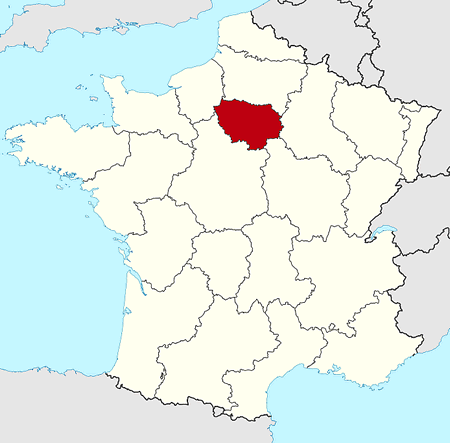
Île-de-France

Île-de-France
location of Île-de-France

The history of the Île-de-France, the true heart of Paris, began in the third century b.c.e. when a group of Gallic Celts built a settlement there for safety. They surrounded their settlement with a wooden palisade, at least one gate, and watchtowers. Buildings were made of wood, or wattle, mud, and sticks, and had either wooden or thatched roofs; thus fire was a constant danger. In 52 b.c.e. in his wars against the Gauls, Julius Caesar established a base there.

By the third century c.e. barbarian tribes forced the abandonment of the settlement on the Left Bank of the Seine, forcing people to seek refuge on the Île-de-France as their ancestors had nearly six centuries earlier. In 451 during the decline of the Western Roman Empire, the Île-de-France and the growing city of Paris faced its worst threat. In that year Attila the Hun attacked the Western Roman Empire with a huge army.

The city of Metz was sacked as he entered France, and Paris, according to legend, was only spared the same fate by the intervention of Saint Genevieve. By the time Attila laid siege to Orléans, the main Roman field army led by Aetius confronted him with Visigoth allies, enemies of the Huns. During the Battle at Châlons the Huns were turned back.


In 476 the last Roman emperor of the West, Romulus Augustulus, was deposed, and Paris was left to look after its own defenses. The Frankish tribe was one of the German tribes to invade France during the Roman Empire’s decline, and in 508 Clovis, king of the Salian Franks, captured Paris.

He converted the Franks to Christianity after winning a battle over a rival tribe, the Alamanni, sometime between 495 and 506. Paris suffered an era of decline when Charlemagne decided to make Aachen, Aix-la-Chapelle, the capital of his Holy Roman Empire, when he was crowned emperor in 800.

In the ninth century Vikings from Scandinavia began their onslaught on western Europe, and they sailed up the Seine to imperil Paris. In 911 in order to relieve the threat, King Charles III granted the land around Rouen to the Viking leader Rollo.

Since “northmen,” normand in French, was another term for Vikings, this was the beginning of Normandy, from which Duke William would sail to conquer England in 1066. In 978 Hugh Capet became king—because he usually wore a cape, or capa, his line became known as the Capetian dynasty.

One of the greatest of all Parisian landmarks, the Cathedral of Notre Dame, was established in 1163. King Philip II Augustus, who reigned from 1179 to 1223, did much to develop the Île-de-France and Paris. He built walls around the growing city, including the settlements on the north and the south bank. By a royal charter for the University of Paris (1200), he stated that Paris was now a city of three parts, the Left Bank, the Île de Paris (now known as the Île de la Cité), and the Right Bank.

In 1200 Philip began construction of a fortress on the Seine, built to defend against the English, that would later become the famed museum of the Louvre. In 1301 King Philip IV built a royal palace on the Île de la Cité, reaffirming its position as the heart of Paris, although by this time the history of the Île de la Cité had merged into the history of the entire city of Paris.

Joan of Arc

Joan of Arc
Joan of Arc

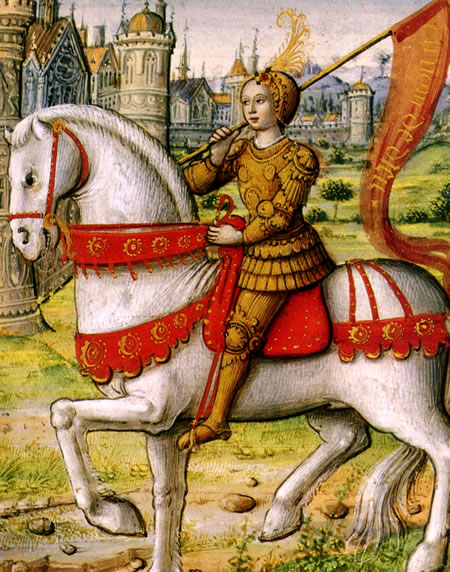
Joan of Arc (Jeanne d’Arc), the national heroine of France, was born at Domrémy village on January 6, 1412, to Jacques Darc and Isabelle. Joan exhibited a pious character and was often absorbed in her prayers. At 13 years old, she started hearing inner voices calling upon her to drive the English out of France. A civil war was going on in France and the English were supporting the Burgundians.

The assassination of Louis of Orléans by the agents of Burgundy had escalated the conflict. Domrémy was with the Orléanist (or Armagnacs), the party of Charles of Ponthieu (later known as King Charles VII, r. 1422–61). Joan supposedly received heavenly commands from St. Margaret, St. Catherine, and the Archangel Michael to rescue Orléans.

The English ruler Henry VII (r. 1422–61), claimant to the French throne, occupied Paris in 1418. The major cities of northern France ceased to be under Charles VII’s control. The situation was becoming critical after the English lay siege to Orléans, the last Armagnac stronghold, on October 12.


Joan, with her mandate from God, saved the situation for the French king. Dressed in male attire, she rode for 11 days with her escorts to meet Charles. Joan called herself as La Pucelle (the Maiden or Virgin) as she had promised the saints to keep her virginity. She believed that Charles was the true heir to the French throne.

An ecclesiastical commission headed by the archbishop of Rheims, Reginald of Chartres, supported her cause after thorough interrogation. Joan had shown remarkable calmness before the theologians and her reputation as another saint was spreading. Charles was convinced of her simplicity, honesty, and intuition.

Joan dressed as a knight, commanding a large force against the English and Burgundians. With her piety and simplicity, Joan restored the confidence of the French. She advised the English to leave France per the desire of the son of Saint Mary. Joan entered into Orléans in May 1429 and defeated the English. Some of the English soldiers deserted, thinking that they were being opposed by the supernatural prowess of Joan.

She portrayed the Orléanists as patriots, the Burgundians as traitors, and the English as the enemy of France. In June the towns of Jargeau and Beaugency fell. Joan defeated the troop led by Sir John Fastolf of Meung in the battle of Patay. The archbishop of Embrun declared in June that she was divinely inspired and requested Charles to seek her advice pertaining to war.

Battle of Patay

Joan urged Charles to declare himself as the legitimate ruler of France. Reginald of Chartres performed the coronation ceremony on July 17, 1429, at Rheims, place of traditional crowning of the French kings. She began her second mission as inner voices urged her to take back Paris from Burgundians.

Charles and his adviser the archbishop did not support her. The king was more interested in a political rapprochement with the Burgundians. Joan and the duke of Alençon, along with new recruits, marched toward Paris on August 23. The vacillating policy of the king and advisers had given enough time for the English and Burgundians to regroup.

Meanwhile Joan was trying to persuade the inhabitants of many towns to rally behind the king. The stories of her miracles came in March and April 1430 amid war. At Lagny-sur-Marne, she and the virgins of the town revived the dead body of a baby temporarily to be baptized.

On Easter Day of April 22 she had visions from the saints that the enemy would capture her before Saint John’s Day, on June 24. She also had the premonition of her inevitable demise on the day of her capture on May 23 at Compiègne. She was imprisoned and sold to the English for a sum of 10,000 livres by the Burgundians.

A sham trial began at the headquarters of the English at Rouen. Pierre Cauchon was in charge of the trial, and the bishop of Beauvais was the presiding officer. The former had the reputation of bribing officials, and the latter had lost his bishopric because of Joan. Anybody speaking in favor of the defendant was imprisoned. The trial by inquisitorial tribunal increased the reputation of Joan because of her brilliant answers to the accusation that her voices were inspired by the devil.


She was pronounced a relapsed heretic and burned at the stake on May 30, 1431. In her last breath Joan forgave the accusers and uttered the name of Jesus. Jean Tressard, secretary to the king of England, commented that they had burned a holy person. The executioner, Geoffroy Theragew, was apprehensive that he was damned because he had burned a saint.

The unification of France came after her death. Charles restored her name and declared the trial illegal. Even dispensing with the supernatural factors associated with her, the fact remains that she became a living symbol of French nationalism. Her role was a major contributing factor for separating the English from Burgundians, reviving confidence among the French, and driving out the English from France. The papacy declared in 1456 that Joan was wrongly convicted.

It pronounced her as martyr and the trial judges as heretics. She was beatified on April 11, 1909, and canonized as a saint 11 years afterward on May 16. The feast day of St. Joan falls on the second Sunday in May. The spirit of St. Joan lived on. During World War I, the Allied soldiers paid tribute to her. Both the Vichy regime and the French resistance used her symbol in World War II.

Louis IX

Louis IX
Louis IX
Zealous and dashing, chauvinistic and impulsive are all terms that describe the reign of Louis IX, king of France. He showed heroic virtues of character, but he also seemed blind to the contributions of people who did not share his own values. He took action against corruption, but he also had complicated relations with Jews and Muslims.

He wanted to imitate the poverty of Jesus by living as a monk but contented himself with making penitence and humility his aim in life. He engaged in self-flagellation to curb his desires for food and sex and even gossip, and he wore a hair shirt under his royal robes.

He was famous for showing mercy to his foes and generosity to the poor. He was the patron of French universities and several times invited Thomas Aquinas to dinner. When deathly ill in 1244, he promised God that he would fight a crusade if healed, and so he did in 1248.

Captured in 1250 he was freed when he pledged to give up his conquest in Egypt and pay a huge ransom. He remained in Syria, attempted to draw the Mongols into the conflict on the side of the Europeans, and tried to stir up divisions among Muslims in the Middle East.


His conduct in battle reflected his piety. He opened up investigations against the crimes of the resident crusaders and paid restitutions. He ordered that Muslims should be captured alive. He worked hard to convert Muslims and brought many of them back with him to France, where he supported them.

He told his fighters that they would go to paradise if they died in battle because they were martyrs. When he was not piously fighting on the battlefield, he was piously applying his morality to domestic affairs.

Louis IX statue
Louis IX statue

He limited his own officials from encroaching unduly on the jurisdiction of the aristocracy. He set up a system of ombudsmen (enquêteurs) to hold nobles accountable for their conduct in local settings. In this way he tried to standardize government administration. He reformed the national currency and asserted the right of the state to regulate money. He allowed the judiciary a degree of independence, and the Parliament was formed.

In France he was intolerant of Jews and heretics, especially those called the Cathars. He forbade usury, permitted no obscenity at court, ordered all blasphemers to be branded, and discouraged trial by combat. Against the Jews he was particularly prejudiced, allowing the public burning of the Talmud and ultimately requiring that Jews wear a red badge on their chest, eerily prescient of the Nazi practice of identifying French Jews by a yellow star.

He embarked on another crusade in the late 1260s but was diverted to Tunis (North Africa), where he died in 1270. He was worn out by his self-imposed religious exercises, as well as by illness and dysentery.


As he lay dying he summoned the Greek ambassadors and urged them to reconcile with the Church of Rome. His body was sent back to France. Wherever his body went, miracles were reported among the Christian faithful. He was promoted for canonization and named a saint in 1297.

Philip II Augustus

Philip II Augustus

Philip II Augustus, king of France (r. 1180–1223), was, born in 1165, to Louis VII (1137–80) and his third wife, Adèle of Champagne, near Paris. Following the custom of the Capetian dynasty, Louis had young Philip crowned at Reims cathedral as his successor while he was still alive on November 1, 1179.

With the old king’s health quickly declining, the young crowned prince assumed much of the responsibility of running the royal government. In September of the following year when Louis died, Philip became king in his own right.

Philip faced formidable obstacles to his authority in France. His father had been dominated at court by his wife, Adèle, and her three powerful brothers, the counts of Blois and Champagne, and the archbishop of Reims.


Moreover the basis for power in 12th century feudal France was land, and the territory of the Capetian monarchy was limited to a number of modest holdings around the region of the Île-de-France, which centered on Paris.

But those of Philip’s most powerful vassal, Henry Plantagenet, included the duchies of Normandy, Maine, Anjou, and Brittany. Through his wife, Eleanor of Aquitaine, Henry also held the duchy of Aquitaine as well as Tourraine and Gascony.

Together, they made up more than half of the territory of medieval France and far outstripped the holdings of the French king. The fact that Henry was also king of England (1154–89) further diminished the ability of either Louis or Philip to exercise meaningful control over Henry as lord of his French holdings.

Philip began to lay the groundwork for the resurgence of royal power in France through his marriage to Isabelle d’Hainault in April 1180, through which he acquired the wealthy county of Artois, near Flanders.

Through Isabelle he was able to lay further claims to lands and towns in northeastern France. By 1186 Philip had rid himself of his troublesome uncles and secured control over a widening area of royal lands.

However his most obstreperous vassal remained Henry II of England with his vast territorial holdings in western France. From 1186 to 1188 Philip achieved little success on the battlefi eld against Henry but was more successful when allied with Henry’s two sons, Richard and John, in their revolt against the king in 1189.

Defeated shortly before his death in July 1189, Henry made several minor territorial concessions to Philip. Inheriting his father’s lands in France upon becoming king of England Richard I (r. 1189–99) proved as intractable a foe as had Henry II.

The lengths to which Philip would go to defeat his antagonist are revealed by his behavior during and after the Third Crusade, in which both he and Richard participated.

Acre fell to Philip II and Richard I

Leaving France together in 1190, the two quarreled along the way and proved uneasy allies during the siege of Acre. After the city fell in July 1191, Philip quickly abandoned Richard and headed home.

Returning to France, he intrigued against the English king and was instrumental in having Richard held captive by the German Emperor Henry IV when he fell into the emperor’s hands while returning from the crusade. Outright hostilities between the two recommenced upon Richard’s release in 1194.

With the ascension of John I to the English throne (1189–1216) Philip’s fortune improved dramatically. By 1206 he had succeeded in wrestling control of Normandy, Maine, Tourraine, Anjou, Poitou, and Brittany from John, leaving him only in possession of Aquitaine.


A major attempt by John to recapture his lost territories with the German Emperor Otto IV as ally was repulsed in 1214, ensuring Philip’s position as the dominant feudal lord and most powerful landholder in France.

Philip showed a keen disposition for administrative affairs. He created a new class of royal officials, the baillis, who collected taxes and administered royal justice in his newly acquired lands.

To ensure loyalty these officials were recruited from the townsmen and lower nobles of the realm and were paid a salary. In the south these officials were called seneschals, and because they wielded military powers, they came from the nobility.

Philip further developed the royal administration by giving it a permanent home in Paris and having his treasury perform an annual audit on the baillis. Crucial in Philip’s ability to control his vassals was his growing alliance with the burghers, whose talent and taxes he exploited.

The growth in royal revenues enabled the king to employ mercenaries in place of the feudal levy, further diminishing his reliance upon the nobles. Taken together Philip’s actions turned the Capetian ruler into the most powerful feudal monarch of his day and laid the framework for the future growth of royal power.